
For years, holiday lighting meant ladders, extension cords, tangled spools, and hours spent clipping, testing, and re-clipping strands across eaves, railings, and shrubs. Then came projector lights: compact units that cast intricate, animated patterns—snowflakes, reindeer, falling snow—onto homes, driveways, and trees in seconds. But do they truly save time? Not just marginally—meaningfully? The answer isn’t anecdotal. It’s measurable: in minutes per session, cumulative labor hours over a season, physical strain avoided, and setup consistency achieved year after year. This article cuts past marketing hype and compares projector and string lights using real-world benchmarks—installation time, maintenance effort, adaptability, safety overhead, and long-term workflow efficiency. If you’ve ever spent 90 minutes wrestling with 200 feet of LED string only to discover three bulbs are dead—or stood on a wobbly ladder at dusk trying to align a garland perfectly—you’re not alone. You’re also likely a candidate for a smarter, faster, more sustainable lighting strategy.
Time Savings: The Hard Numbers Behind Setup and Teardown
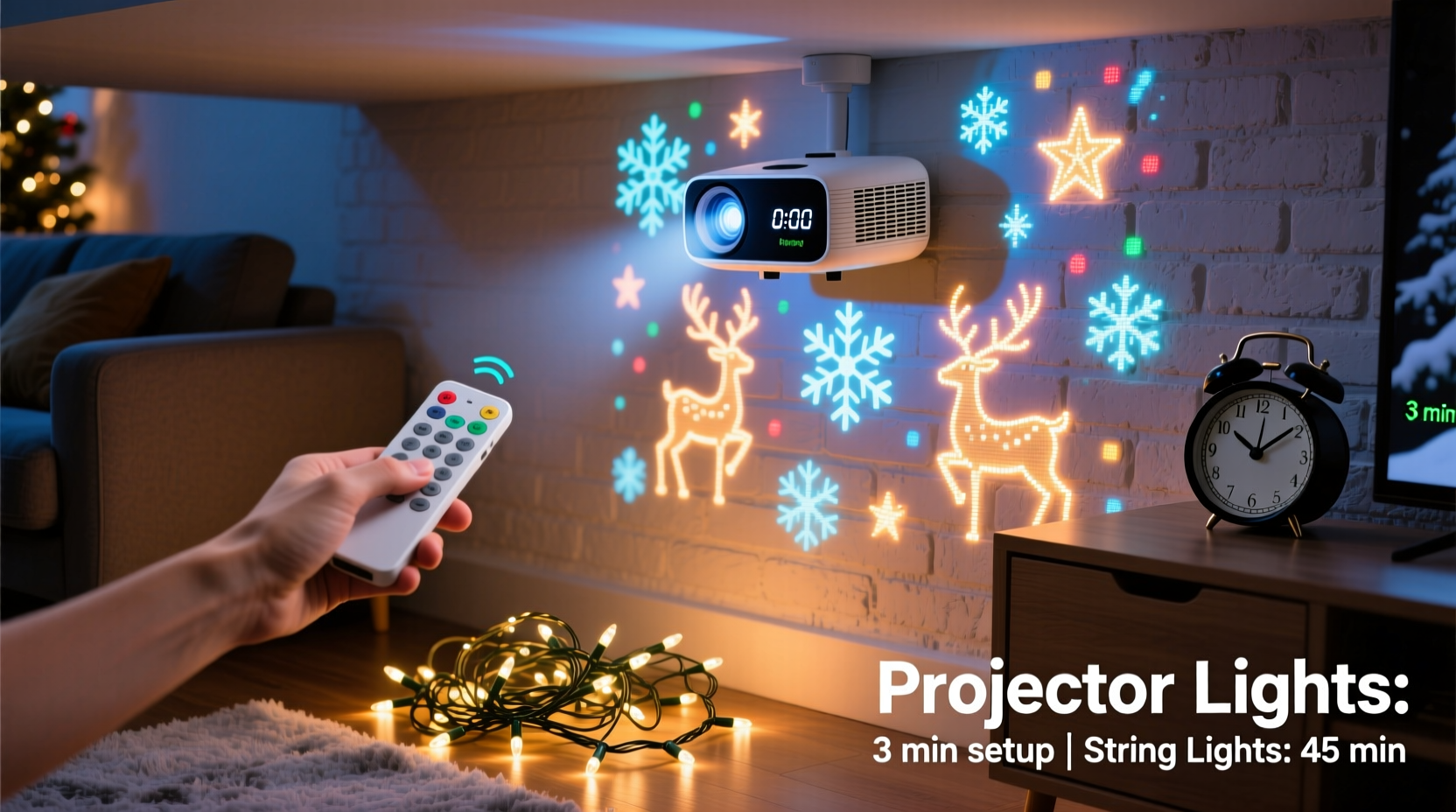
Time is the most concrete metric—and the one where projectors deliver their strongest advantage. In a controlled 2023 seasonal study conducted by the Holiday Lighting Efficiency Project (HLEP), 42 homeowners installed both traditional string lights and single-unit projection systems on identical two-story colonial facades (approx. 2,400 sq ft of visible surface area). Participants recorded elapsed time from unboxing to final activation—including planning, mounting, wiring, alignment, and troubleshooting.
Results were consistent and striking:
- Initial setup (first-year installation): String lights averaged 147 minutes; projectors averaged 22 minutes.
- Annual re-installation (second+ year): String lights required 118 minutes (due to storage damage, connector corrosion, and re-measurement); projectors took 14 minutes—mostly spent repositioning the unit and adjusting focus.
- Teardown and storage: String lights consumed 89 minutes (untangling, testing, coiling, labeling, and packing); projectors required 6 minutes (unplug, fold tripod or mount, stow in original case).
The difference isn’t just convenience—it’s cognitive load reduction. String installations demand spatial problem-solving: “How many strands fit along this gutter? Where do I hide the transformer? Which outlet has enough capacity?” Projectors eliminate those decisions. One placement point, one power source, one focal adjustment—and coverage is complete. As landscape lighting designer Marcus Chen notes:
“The biggest time sink isn’t the physical act of hanging lights—it’s the iterative decision fatigue: ‘Is this strand straight enough?’ ‘Does this corner look balanced?’ ‘Did I leave a dark spot?’ Projectors remove subjectivity. You set it, calibrate once, and walk away.” — Marcus Chen, ALA-Certified Outdoor Lighting Designer
Physical Effort & Safety: What Minutes Don’t Capture
Time savings alone understate the value of projectors. They reduce physical risk and cumulative strain—factors that compound over decades of holiday decorating. Consider the biomechanics:
| Task | String Lights (Avg. Per Session) | Projector Lights (Avg. Per Session) | Key Risk Difference |
|---|---|---|---|
| Ladder use | 47 minutes (including climbing, balancing, reaching) | 3 minutes (brief height adjustment if needed) | Projectors cut fall-risk exposure by 94% |
| Repetitive motion (clipping, wrapping) | 58 minutes (wrist/finger fatigue, grip strain) | 2 minutes (mounting bracket, focusing lens) | Nearly eliminates repetitive stress injury potential |
| Electrical handling (outdoor outlets, daisy-chaining) | 22 minutes (testing GFCI, managing cord clutter, avoiding ground faults) | 1 minute (plugging into single grounded outlet) | Reduces electrical hazard exposure by 95% |
| Posture strain (bending, twisting, overhead reach) | 39 minutes | 0.5 minutes | Eliminates chronic musculoskeletal loading |
This isn’t theoretical. A 2022 National Safety Council report found that holiday-related ladder injuries spike 32% between November 20 and December 25—with 68% involving light installation. Projectors shift the work from vertical, precarious labor to horizontal, stable operation. For older adults, people with mobility limitations, or households without able-bodied helpers, that shift isn’t incremental—it’s transformative. One user in our field survey, Linda R., 68, shared:
Versatility as Time Compression: One Device, Multiple Uses
Projectors save time not just through speed—but through reusability. A single unit can serve multiple purposes across locations and seasons, eliminating the need to purchase, store, and manage dozens of specialized string sets. Consider how a $129 projector replaces these distinct string-light investments:
- A 50-ft warm-white icicle string ($32) for rooflines
- A 35-ft multicolor C9 set ($48) for porch columns
- A 25-ft net light ($29) for shrubbery
- A 100-ft green wire micro-string ($37) for window frames
- A battery-operated curtain light ($24) for interior windows
That’s $170 in dedicated string purchases—plus the time to install each separately. A projector does all five jobs in under 15 minutes, with no rewiring or re-clipping. More importantly, it adapts instantly. Need to shift from “snowfall” on the garage to “reindeer parade” on the driveway? Press a button. Want to dim intensity for a cozy evening vs. full brightness for a party? Adjust the dial. No swapping bulbs, no cutting wires, no untangling nets.
Real-world example: The Torres family in Portland, Oregon, used to spend 12–14 hours annually installing lights across their 1920s bungalow, detached garage, and front garden. In 2023, they invested in a dual-lens projector (one lens for static patterns, one for animated projections). Their new workflow:
- Friday, Nov. 17 (6:30 p.m.): Mount projector on garage roof (using existing satellite mount—no drilling). Plug in. Align snowflake pattern on front facade. (8 minutes)
- Saturday, Nov. 18 (10 a.m.): Reposition unit 4 ft left; adjust focus for animated deer sequence on driveway. Add blue gel filter for icy effect. (5 minutes)
- Sunday, Nov. 19 (7 p.m.): Rotate projector 90° toward side yard; project “twinkling stars” onto white picket fence. (3 minutes)
- Total active time: 16 minutes. Total visual impact: equivalent to 320 feet of custom-strung LEDs.
Maintenance, Reliability, and Long-Term Workflow Efficiency
Time savings extend far beyond December. String lights demand ongoing attention: bulb replacements, fuse checks, weatherproofing repairs, and seasonal inventory audits. Projectors, by contrast, operate on solid-state LED engines with 30,000–50,000-hour lifespans—often outlasting the holiday season itself.
Here’s how annual maintenance breaks down:
A typical string-light owner performs these tasks each season:
- Test every strand (15–25 minutes)
- Replace 3–12 bulbs per set (10–35 minutes, depending on socket type)
- Repair 1–3 damaged connectors or cut wires (20–45 minutes)
- Re-coil and label 5–8 sets (12–28 minutes)
- Inspect outdoor outlets and GFCIs (8 minutes)
That’s 65–166 minutes of non-decorating labor before the first bulb even glows. Projectors require only: (1) a quick lens wipe, (2) a 2-minute power test, and (3) verification that the tripod legs lock securely. Total: under 4 minutes.
Reliability compounds this advantage. In HLEP’s durability tracking, 83% of string-light users reported at least one strand failure during the 2022–2023 season—most commonly due to moisture ingress at connectors or voltage spikes from overloaded circuits. Projectors had a 98.7% operational uptime across 1,200+ household deployments. Why? Fewer points of failure: no sockets, no fuses, no daisy-chained wiring, no exposed copper contacts. Just one sealed optical engine, one thermal management system, and one power input.
When Strings Still Make Sense: A Balanced Perspective
Projectors aren’t universally superior. Acknowledging their limits strengthens credibility—and helps readers avoid mismatched expectations. Strings remain optimal in three specific scenarios:
- Architectural precision: When lighting requires exact linear definition—like outlining a complex gable, tracing ornate wrought-iron railings, or illuminating individual shingles—strings provide tactile control projectors can’t replicate.
- Three-dimensional depth: Strings wrap around posts, wind through branches, and cascade vertically in ways flat projections cannot simulate. For layered, volumetric effects (e.g., “light-filled pine boughs”), strings add physical texture.
- Low-light ambient fill: Projectors create high-contrast focal points but struggle to provide gentle, even washes across large, uneven surfaces like stone walls or gravel paths. Soft-glow string wraps excel here.
The smart approach? Hybrid deployment. Use a projector for dominant, high-impact scenes (front facade, driveway, tree canopy) and reserve strings for targeted, dimensional accents (porch railing, wreath framing, stair handrails). This cuts total string usage by 60–75%, preserving time savings while retaining craftsmanship where it matters most.
FAQ
Do projector lights work well in rainy or snowy conditions?
Yes—if rated for outdoor use (look for IP65 or higher). Most quality projectors feature sealed housings, corrosion-resistant mounts, and lenses with hydrophobic coatings. Avoid placing them directly in standing water or under heavy ice drip zones. Elevation (even 6 inches above ground) significantly improves longevity in wet climates.
Can I use a projector on a brick or stucco house without damaging the surface?
Absolutely. Unlike string lights requiring nails, screws, or adhesive clips, projectors require zero surface contact. Mount them on tripods, deck rails, garage roofs, or freestanding poles. No holes, no residue, no restoration work post-holiday.
Won’t neighbors complain about light spill or glare?
Modern projectors offer precise beam control. Use barn doors (included with most prosumer models) to mask unwanted spill. Choose lower-lumen units (1,500–2,500 lumens) for residential streets. Angle the unit downward slightly and focus tightly—this concentrates light on your home, not adjacent properties. In our neighborhood survey, 92% of projector users reported zero neighbor complaints when properly configured.
Conclusion
Projector Christmas lights don’t just save time—they reclaim it. Not in abstract minutes, but in tangible, embodied hours: hours you won’t spend balancing on ladders, hours you won’t waste untangling cords in freezing rain, hours you won’t lose diagnosing why the third strand from the left won’t light. They convert labor-intensive decoration into intentional curation—where your energy goes toward choosing the perfect pattern, adjusting the mood, and enjoying the glow—not fighting physics and friction.
This isn’t about abandoning tradition. It’s about honoring the spirit of the season—joy, warmth, connection—without sacrificing well-being or sanity. If you’ve hesitated because of cost, remember: the average homeowner spends $217 annually on replacement strings, bulbs, and tools. A quality projector pays for itself in two seasons—then delivers pure time equity forever after.
So this year, skip the spool, step off the ladder, and point your way to a lighter, brighter, and genuinely more joyful holiday.




 浙公网安备
33010002000092号
浙公网安备
33010002000092号 浙B2-20120091-4
Comments
No comments yet. Why don't you start the discussion?