
As the holiday season approaches, homeowners face the annual decision: how to decorate efficiently without sacrificing festive charm. Among the most debated choices is whether to use traditional string lights or modern projector lights. While both options deliver brightness and cheer, their setup, maintenance, and overall time investment differ significantly. For busy families, working professionals, or anyone seeking a simpler decorating experience, understanding the time-saving potential of projector Christmas lights is essential.
This article examines the time efficiency of projector lights versus string lights through practical analysis, real-life scenarios, and expert input. We’ll break down setup times, durability, versatility, and long-term convenience to help you make an informed choice that aligns with your schedule and aesthetic goals.
Understanding the Basics: How Each Option Works
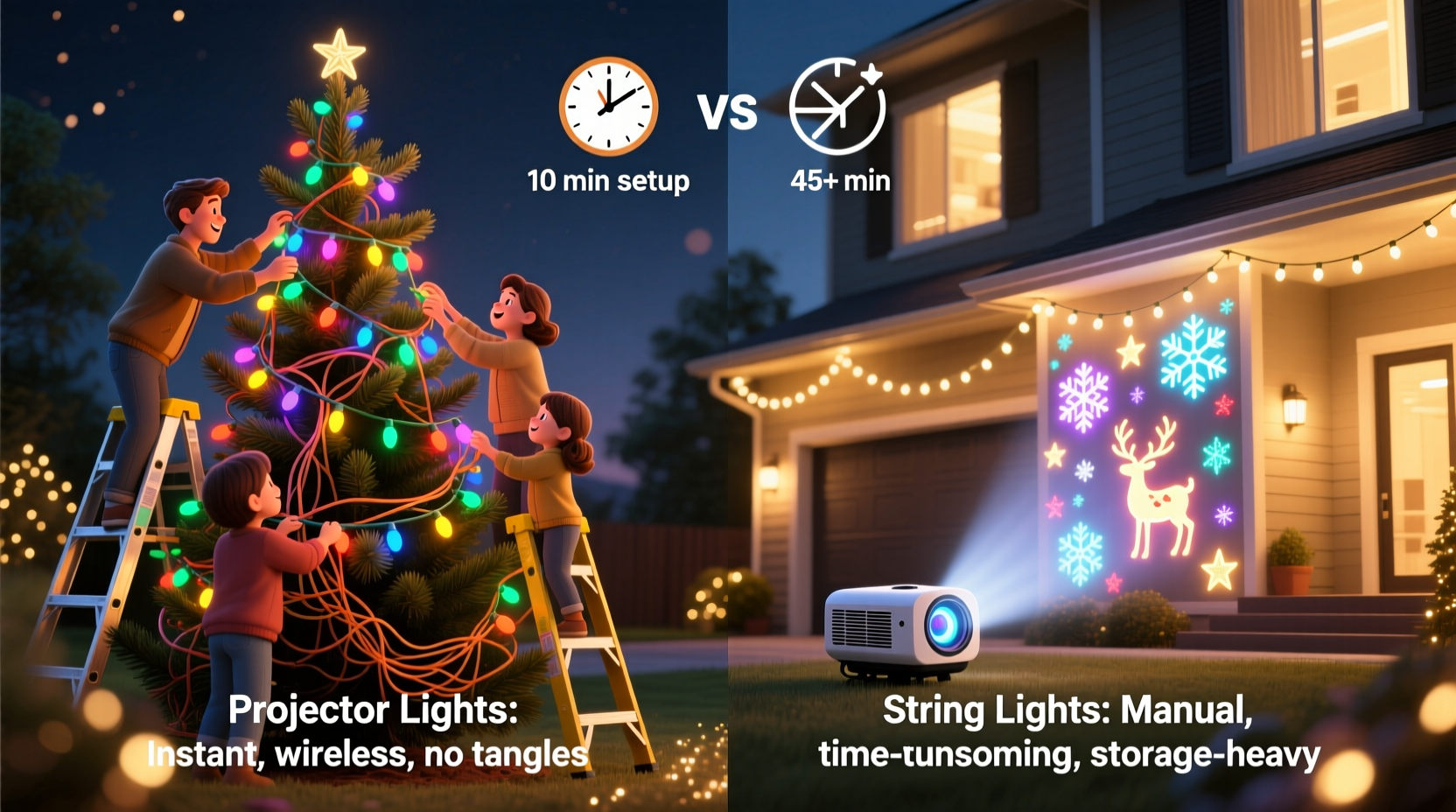
Before comparing time efficiency, it’s important to understand the fundamental differences between projector and string lights.
String lights are the traditional option—long cords embedded with small bulbs, typically LED or incandescent. They require physical placement along rooflines, trees, railings, and windows. Installation involves untangling, draping, securing with clips or tape, and connecting multiple strands to power sources.
Projector Christmas lights, on the other hand, use high-lumen projectors to cast light patterns onto surfaces like walls, lawns, or fences. A single unit can simulate hundreds of twinkling bulbs by projecting animated or static designs such as snowflakes, stars, or multicolored dots. These devices plug into an outlet and often come with stakes or mounting brackets for quick positioning.
The core distinction lies in coverage method: string lights rely on proximity and density, while projectors rely on optical illusion and distance. This difference directly impacts how much time each system demands during installation, adjustment, and removal.
Time Comparison: Setup, Adjustment, and Removal
To evaluate which lighting system saves more time, we analyzed three key phases: initial setup, mid-season adjustments, and post-holiday takedown.
Initial Setup Time
String lights are notoriously time-consuming to install. A typical 3,000-square-foot home with roofline, front porch, and driveway may require 15–25 strands. The process includes:
- Unpacking and untangling tangled cords
- Measuring and cutting extension cords
- Securing each strand with clips, staples, or adhesive mounts
- Testing connections and troubleshooting dead sections
- Daisy-chaining compatible strands
On average, this process takes between 4 to 8 hours—even for experienced decorators.
In contrast, projector lights can be operational in under 30 minutes. Most models include adjustable stands or ground stakes. After placing the projector at the optimal distance (usually 15–30 feet from the target surface), users simply plug it in, adjust the focus and pattern rotation, and secure the position. One or two units can cover an entire façade.
“With projector lights, I went from a full Saturday of decorating to less than an hour. It was almost too easy.” — Mark T., homeowner and DIY enthusiast from Colorado
Mid-Season Maintenance
Over the course of a 4–6 week holiday display, minor issues often arise. String lights may suffer from bulb burnouts, rodent damage, wind displacement, or moisture-related shorts. Diagnosing and repairing these problems requires climbing ladders, checking individual sockets, and replacing damaged segments.
Projector lights, being centralized systems, are easier to monitor. If a projector fails, it's immediately noticeable—there’s no partial outage. Most models have built-in diagnostics (like indicator lights) and are easily unplugged and stored indoors during storms. Since there are no exposed wires across large distances, risks of accidental disconnection or tripping hazards are minimal.
Takedown and Storage
After the holidays, string lights must be carefully removed, coiled, and stored to prevent future tangles. Poor storage leads to “Christmas light knots” that can take longer to undo than the original installation. Labeling and organized bins help—but still add time.
Projector lights simplify takedown. Unplug, fold the stand or remove the stake, wipe down if needed, and store in its original box or padded container. No coiling, no clipping, no ladder work.
Real-World Example: The Johnson Family Holiday Test
The Johnsons, a family of four in suburban Ohio, decided to compare both methods over two consecutive years. In 2022, they used traditional string lights across their two-story home, garage, and front yard trees. Total setup time: 7 hours and 22 minutes. Mid-season, they replaced one failed strand and reattached two wind-loosened sections. Takedown required 3 hours.
In 2023, they switched to three high-lumen projector lights—one for the house front, one for the garage, and one for the lawn. Setup took 48 minutes. No adjustments were needed during display. Takedown was completed in 20 minutes.
While some neighbors missed the three-dimensional sparkle of physical bulbs, the Johnsons reported a dramatic reduction in stress and time commitment. “We gained back an entire weekend,” said Sarah Johnson. “That time meant more family dinners, fewer arguments about who forgot to test the lights.”
Comprehensive Comparison Table: Projector vs. String Lights
| Factor | Projector Lights | String Lights |
|---|---|---|
| Average Setup Time | 20–45 minutes | 4–8 hours |
| Coverage per Unit | Up to 500 sq ft per projector | ~50–100 sq ft per 25-ft strand |
| Adjustment Needs | Minimal (focus/angle) | Frequent (wind, outages) |
| Takedown Time | 10–30 minutes | 2–4 hours |
| Storage Requirements | Compact, box-sized | Large bins, careful coiling |
| Best For | Flat surfaces, renters, time-constrained | Architectural detail, 3D effects |
When Projector Lights Save the Most Time
Projector lights offer maximum time savings in specific situations:
- Rental properties where drilling or stapling isn’t allowed
- Multilevel homes with hard-to-reach eaves or steep roofs
- Short display seasons due to travel or scheduling
- Urban environments with limited outdoor access or security concerns
- Families with young children where ladder safety is a concern
Additionally, projector lights excel when used in combination with minimal string lighting. For example, using a projector for wall coverage and just a few strands on a wreath or tree creates visual depth while minimizing labor.
Step-by-Step Guide: Installing Projector Lights in Under 30 Minutes
- Choose your location: Place the projector on a level surface 15–30 feet from the target wall or fence. Avoid obstructions like bushes or parked cars.
- Stake or mount: Insert the included ground stake or attach to a stable base. Ensure it won’t shift in wind.
- Aim and focus: Turn on the projector and adjust the tilt and zoom until the pattern fills the desired area evenly.
- Select pattern mode: Choose between static, twinkle, fade, or seasonal animations via button or remote.
- Secure power source: Use a weatherproof extension cord connected to a GFCI outlet. Elevate the connection off the ground.
- Test overnight: Run the system for several hours to ensure stability and check for overheating.
- Document placement: Take a photo or note measurements so reinstallation next year takes minutes.
Limitations and Considerations
Despite their time-saving benefits, projector lights aren't ideal for every situation.
They require a flat, light-colored surface for best visibility. Dark brick, heavy timber siding, or heavily textured walls can absorb or distort the image. Trees and shrubs block projection, limiting yard flexibility. Also, the effect is purely visual—there’s no physical presence or depth that string lights provide when viewed up close.
Weather resistance varies by model. While many are rated for outdoor use, prolonged exposure to rain or snow may shorten lifespan. Always check the IP (Ingress Protection) rating—IP44 or higher is recommended for winter conditions.
“The trade-off with projector lights is realism versus efficiency. You’re not fooling anyone into thinking those are real bulbs—but you are saving hours.” — Laura Simmons, Lighting Designer and Holiday Display Consultant
Checklist: Choosing the Right Option for Your Needs
- ✅ Do you have flat, light-colored exterior walls? → Favors projectors
- ✅ Are you short on time or physical ability? → Favors projectors
- ✅ Do you want 3D sparkle around windows, gutters, or trees? → Favors string lights
- ✅ Is drilling or stapling prohibited (e.g., rental)? → Favors projectors
- ✅ Do you enjoy the ritual of decorating? → Favors string lights
- ✅ Are you displaying for a short period? → Favors projectors
- ✅ Do you want customizable colors and animations? → Both offer this, but projectors do it dynamically
Frequently Asked Questions
Can projector lights work on brick or dark siding?
Results vary. Light-colored brick may reflect enough illumination, but dark or porous surfaces absorb light and reduce brightness. Some users compensate with higher-lumen models (5,000+), but even then, clarity diminishes. For dark exteriors, string lights remain the superior choice for visibility.
Do projector lights use less electricity than string lights?
Generally, yes. A typical projector uses 15–30 watts, comparable to a single string of LED lights. However, one projector can replace 10–15 strands, leading to significant energy savings. Over a 30-day display, a projector might cost under $2 in electricity, while extensive string setups can exceed $10–$15 depending on length and bulb type.
Can I mix projector and string lights?
Absolutely—and many decorators do. Use projectors for broad wall coverage and string lights for architectural accents, trees, or porches. This hybrid approach balances efficiency with visual richness, offering the best of both worlds.
Final Verdict: Yes, Projector Lights Save Significant Time
The evidence is clear: projector Christmas lights save substantial time compared to traditional string lights. From faster setup and easier maintenance to simplified storage, they offer a compelling alternative for time-conscious decorators. While they lack the tactile charm and dimensional glow of physical bulbs, their speed, safety, and scalability make them a smart upgrade—especially for modern households juggling work, family, and seasonal obligations.
For those willing to accept a slightly different aesthetic, the time saved can be reinvested in meaningful holiday activities—baking, visiting, or simply enjoying the lights without the ladder. As technology improves, projector brightness, color accuracy, and pattern variety continue to close the gap with traditional displays.




 浙公网安备
33010002000092号
浙公网安备
33010002000092号 浙B2-20120091-4
Comments
No comments yet. Why don't you start the discussion?