
When it comes to decorating large homes for the holidays, traditional string lights have long been the go-to choice. But in recent years, projector Christmas lights have emerged as a bold alternative—promising faster setup, wider coverage, and fewer tangled cords. For homeowners with expansive facades, two-story exteriors, or sprawling yards, the question isn’t just about aesthetics; it’s about practicality, visibility, and effort. So, do projector Christmas lights actually perform better than traditional strings on large homes? The answer depends on several factors, from architectural layout to personal preference.
Understanding Projector vs. String Lights
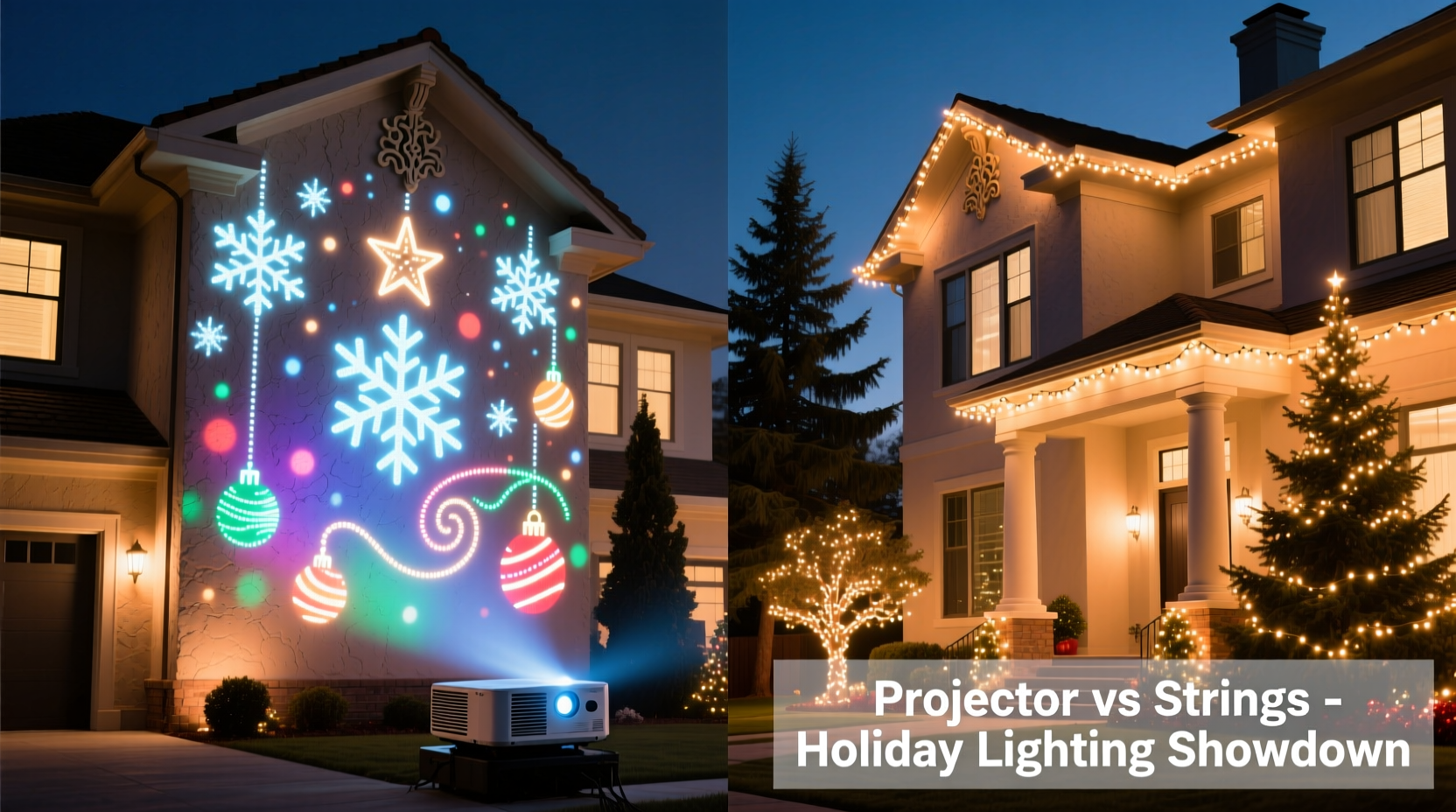
Before comparing performance, it's important to understand how each lighting system works.
Projector Christmas lights are compact units that project beams of light onto walls, roofs, or trees using LED arrays and lens technology. They typically come in rotating or static models, casting patterns like snowflakes, stars, or clusters of multicolored dots. One unit can cover up to 500–700 square feet depending on distance and angle.
Traditional string lights, on the other hand, consist of connected bulbs (usually LED) threaded along wires. These are manually draped along rooflines, wrapped around trees, or hung across porches. A single strand may cover 10–50 feet, meaning multiple strands—and often hundreds of bulbs—are needed for full exterior coverage.
While both aim to create festive ambiance, their mechanisms lead to vastly different installation experiences, visual effects, and maintenance demands.
Coverage and Visibility: Which Delivers More Impact?
For large homes, coverage is a top priority. A house with wide gables, tall eaves, and a broad front facade requires significant illumination to avoid looking sparsely decorated.
Projector lights excel here. A single high-lumen projector can blanket an entire wall or garage door in shimmering dots or animated patterns. Some models even offer dual projections, allowing you to illuminate two surfaces simultaneously. This makes them ideal for reaching second-story windows, dormers, or hard-to-access overhangs without ladders or extension cords.
String lights, while capable of dense coverage, demand time and physical labor. Covering a 30-foot roofline might require six to eight 25-foot strands, each needing secure clips, power access, and alignment. On multi-level homes, this becomes exponentially more complex. Gaps between strands or sagging wires can diminish visual impact, especially when viewed from the street.
However, string lights provide consistent, pinpoint illumination along defined paths. They’re superior for outlining architectural details like columns, railings, or window frames. Projectors, by contrast, produce diffused spots or shapes that don’t follow edges precisely, making them less effective for crisp delineation.
Installation: Speed vs. Precision
One of the biggest selling points of projector lights is speed of setup. Most models install in under 10 minutes: plug in, aim, and turn on. No climbing ladders, no untangling wires, no measuring distances between clips. For homeowners short on time or uncomfortable with heights, this convenience is invaluable.
String lights, meanwhile, require careful planning. You must map out circuits, calculate wattage loads, ensure proper spacing between clips, and manage overlapping cords. On a 3,000+ sq ft home, installation can take 6–10 hours spread over multiple days. Even with pre-lit netting or curtain lights, large-scale deployment remains labor-intensive.
That said, string lights offer far greater control. You decide exactly where each bulb goes. Want to highlight a wreath above the door? Wrap a porch column? Accentuate a stone pathway? Strings allow granular customization. Projectors are more “set and forget,” with limited flexibility once positioned.
Step-by-Step: Installing Projector Lights on a Two-Story Home
- Choose a grounded outdoor outlet near the target wall.
- Position the projector on a stable surface (e.g., deck railing, step stool).
- Adjust the tilt and rotation to maximize coverage on upper floors.
- Use included stakes or mounts to secure the unit if exposed to wind.
- Test brightness and pattern clarity after dark.
- Connect to a timer or smart plug for automated operation.
Cost Comparison Over Time
Upfront cost is a major consideration. A quality projector light ranges from $40 to $80, with premium models featuring remote controls, multiple patterns, and app integration reaching $100+. Most cover 500+ sq ft per unit.
String lights vary widely. Basic 25-foot LED strands cost $10–$15 each. To fully decorate a large home, you may need 20–30 strands—totaling $200–$450. Add in roof clips ($20), extension cords ($30), timers ($25), and potential replacement bulbs, and the investment grows.
| Feature | Projector Lights | String Lights |
|---|---|---|
| Average Upfront Cost (per unit/strand) | $50–$100 | $10–$20 |
| Units Needed for Large Home | 2–4 | 20–30+ |
| Total Estimated Cost | $100–$300 | $250–$500+ |
| Energy Use (per unit/hour) | 15–25 watts | 5–10 watts per strand |
| Lifespan | 3–5 years (lens degradation) | 5–7 years (with care) |
| Maintenance Needs | Low (clean lens annually) | High (check for burnt bulbs, tangles) |
While projectors may cost less initially for equivalent coverage, they have shorter lifespans due to plastic lens yellowing and internal component wear. String lights, particularly commercial-grade LEDs, can last for many seasons if stored properly and checked yearly.
Real-World Example: The Miller Family’s 3,200 Sq Ft Colonial
The Millers live in a two-story colonial with a wraparound porch and steep roof pitch. In past years, they spent nearly two weekends installing over 25 strands of string lights—only to find gaps on the upper gable and frequent outages from moisture damage.
Last holiday season, they switched to three high-output projector lights: one aimed at the front gable, one at the garage, and one highlighting the front yard tree. Setup took under an hour. Neighbors commented on the bright, uniform display visible from the street. The family saved approximately $120 compared to previous years’ purchases and reduced energy use by 40%.
However, they missed the detailed outlining effect of strings along the porch railing and eaves. As a compromise this year, they plan to use one projector for the upper facade and supplement with a few strategic string runs along lower features.
Expert Insight: What Lighting Professionals Say
“Projector lights are a game-changer for accessibility and large-scale impact, but they shouldn’t replace strings entirely. The best displays combine both: projectors for broad washes of color and strings for precision detailing.” — Daniel Reyes, Holiday Lighting Designer & Founder of Luminous Exteriors
Reyes has designed lighting for over 200 residential properties and emphasizes hybrid approaches. “On homes over 2,500 square feet, I recommend starting with two projectors to cover primary vertical surfaces, then using strings to define horizontal lines and entryways. It balances efficiency with craftsmanship.”
When Projector Lights Shine—and When They Fall Short
Projector lights perform exceptionally well in specific scenarios:
- Homes with tall, flat walls or garages
- Wet or windy climates (fewer exposed connections)
- Renters or temporary decorators (no nails or permanent fixtures)
- Narrow lots where front views dominate
But they struggle in others:
- Heavily textured surfaces (shingles, stucco) that scatter light
- Areas with ambient light pollution (projected dots become faint)
- Homes with deep eaves or overhangs that block projection angles
- When intricate designs or custom shapes are desired
Additionally, some HOAs and historic districts discourage projector lights for appearing “artificial” or “commercial.” Always check local guidelines before investing.
Frequently Asked Questions
Can I use projector lights indoors or in a garage?
Yes, but most are designed for outdoor use with weather-resistant casings. Indoors, the brightness may be overwhelming unless dimmable. Indoor projectors exist but usually serve decorative rather than festive purposes.
Do projector lights work in snowy conditions?
They can, but snow accumulation on the lens will block or distort the image. Units should be angled slightly downward or placed under eaves for protection. Regular clearing may be necessary during heavy winter months.
Are projector lights safe for long-term use?
Modern LED-based projectors generate minimal heat and are generally safe for continuous operation (6–8 hours nightly). However, always use outdoor-rated extension cords and surge protectors. Avoid covering the unit or blocking ventilation slots.
Action Checklist: Choosing the Right Option for Your Home
Use this checklist to determine whether projector lights, string lights, or a combination suits your large home:
- ✅ Measure your home’s main vertical surfaces (front wall, garage, gables)
- ✅ Assess ladder access and safety concerns for high areas
- ✅ Determine your budget for initial purchase and future replacements
- ✅ Evaluate nearby light pollution (streetlights, neighbor displays)
- ✅ Decide on desired aesthetic: soft glow vs. sharp outlines vs. dynamic patterns
- ✅ Check HOA rules or neighborhood norms
- ✅ Consider storage space—strings require more organized coiling and bins
- ✅ Plan for power sources—projectors need one outlet per unit; strings can daisy-chain
Conclusion: Matching Technology to Your Needs
Projector Christmas lights offer undeniable advantages for large homes: rapid setup, expansive coverage, and lower physical effort. They’re particularly effective for illuminating upper facades and creating dramatic nighttime curb appeal with minimal hardware. However, they lack the precision, versatility, and traditional charm of string lights.
The most successful holiday displays on large properties often blend both technologies. Use projectors to handle broad, hard-to-reach zones efficiently, then enhance with string lights for definition, depth, and nostalgic sparkle. This hybrid strategy maximizes visual impact while minimizing labor and long-term costs.




 浙公网安备
33010002000092号
浙公网安备
33010002000092号 浙B2-20120091-4
Comments
No comments yet. Why don't you start the discussion?