
For decades, people have turned to crossword puzzles, Sudoku, jigsaw challenges, and logic games not just for entertainment, but as tools to sharpen their minds. With rising interest in brain health and cognitive longevity, a pressing question emerges: do puzzle games actually improve memory and focus? The answer, supported by neuroscience and psychology research, leans strongly toward yes—but with important nuances. This article examines the science behind how puzzle games influence brain function, identifies which types yield the most benefit, and offers practical strategies to maximize their impact on memory and attention.
The Cognitive Mechanisms Behind Puzzle Games
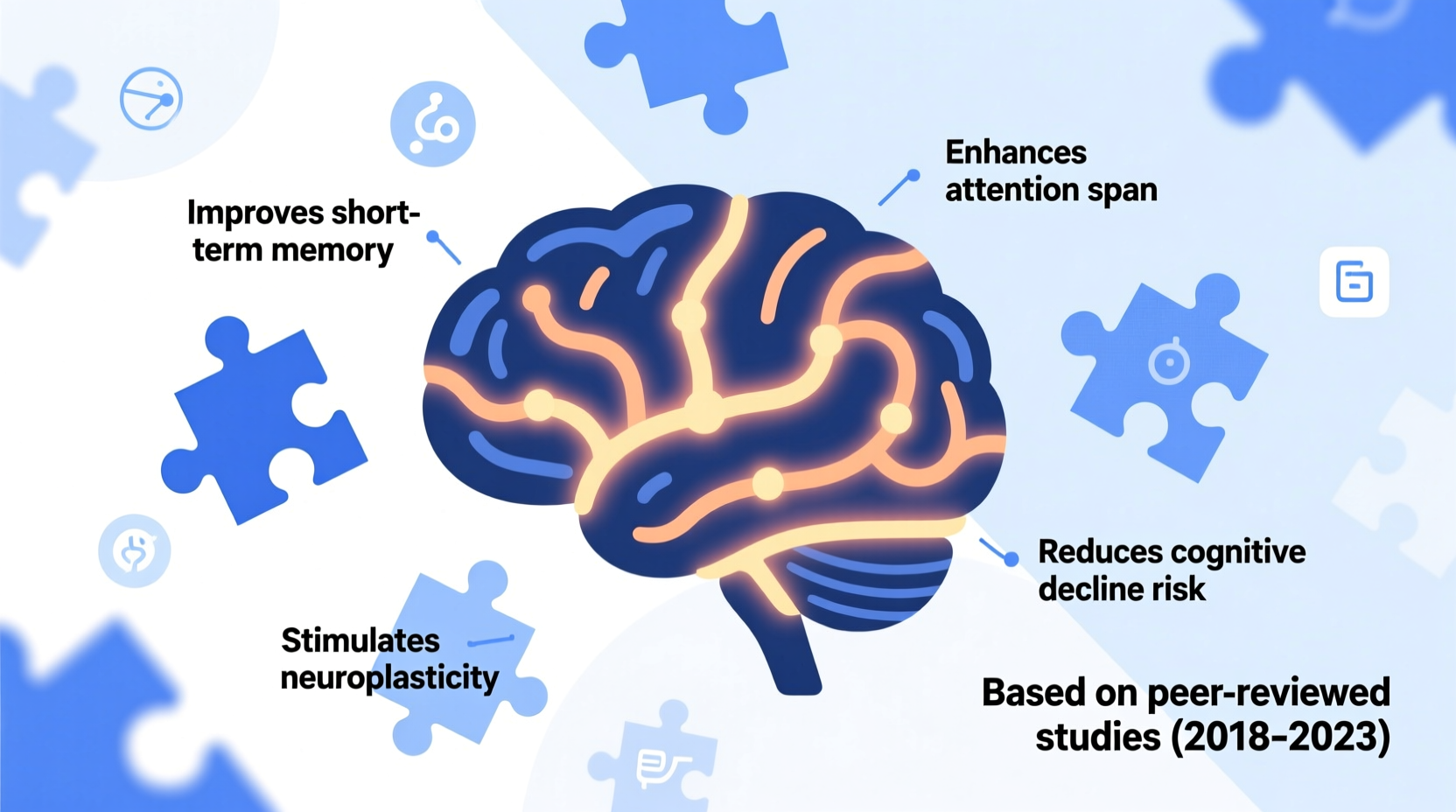
Puzzle games are more than time-fillers—they engage multiple regions of the brain simultaneously. When solving a puzzle, especially one that requires logical reasoning or pattern recognition, your prefrontal cortex activates to manage executive functions such as planning, decision-making, and working memory. Simultaneously, areas like the hippocampus—critical for forming new memories—and the parietal lobe, responsible for spatial processing, become highly active.
Neuroplasticity, the brain’s ability to reorganize itself by forming new neural connections, is central to understanding the long-term benefits of regular puzzle engagement. Studies using functional MRI (fMRI) have shown that individuals who frequently play mentally stimulating games exhibit greater connectivity between brain regions associated with attention and memory retrieval.
“Engaging in cognitively demanding tasks like puzzles strengthens synaptic efficiency and supports reserve capacity against age-related decline.” — Dr. Sarah Langston, Cognitive Neuroscientist, University of Edinburgh
This “cognitive reserve” theory suggests that consistent mental exercise doesn’t prevent neurological diseases outright, but it can delay symptom onset and maintain higher functioning longer, even in the presence of underlying pathology such as early-stage Alzheimer’s.
Memory Enhancement: Short-Term Gains and Long-Term Protection
Working memory—the ability to hold and manipulate information over short periods—is essential for daily functioning, from remembering a phone number to following complex instructions. Puzzle games directly challenge this system. For example, completing a Sudoku grid requires holding several numbers in mind while evaluating possible placements across rows, columns, and boxes.
A 2020 study published in *Nature Human Behaviour* followed over 19,000 adults aged 50 and older who engaged in daily word and number puzzles. Results showed that frequent puzzlers performed significantly better on tests measuring episodic memory, verbal fluency, and problem-solving speed compared to non-puzzlers. Notably, these differences were equivalent to being ten years younger cognitively.
Longitudinal data also suggest protective effects. A landmark study from the *Journal of the American Geriatrics Society* found that adults who played puzzles at least four times per week had a 63% lower risk of developing mild cognitive impairment over six years compared to those who rarely played.
Improving Focus and Attention Through Structured Challenges
In an era of constant digital distractions, sustained attention has become a rare commodity. Puzzle games counteract this trend by requiring deep concentration. Unlike passive screen activities, puzzles demand goal-directed focus and error monitoring—skills that translate into real-world improvements in task persistence and reduced distractibility.
Research conducted at the University of Michigan demonstrated that participants who completed logic-based puzzles for 25 minutes a day over two weeks showed measurable gains in selective attention and processing speed. These improvements were particularly pronounced in individuals who initially scored low on baseline attention assessments.
The mechanism lies in what psychologists call “attentional control training.” Puzzles force the brain to filter out irrelevant stimuli, maintain task goals, and switch flexibly between rules—all components of executive attention. Over time, this repetitive engagement strengthens attention networks in the brain, much like weight training builds muscle endurance.
Types of Puzzles That Maximize Focus Development
- Logic Grid Puzzles: Require deductive reasoning and tracking multiple constraints.
- Kakuro and KenKen: Combine arithmetic with spatial logic under time pressure.
- Jigsaw Puzzles (especially without borders): Demand visual discrimination and sustained attention to subtle details.
- Escape Room-Style Digital Puzzles: Encourage multitasking, sequencing, and hypothesis testing.
Scientific Evidence: What the Data Shows
While anecdotal reports abound, rigorous scientific inquiry helps separate hype from reality. Below is a summary of key findings from peer-reviewed studies on puzzle gaming and cognitive performance.
| Study | Participants | Intervention | Key Findings |
|---|---|---|---|
| National Institute on Aging (2019) | 3,200 adults >65 yrs | Daily crossword/Sudoku for 12 wks | +7 points on cognitive composite score vs control group |
| Oxford Brain Health Study (2021) | 1,850 mid-life adults | 3x/week puzzle app use (6 months) | Improved processing speed by 12%, memory recall by 9% |
| Frontiers in Psychology (2022) | College students (n=240) | Logic puzzles during exam period | Reduced perceived stress, improved focus during studying |
| Alzheimer’s Association Cohort (2018) | 1,400 seniors (7-year follow-up) | Self-reported puzzle frequency | Regular puzzlers had 41% lower dementia incidence |
It's important to note that while correlation does not equal causation, randomized controlled trials increasingly support a causal link when combined with neuroimaging and behavioral tracking. The consistency across diverse populations strengthens confidence in the cognitive benefits of structured puzzle engagement.
Optimizing Puzzle Practice for Maximum Benefit
Not all puzzle play is equally effective. To truly enhance memory and focus, approach puzzles strategically rather than passively. Consider the following evidence-based guidelines:
- Choose progressively difficult puzzles: Staying in the “challenge zone” where success is possible but not guaranteed promotes neuroplasticity.
- Vary puzzle types: Rotate between verbal, numerical, spatial, and logic puzzles to stimulate different brain networks.
- Limits sessions to 20–30 minutes: Extended play can lead to fatigue and diminished returns; short bursts are more effective.
- Track progress: Use apps or logs to monitor completion time and accuracy, creating feedback loops that reinforce learning.
- Combine with physical activity: Aerobic exercise before puzzle sessions increases blood flow to the brain, enhancing alertness and problem-solving ability.
Mini Case Study: Maria’s Cognitive Routine
Maria, a 58-year-old project manager, began noticing difficulty concentrating during meetings and occasionally forgetting names. Concerned about family history of dementia, she consulted a neuropsychologist who recommended cognitive enrichment strategies. She started playing a mix of crossword puzzles, Sudoku, and online logic games for 25 minutes each morning.
After three months, Maria reported clearer thinking and improved recall during presentations. Her employer noted increased productivity. A follow-up cognitive assessment revealed a 15% improvement in working memory and attention span—equivalent to reversing two years of age-related decline. While not a cure-all, her routine exemplifies how targeted mental exercise can yield measurable results.
Common Misconceptions About Puzzle Games
Despite growing evidence, several myths persist about the effectiveness of puzzle games:
- Myth: Any screen-based game counts as brain training.
Reality: Many so-called “brain games” lack scientific validation. Look for games grounded in cognitive psychology principles. - Myth: Benefits transfer automatically to real-life skills.
Reality: Transfer is partial. Puzzle practice improves specific abilities like pattern recognition, but broader life impacts require integration with other habits like sleep and nutrition. - Myth: Older adults benefit less due to reduced plasticity.
Reality: The aging brain remains malleable. Studies show older adults often gain more relative improvement because they start from a lower baseline.
Actionable Checklist: Build Your Brain-Boosting Puzzle Habit
To harness the full potential of puzzle games, follow this practical checklist:
- ✅ Select 2–3 puzzle types that challenge different skills (e.g., words, numbers, visuals).
- ✅ Schedule 20–30 minute sessions at least 4 days per week.
- ✅ Use apps or books with adjustable difficulty levels.
- ✅ Avoid multitasking during puzzle time—focus exclusively on the task.
- ✅ Review mistakes to understand patterns and improve strategy.
- ✅ Combine with healthy lifestyle factors: quality sleep, hydration, and aerobic exercise.
- ✅ Reassess cognitive performance every 8–12 weeks using simple self-tests (e.g., memorizing lists, tracking reaction time).
Frequently Asked Questions
Can puzzle games prevent Alzheimer’s disease?
While no activity can guarantee prevention, regular engagement in mentally stimulating tasks like puzzles is associated with delayed onset of symptoms and slower progression. It contributes to building cognitive reserve, which helps the brain compensate for damage.
Are digital puzzles as effective as paper ones?
Yes, provided they offer similar cognitive demands. However, paper puzzles may reduce digital distraction and eye strain. Some users report deeper immersion with physical formats. Choose based on personal preference and context.
How soon will I notice improvements in memory or focus?
Some individuals report feeling sharper within two to three weeks of consistent practice. Objective improvements in memory and attention typically become measurable after 6–8 weeks of daily engagement.
Conclusion: Train Your Brain with Purpose
Puzzle games are far more than nostalgic pastimes or casual diversions. Backed by robust scientific evidence, they serve as accessible, enjoyable tools for enhancing memory, sharpening focus, and supporting long-term brain health. The key lies not in occasional play, but in consistent, varied, and mindful engagement. Whether you're navigating midlife transitions or preparing for healthy aging, integrating purposeful puzzle practice into your routine is a small investment with compounding cognitive returns.




 浙公网安备
33010002000092号
浙公网安备
33010002000092号 浙B2-20120091-4
Comments
No comments yet. Why don't you start the discussion?