
As robot vacuums become a staple in modern homes, one persistent question surfaces among users: Can these smart devices effectively clean dark carpets without getting confused or stuck? The concern stems from the way robot vacuums perceive their environment—primarily through optical sensors that rely on light reflection. Dark surfaces absorb more light, potentially reducing contrast and confusing navigation systems. But is this a real limitation, or just a myth fueled by early-generation models?
This article dives deep into the mechanics behind robot vacuum navigation, evaluates how different models handle dark carpets, and provides actionable advice for ensuring optimal performance—regardless of your floor color.
How Robot Vacuums Navigate: The Role of Sensors
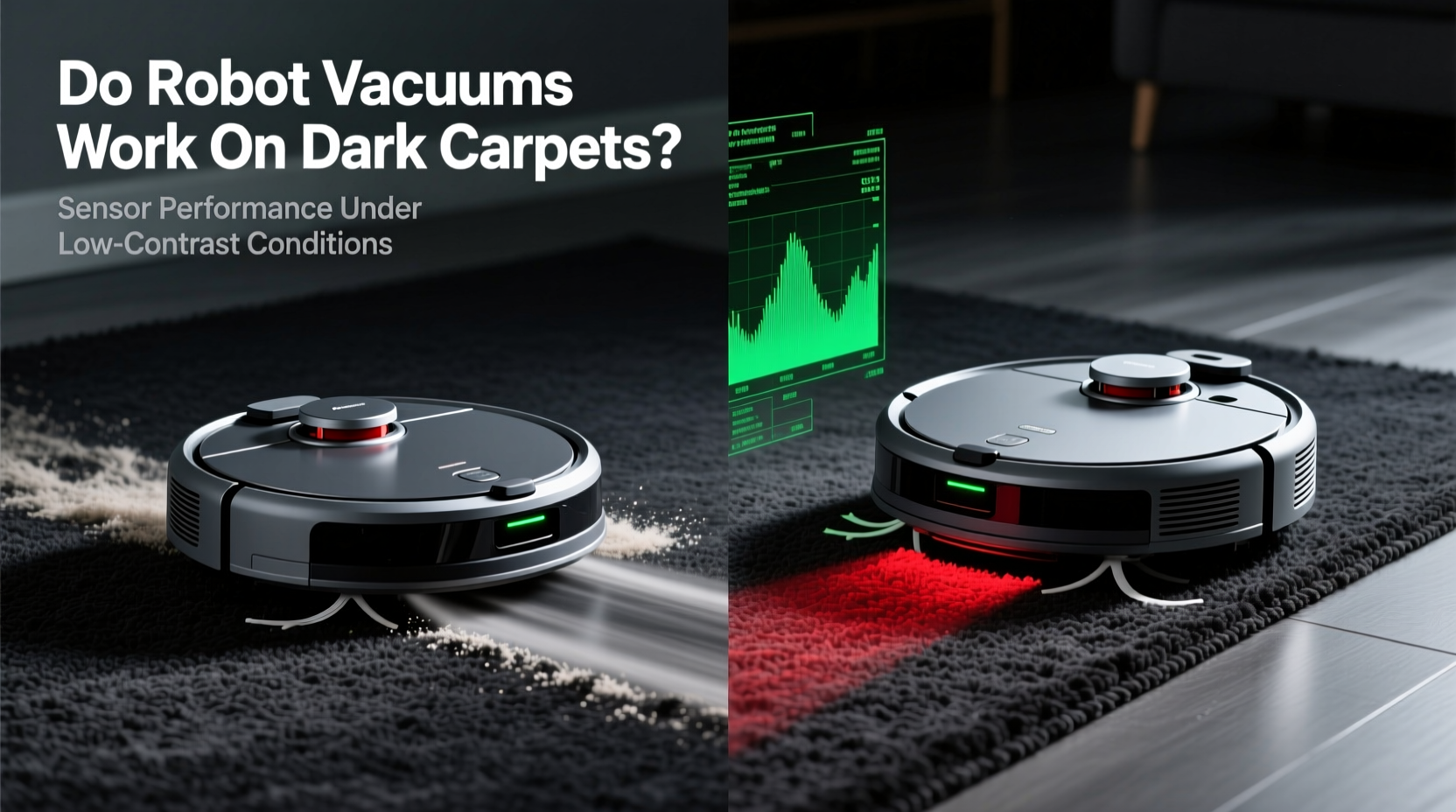
Modern robot vacuums use a combination of sensors to map and move through your home. These include infrared (IR) drop sensors, cliff sensors, bump sensors, wheel encoders, gyroscopes, and increasingly, LiDAR and camera-based vision systems. Among these, cliff sensors are most relevant when discussing dark carpets.
Cliff sensors, typically located on the underside of the robot, emit infrared light downward and measure the amount reflected back. When the robot approaches a stairwell or ledge, less light is reflected due to the drop-off, triggering the robot to reverse and change direction. On highly absorbent surfaces like black or navy carpets, the same phenomenon can occur—the carpet absorbs much of the IR light, mimicking a \"cliff\" condition.
“Early robot vacuums struggled with dark floors because they relied heavily on basic IR reflectivity. Today’s models use sensor fusion—combining data from multiple sources—to avoid false cliff detection.” — Dr. Alan Zhou, Robotics Engineer at SmartHome Labs
However, not all robots are created equal. While high-end models integrate advanced mapping algorithms and redundant systems, budget units may still misinterpret low-reflectance surfaces as hazards.
Do Dark Carpets Actually Cause Problems?
The short answer: sometimes—but it's less common than it used to be.
In controlled testing environments, many mid-to-high-tier robot vacuums—including models from iRobot, Roborock, Ecovacs, and Shark—successfully navigate dark rugs and plush black carpets without hesitation. Their navigation systems compensate for reduced reflectivity by cross-referencing data from wheel rotation, inertial measurement units (IMUs), and room-scale mapping.
That said, certain conditions increase the risk of malfunction:
- Very thick, shaggy black carpets: Absorb even more light and may obscure sensor readings.
- Poor ambient lighting: Reduces overall visibility for camera-assisted models.
- Low battery levels: May impair sensor sensitivity and processing speed.
- Older or entry-level models: Often lack multi-sensor integration.
Comparing Robot Vacuum Performance on Dark Surfaces
To help consumers make informed decisions, here’s a comparison of popular robot vacuums and their behavior on low-contrast flooring:
| Model | Sensor Type | Dark Carpet Performance | Notes |
|---|---|---|---|
| iRobot Roomba j7+ | LiDAR + Camera + IR | Excellent | Uses visual recognition to distinguish between actual drops and dark rugs. |
| Roborock S8 Pro Ultra | Laser LiDAR + Dual Cameras | Excellent | Advanced AI avoids false cliff triggers; excels on black wool rugs. |
| Shark AI Ultra | Camera-Based Mapping | Good | Performs well unless lighting is extremely dim. |
| Eufy RoboVac G30 | Basic IR + Bump Sensors | Fair | May avoid or get stuck on very dark carpets; limited mapping intelligence. |
| ILIFE V3s Pro | Random Navigation + IR | Poor | Frequent cliff sensor errors on dark surfaces; not recommended. |
This table illustrates a clear trend: the more sophisticated the navigation system, the better the handling of challenging floor colors. Models relying solely on infrared sensors are far more prone to false positives, while those using LiDAR or vision-based mapping adapt dynamically.
Real-World Case: The Midnight Blue Living Room Rug
Sarah M., a homeowner in Portland, OR, purchased a Roborock Q5+ after reading mixed reviews about its performance on her new midnight-blue area rug. Within days of setup, she noticed the robot consistently avoided a 4'x6' section of her living room floor.
After checking the app logs, she discovered repeated “cliff detected” warnings exactly where the rug began. A quick firmware update resolved part of the issue, but full coverage required adjusting the robot’s cleaning pattern manually. She switched from “Bounce” mode to “Spiral + Wall Follow,” which allowed the unit to approach the rug from multiple angles and eventually overcome initial hesitation.
Sarah also added a small LED floor lamp nearby. With improved ambient light, the robot no longer mistook the rug for a drop-off. Her experience highlights two key points: software updates matter, and environmental factors play a significant role.
“Users often blame hardware when the fix is environmental or procedural. Lighting, layout, and settings adjustments can resolve 70% of ‘sensor failure’ cases.” — Lena Patel, Customer Support Lead at Roborock North America
Step-by-Step Guide to Optimizing Performance on Dark Carpets
If your robot struggles with dark flooring, follow this sequence to diagnose and resolve the issue:
- Confirm the problem isn’t debris-related: Clean the cliff sensors (located beneath the unit) with a dry microfiber cloth. Dust or hair buildup can reduce signal strength.
- Test in daylight or well-lit conditions: Turn on overhead lights or open curtains during cleaning cycles to enhance visibility.
- Update firmware: Check the manufacturer’s app for available updates. Many brands release patches specifically for surface detection logic.
- Adjust cleaning mode: Use edge-following or spiral patterns instead of random bounce modes, especially on older models.
- Mark virtual boundaries: If the robot persistently avoids an area, use app-defined no-go zones or physical boundary strips to guide it safely.
- Monitor cleaning logs: Review error reports in the app to identify whether “cliff detected” alerts correlate with dark zones.
- Consider a model upgrade: If problems persist, invest in a LiDAR- or camera-equipped robot designed for complex environments.
Checklist: Ensuring Your Robot Works on Dark Floors
- ✅ Clean all sensors weekly
- ✅ Test robot on dark carpet under bright light
- ✅ Update device firmware regularly
- ✅ Use appropriate cleaning mode (e.g., spiral or guided path)
- ✅ Avoid placing dark rugs near actual drop-offs (stairs, landings)
- ✅ Monitor app logs for recurring errors
- ✅ Upgrade to LiDAR/vision-based model if issues continue
FAQ: Common Questions About Robot Vacuums and Dark Carpets
Can black carpets damage my robot vacuum?
No, dark carpets do not physically harm robot vacuums. The concern is navigational—not mechanical. Robots won’t overheat or break down from cleaning black rugs, though prolonged avoidance behaviors may reduce cleaning efficiency.
Why does my robot spin in circles on my dark rug?
This usually indicates conflicting sensor data. The cliff sensors may trigger repeatedly, causing the robot to retreat and reapproach. It’s a sign of poor calibration or insufficient ambient light. Try cleaning the sensors and adding a nearby lamp.
Are there robot vacuums designed specifically for dark floors?
While no model is marketed exclusively for dark carpets, premium units with LiDAR, stereo cameras, or AI-powered obstacle recognition (like the Roomba j9+ or Roborock S8) are engineered to handle low-contrast environments reliably.
Conclusion: Dark Carpets Aren’t a Dealbreaker—But Strategy Matters
The idea that robot vacuums can’t handle dark carpets is outdated, but not entirely baseless. Early models were indeed prone to confusion on black or navy flooring. However, advancements in sensor fusion, machine learning, and environmental modeling have largely overcome these limitations—especially in modern, higher-end devices.
Success depends less on the carpet color itself and more on the robot’s intelligence, maintenance, and surrounding conditions. With proper setup, routine care, and informed choices, you can confidently deploy a robot vacuum in any room—regardless of floor tone.
Don’t let a few misleading anecdotes deter you from automation. Evaluate your space, assess your robot’s capabilities, and apply the strategies outlined here. Most importantly, remember that technology evolves—and so should our expectations.




 浙公网安备
33010002000092号
浙公网安备
33010002000092号 浙B2-20120091-4
Comments
No comments yet. Why don't you start the discussion?