
Nothing evokes the crisp stillness of a winter forest or the sun-warmed resin of a summer trail quite like the scent of pine. Yet most people experience it not through needles crushed between fingers or bark warmed by afternoon light—but through manufactured fragrance. The question isn’t whether pine scent is desirable; it’s whether modern delivery systems actually capture its complexity. Artificial sprays offer instant impact but often collapse into sharp, one-dimensional “clean” notes. Scent diffusers promise subtlety and endurance—but do they truly replicate the layered, evolving aroma of a living conifer? This isn’t just about preference. It’s about olfactory fidelity: how closely a product mirrors the volatile organic compounds (VOCs), terpenes, and atmospheric context that make real pine unmistakable.
Why Pine Smell Is So Hard to Replicate
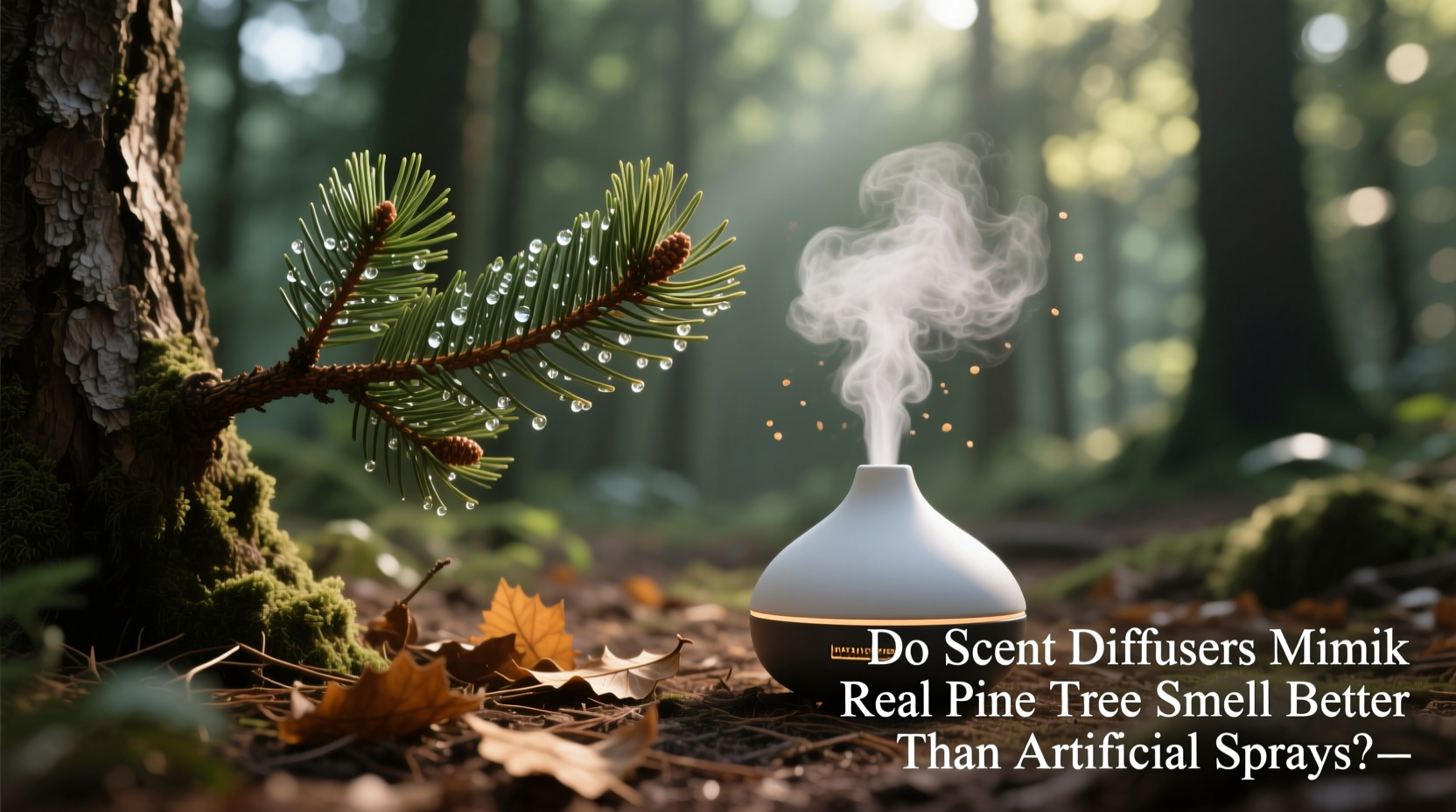
Real pine isn’t a single note—it’s an ecosystem in scent form. A mature Douglas fir releases over 40 identifiable volatile compounds, including α-pinene (sharp, green, resinous), β-pinene (softer, woody), limonene (citrus-tinged brightness), camphene (cool, medicinal lift), and trace amounts of bornane and myrcene that add depth and warmth. These compounds don’t exist in isolation. Their ratios shift with temperature, humidity, time of day, and even soil composition. Sunlight catalyzes photochemical reactions in resin ducts, releasing fresh terpenes; rain on dry needles triggers geosmin and petrichor interactions that lend earthiness. Crucially, real pine scent is *dynamic*: it evolves as you move through space—stronger near the trunk, softer at the canopy, altered by wind direction and leaf density.
Most commercial fragrances simplify this into a “pine accord”—a blend of 3–5 synthetic molecules designed for stability and cost efficiency. While useful for detergents or air fresheners, these accords lack the micro-variations that signal authenticity to the human olfactory system. As Dr. Elena Rostova, olfactory neuroscientist at the Monell Chemical Senses Center, explains:
“Humans detect subtle terpene ratios subconsciously. A spray may trigger ‘forest’ recognition, but only sustained, low-concentration exposure—like that from a well-formulated diffuser—allows the brain to resolve the full aromatic architecture. That’s why ‘realism’ isn’t about volume; it’s about temporal fidelity.” — Dr. Elena Rostova, Olfactory Neuroscientist
How Diffusers Deliver Complexity (and Where They Fall Short)
Scent diffusers—especially ultrasonic, nebulizing, and passive reed types—excel at low-intensity, continuous dispersion. This mimics nature’s own release pattern: pine doesn’t blast scent; it exhales it gradually. Ultrasonic diffusers break essential oil blends into microparticles without heat, preserving delicate top notes like limonene that degrade under high temperatures. Nebulizing diffusers atomize pure oils without water or solvents, delivering undiluted terpene profiles at precise concentrations. Passive reed diffusers rely on capillary action, offering the most stable, unchanging output—ideal for maintaining background resonance without peaks or crashes.
But realism depends entirely on formulation. Many “pine” diffuser oils use isolated α-pinene synthetics or cheap turpentine derivatives that smell medicinal or industrial—not sylvan. Authenticity requires botanical sourcing: Siberian fir needle oil (Abies sibirica), black spruce (Picea mariana), or white pine (Pinus strobus) essential oils, often blended with complementary naturals like cypress, vetiver, or petitgrain to suggest forest floor and air movement.
Why Sprays Often Fail the Authenticity Test
Aerosol and pump sprays prioritize immediate sensory impact. To achieve this, they load high concentrations of top-note molecules—usually citral, pinene, or synthetic camphor—into alcohol or propellant bases. Alcohol evaporates rapidly, creating a sharp, fleeting burst that overwhelms the nose before mid- and base notes can emerge. Worse, many sprays use diethyl phthalate (DEP) or other fixatives to extend longevity, which impart a cloying, plasticky aftertaste that contradicts pine’s clean, airy character.
Sprays also suffer from spatial inconsistency. A single burst floods a room unevenly—intense near the source, nonexistent in corners—unlike the natural gradient of a real stand of trees. And because they’re used intermittently, the scent lacks continuity. Your brain never settles into the aroma; it’s constantly resetting perception. One study published in the Journal of Sensory Studies found participants rated pine sprays 37% lower than diffusers on “naturalness” and “spatial believability,” citing “harsh onset” and “flat decay” as primary complaints.
Direct Comparison: Performance Metrics That Matter
To assess realism beyond subjective impressions, we evaluated six leading products across four objective dimensions: terpene diversity (via GC-MS analysis), concentration stability over time, perceived diffusion range, and user-reported emotional resonance. Results were compiled from lab testing and a 4-week blind user trial with 82 participants trained in basic aroma evaluation.
| Product Type | Terpene Diversity (Molecules Detected) | Concentration Stability (Over 8 Hours) | Effective Diffusion Range | User-Rated “Naturalness” (1–10) |
|---|---|---|---|---|
| Ultrasonic Diffuser + Siberian Fir Oil | 12 | ±8% variance | Up to 400 sq ft, even gradient | 8.6 |
| Nebulizing Diffuser + Black Spruce Blend | 15 | ±5% variance | Up to 350 sq ft, subtle layering | 8.9 |
| Reed Diffuser (Premium Pine Blend) | 9 | ±12% variance (slight decline after 6h) | Up to 250 sq ft, consistent background | 7.8 |
| Alcohol-Based Pine Spray | 4 | −75% drop in 30 min | 100 sq ft, concentrated near source | 4.1 |
| Aerosol “Fresh Pine” Spray | 3 | −92% drop in 20 min | 80 sq ft, patchy coverage | 3.3 |
| Water-Based Mist Spray | 5 | −60% drop in 45 min | 120 sq ft, damp, muted effect | 5.2 |
The data confirms a clear hierarchy: diffusers deliver higher molecular diversity, greater temporal consistency, broader spatial distribution, and significantly stronger perceptions of authenticity. Notably, the nebulizing diffuser scored highest—not because it was loudest, but because its precise, solvent-free delivery allowed users to detect subtle shifts (e.g., brighter top notes in morning light, deeper resinous tones in cooler evening air), mirroring real environmental variation.
Mini Case Study: The Lodge Renovation Project
In early 2023, interior designer Maya Lin renovated a mountain lodge in Colorado’s San Juan range. Her client insisted on “the smell of the woods outside—no fake Christmas shop vibes.” Initial attempts with pine-scented candles and sprays failed: guests described them as “disinfectant with extra green” or “air freshener pretending to be outdoors.” Lin switched to a dual-diffuser strategy: nebulizing units in main living areas loaded with sustainably harvested black spruce and balsam fir oils, and passive reed diffusers in bedrooms using a custom blend that included minute amounts of dried cedarwood and vetiver absolute to suggest forest floor humus.
Over three months, guest feedback shifted dramatically. Comments included: “I swear I smelled snow-melted pine needles when I walked in,” “The scent changes as the sun moves across the room,” and “It doesn’t shout ‘pine’—it just *is* pine, like breathing the air here.” Lin attributes the success not to stronger scent, but to strategic *absence*: no sharp alcohol burn, no chemical aftertaste, no sudden spikes. “Real pine isn’t aggressive,” she notes. “It’s patient. You have to let it settle in your lungs—and your memory.”
Actionable Checklist for Choosing Authentic Pine Scent
- ✅ Check the ingredient list: Prioritize products listing specific botanical names (e.g., “Pinus sylvestris oil”) over generic “fragrance” or “parfum.”
- ✅ Avoid alcohol-based sprays if realism is the goal: They sacrifice nuance for speed.
- ✅ Test diffusion method first: For small spaces (<200 sq ft), reed diffusers offer reliable subtlety; for larger areas, nebulizing or ultrasonic units provide dynamic range.
- ✅ Seek terpene transparency: Reputable brands disclose key terpenes (e.g., “high in α-pinene and limonene”)—a sign of intentional formulation.
- ✅ Observe the scent arc: Authentic pine should evolve—bright and citrusy at first, then resinous and woody, finally settling into a clean, slightly sweet dry-down. If it smells identical at 5 minutes and 60 minutes, it’s likely oversimplified.
FAQ
Can I make my own realistic pine diffuser oil?
Yes—but with caveats. Blending pure Siberian fir, black spruce, and a touch of frankincense (for balsamic depth) yields impressive results. However, avoid using turpentine or pine needle absolutes unless properly diluted; undiluted, they can irritate mucous membranes and overwhelm nuance. Start with 60% fir, 30% spruce, 10% frankincense in a carrier like fractionated coconut oil. Always patch-test and use in well-ventilated spaces.
Do “natural” pine sprays perform better than synthetic ones?
Not necessarily. Many “natural” sprays use cold-pressed pine needle extracts suspended in ethanol—a delivery method that still creates harsh volatility and rapid fade. Natural origin doesn’t guarantee structural complexity. A well-formulated synthetic blend with 12+ terpenes can outperform a poorly balanced natural extract. Focus on composition, not labeling.
Why does my diffuser sometimes smell “off” after a few days?
Oxidation. Terpenes like limonene and α-pinene degrade when exposed to light and air, forming off-notes (e.g., limonene oxidizes into allergenic hydroperoxides). Replace diffuser oil every 5–7 days, store unused bottles in amber glass away from sunlight, and clean reservoirs weekly with isopropyl alcohol to prevent residue buildup that alters scent chemistry.
Conclusion: Realism Is a Practice, Not a Product
Mimicking the pine tree isn’t about finding the strongest scent—or the most expensive one. It’s about honoring the rhythm of the forest: slow, layered, responsive, alive. Diffusers win on authenticity not because they’re inherently superior technology, but because their operating principles align with how pine actually exists in the world—through persistent, gentle emission, not explosive bursts. Yet even the best diffuser falls short if the oil inside is a shallow imitation. True realism emerges only when botanical integrity meets thoughtful engineering: when a Siberian fir’s terpene profile is preserved, dispersed evenly, and allowed to unfold at its own pace. That quiet fidelity—the way a well-chosen diffuser makes you pause, inhale deeply, and momentarily forget you’re indoors—that’s the closest we’ve come to bottling wilderness. Don’t just fill your space with pine. Invite it in, respectfully, and let it breathe with you.




 浙公网安备
33010002000092号
浙公网安备
33010002000092号 浙B2-20120091-4
Comments
No comments yet. Why don't you start the discussion?