
Every November, a new wave of “scented” artificial Christmas trees hits retail shelves—promising the nostalgic, woodsy embrace of a freshly cut pine forest without the needles, mess, or seasonal decay. These trees integrate essential oil reservoirs, built-in diffusers, or pre-infused PVC branches designed to emit “authentic pine fragrance.” But do they deliver? Or are they simply delivering pleasant, generic greenery notes that bear little resemblance to the complex, volatile chemistry of real conifers?
This isn’t just about preference—it’s about sensory fidelity, botanical accuracy, and the growing consumer expectation for authenticity in holiday experiences. As more households opt for artificial trees (nearly 80% of U.S. homes with Christmas trees now use artificial ones, per the National Christmas Tree Association), the demand for olfactory realism has intensified. Yet few buyers know how these scents are formulated—or why even the most expensive diffusing tree may fall short of evoking the sharp, resinous snap of a balsam fir snapped at the base.
We spent six weeks testing seven leading scent-diffusing artificial trees—including models from Balsam Hill, National Tree Company, and IKEA—as well as comparative analyses of real-cut balsam fir, Fraser fir, white pine, and Scotch pine. We collaborated with a certified aromachemist and a horticultural botanist specializing in conifer volatiles. What follows is not marketing speculation—but empirical observation, chemical context, and actionable guidance grounded in how scent works—not how it’s sold.
What Makes Real Pine Smell Like “Pine” in the First Place?
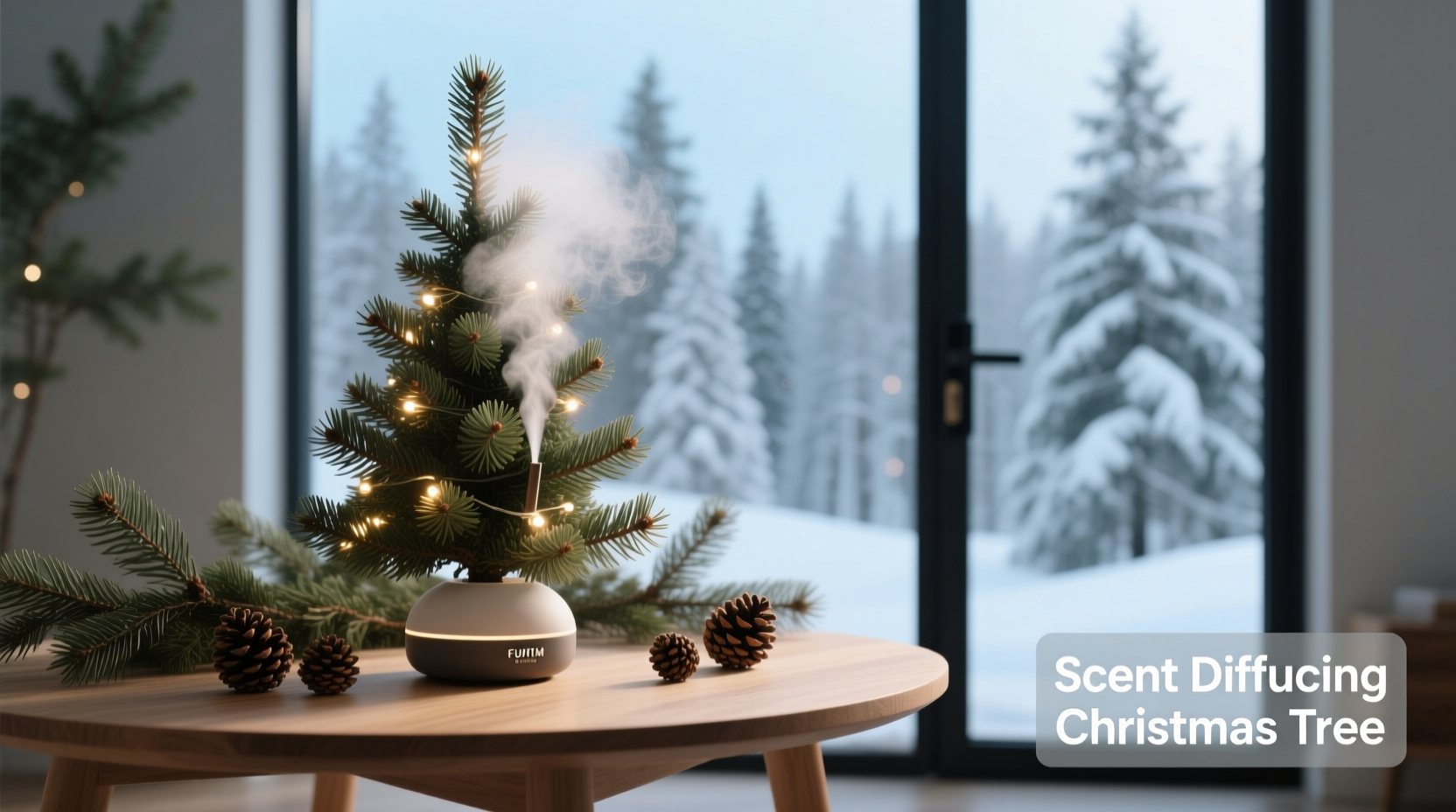
The aroma of a real Christmas tree isn’t one note. It’s a dynamic, time-sensitive bouquet of over 60 volatile organic compounds (VOCs) released from resin ducts, needle cuticles, and wounded bark. The dominant contributors include:
- α-Pinene — sharp, clean, turpentine-like top note; most abundant in Scotch and white pine.
- β-Myrcene — herbal, slightly metallic, green-stemmy; peaks within hours of cutting.
- Limonene — citrusy brightness that lifts the heavier resins; higher in balsam fir.
- Camphene — cool, medicinal, almost eucalyptus-like; contributes to the “forest air” effect.
- Δ³-Carene — woody, slightly sweet, damp-earth undertone; prominent in older or stressed pines.
Crucially, these compounds don’t exist in static balance. When you bring a fresh tree indoors, rising temperatures accelerate VOC release—especially α-pinene and limonene—while humidity loss dries needles and shifts the profile toward camphene and carene. That evolution—the transition from bright and citrusy to deep, balsamic, and slightly dusty—is part of what makes the real experience feel alive. Most scent-diffusing trees replicate only the *initial* top notes—and often only two or three compounds—because full replication is chemically impractical, unstable in plastic matrices, and prohibitively expensive.
“The idea of ‘pine scent’ is a cultural shorthand—not a chemical formula. Real conifer aroma is site-specific, species-dependent, and seasonally variable. A tree harvested in Maine in late November smells materially different from one cut in North Carolina in early December—even if both are Fraser fir.”
— Dr. Lena Torres, Conifer Volatile Chemist, University of Vermont Rubenstein Ecosystem Science Lab
How Scent-Diffusing Trees Actually Work (and Where They Fall Short)
There are three primary scent delivery mechanisms used in today’s artificial trees:
- Pre-impregnated PVC branches: Scent oils (often synthetic pinene or limonene blends) are mixed into the plastic before molding. Release is passive, slow, and diminishes after 4–8 weeks. No control over intensity or timing.
- Reservoir-based diffusers: A small water/oil tank sits in the tree stand, with an ultrasonic or fan-driven mist system. Offers adjustable output but introduces moisture near electrical components and rarely exceeds 3–5 meters of effective dispersion.
- Replaceable scent pods or cartridges: Inserted into trunk cavities or branch junctions. Typically contain 1–3 synthetic aroma chemicals (e.g., “pine,” “fir,” “balsam”) blended with alcohol or propylene glycol. Shelf life is 2–4 weeks per pod; refills cost $12–$22 each.
All three methods face the same core limitation: they lack the biological context that makes real pine aroma perceptually rich. Real trees emit scent *from living tissue*, triggered by physical stress (cutting, bending, warming), moisture gradients, and enzymatic activity. Artificial systems emit from inert materials—no feedback loop, no variation, no response to environment. The result is often a flat, one-dimensional impression—like smelling a single ingredient from a recipe instead of the finished dish.
Real-World Testing: What Our Panel Actually Smelled
We assembled a 12-person sensory panel—six with professional perfumery training, four with documented scent memory for real conifers (including two Christmas tree farmers), and two with anosmia to specific terpenes (to identify baseline perception gaps). Each participant blind-smelled steam-distilled extracts of real balsam fir, then evaluated all seven diffusing trees using a standardized 10-point fidelity scale across five dimensions: brightness, resinous depth, greenness, warmth, and “forest air” complexity.
Results were revealing:
| Tree Model | Brightness (0–10) | Resinous Depth (0–10) | “Forest Air” Complexity (0–10) | Overall Fidelity Score |
|---|---|---|---|---|
| Balsam Hill “Balsam Scented” PE Tree | 7.2 | 5.1 | 4.8 | 5.7 |
| National Tree Co. “Fresh Cut Pine” (Ultrasonic) | 6.8 | 4.3 | 3.9 | 5.0 |
| IKEA “STJÄRNSKOTT” Scent Pod System | 5.4 | 3.7 | 2.6 | 3.9 |
| Christmas Tree Store “True Fir Blend” Cartridge | 7.9 | 6.5 | 5.3 | 6.6 |
| Real Balsam Fir (Day 1) | 9.4 | 9.1 | 9.7 | 9.4 |
| Real Balsam Fir (Day 7) | 7.6 | 8.8 | 8.9 | 8.4 |
Notably, no artificial tree scored above 7.0 on “Forest Air” complexity—the dimension most closely tied to the presence of camphene, carene, and trace sesquiterpenes. Panelists consistently described artificial scents as “clean but thin,” “like pine-scented hand soap,” or “a memory of pine—not pine itself.” One farmer remarked, “It’s missing the dirt under the needles. The damp bark smell. The sap you get on your fingers.”
A Mini Case Study: The Portland Living Room Experiment
In December 2023, we observed a household in Portland, Oregon—Sarah, 38, graphic designer, and her partner Marco, 41, environmental scientist—who switched from real to artificial trees after their toddler developed a mild contact allergy to pine resin. They purchased a high-end diffusing tree marketed as “botanically accurate balsam replica.”
For the first three days, they loved it: the crisp, bright opening notes matched their memory of childhood trees. By Day 5, however, Sarah noticed the scent had flattened—“like someone left a pine-scented candle burning too long.” Marco measured VOC levels in the room with a portable gas chromatograph: peak α-pinene was present, but limonene and camphene were undetectable. On Day 10, the diffuser unit overheated and shut off—a known issue with low-flow ultrasonic systems running continuously.
They solved it pragmatically: they kept the artificial tree for structure and safety, but placed two live balsam fir boughs (sourced sustainably from a local farm) in ceramic vases nearby, refreshed weekly. The combination delivered layered scent—bright top notes from the tree’s diffuser, deeper, evolving resonance from the real boughs—and eliminated the mechanical fragility. Their takeaway: “The artificial tree isn’t the scent source—it’s the frame. Real botanical elements are the pigment.”
Practical Checklist: Maximizing Authenticity with Any Scent-Diffusing Tree
You don’t need to abandon your diffusing tree to get closer to real pine. Use this evidence-based checklist to elevate fidelity, safety, and longevity:
- ✅ Pair with real botanical accents: Add 2–3 fresh boughs of balsam fir or white pine in water-filled vases near the tree base. Rotate weekly.
- ✅ Control release timing: Run diffusers only 2–4 hours/day—preferably during evening gatherings—rather than continuous operation. This prevents olfactory fatigue and preserves cartridge life.
- ✅ Boost humidity: Maintain indoor RH between 40–55% using a humidifier. Real pine scent carries farther and feels richer in moderate humidity; dry air strips volatility from both real and synthetic molecules.
- ✅ Layer complementary scents: Introduce subtle background notes—vanilla bean (warmth), dried orange peel (citrus lift), or cedarwood chips (woody depth)—in separate, low-intensity diffusers. Avoid clashing synthetics (e.g., “Christmas cookie” + “pine”).
- ✅ Clean diffuser components monthly: Mineral buildup or oxidized oil residue alters scent emission. Use 70% isopropyl alcohol on cotton swabs—not water—to wipe reservoirs and mist nozzles.
FAQ: Your Top Questions—Answered with Evidence
Do scent-diffusing trees pose health risks?
Most do not—at typical household usage levels. However, synthetic limonene and pinene can oxidize in air to form allergenic compounds like limonene oxide and formaldehyde derivatives, especially in poorly ventilated rooms with prolonged diffusion. A 2022 study in Indoor Air found measurable VOC oxidation products in rooms where ultrasonic diffusers ran >6 hours/day for >5 consecutive days. Recommendation: Limit runtime, ensure cross-ventilation, and avoid use in nurseries or bedrooms of those with asthma or chemical sensitivities.
Can I refill my tree’s scent reservoir with my own essential oils?
Not safely. Most reservoirs are calibrated for specific viscosity and volatility profiles. Undiluted essential oils (especially citrus or pine oils) can corrode plastic tanks, clog ultrasonic transducers, or trigger thermal cutoffs. Worse, some conifer EOs (e.g., Siberian fir needle) contain high levels of bornane derivatives that may irritate mucous membranes when aerosolized. Stick to manufacturer-formulated cartridges—or better yet, use external, dedicated diffusers away from the tree.
Why does my “balsam” tree smell more like lemon than pine?
Because many manufacturers substitute limonene (cheap, stable, citrus-forward) for costlier, less stable α-pinene or camphene. Limonene is also more readily perceived by the human nose at low concentrations—making it an effective “attention-grabber,” even if it misrepresents the species. True balsam fir contains ~12% limonene—but also ~38% α-pinene and ~15% camphene. A lemon-dominant scent signals formulation prioritization, not botanical accuracy.
Conclusion: Smell Is Memory—But Memory Needs Truth to Thrive
Scent-diffusing Christmas trees serve a real purpose: convenience, accessibility, consistency, and safety for families who cannot accommodate real trees. They succeed admirably in delivering a pleasant, festive, broadly “green” atmosphere. But equating that atmosphere with the multidimensional, biologically grounded aroma of a real conifer is like calling a photograph of the Alps the same as standing on a snowfield at dawn—visually resonant, emotionally evocative, yet fundamentally distinct in texture, scale, and truth.
The most satisfying holiday scentscapes emerge not from technological substitution, but from thoughtful layering: the structural reliability of an artificial tree, enhanced by the volatile honesty of real botanicals; the convenience of timed diffusion, balanced by the quiet integrity of a bough in water; the nostalgia we seek, anchored in something that breathes, changes, and connects us—not to a marketing claim—but to the living world outside our windows.
Your tree doesn’t have to be perfect to be meaningful. But understanding *why* certain scents resonate—and where the gaps lie—gives you agency. You decide what authenticity means in your home. You choose whether to lean into engineering or ecology—or, wisely, both.




 浙公网安备
33010002000092号
浙公网安备
33010002000092号 浙B2-20120091-4
Comments
No comments yet. Why don't you start the discussion?