
In the world of international media consumption, viewers often face a choice: watch a foreign-language film or series with subtitles (subbed) or opt for a version where the original dialogue is replaced with localized speech (dubbed). While both formats serve the same purpose—making content accessible across language barriers—there’s a subtle but significant difference in how they’re produced, especially when it comes to voice performance. A common question among fans and industry observers alike is whether voice actors are deliberately changed between dubbed and subbed versions. The short answer is yes—but not in the way most people assume.
The confusion often stems from a misunderstanding of what “subbed” actually entails. Subtitled versions do not involve new voice acting; they preserve the original audio track. However, promotional materials, alternate releases, or region-specific edits sometimes feature different voice talent even within dubbed editions. This leads to the perception that there’s a deliberate swap between subbed and dubbed iterations. In reality, the variation occurs not between sub and dub formats per se, but across different dubbing productions themselves.
Understanding the Difference: Subbed vs. Dubbed
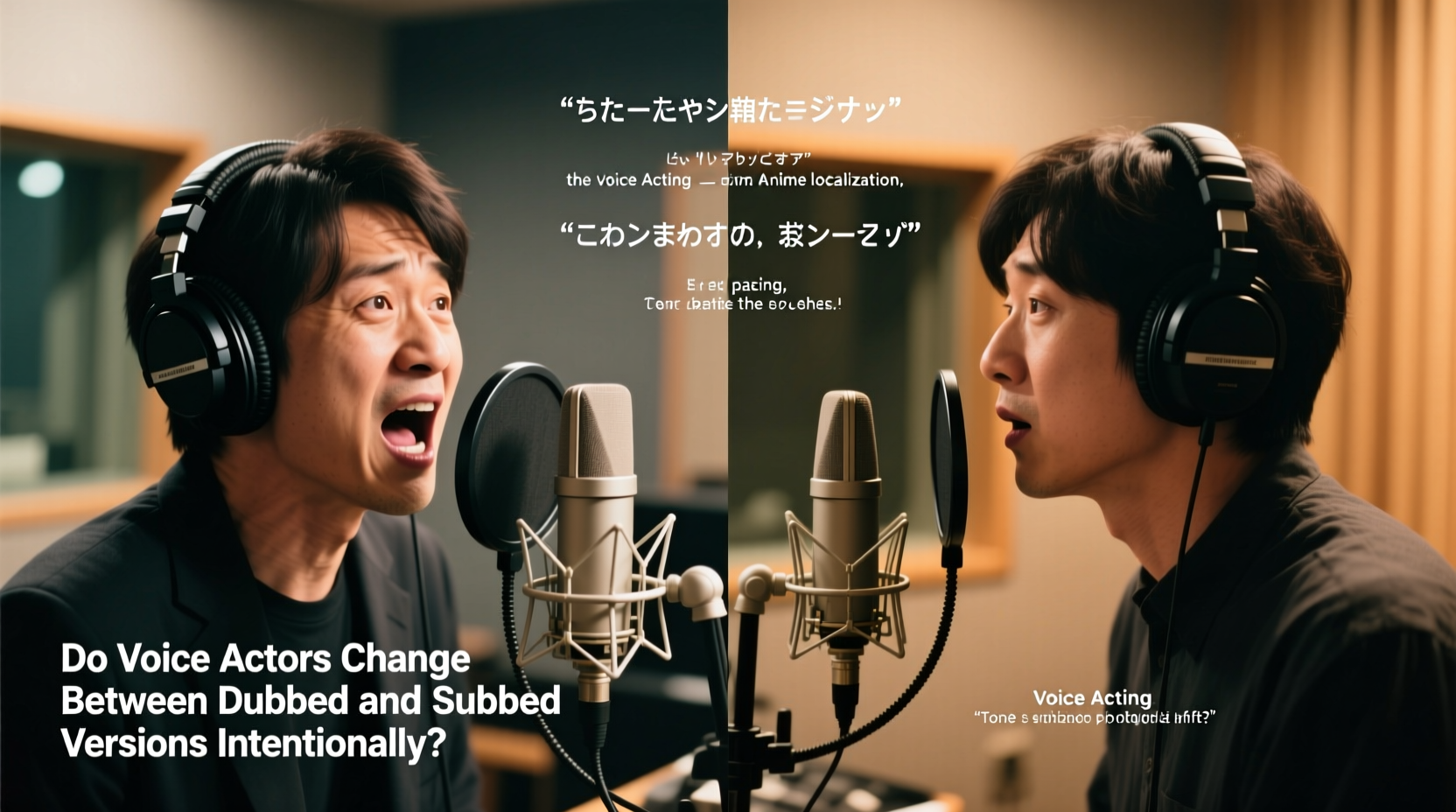
To clarify the core issue, it's essential to define both formats:
- Subbed (Subtitled): The original audio remains unchanged. Text translations appear at the bottom of the screen, synchronized with dialogue. No new voice actors are involved.
- Dubbed: The original voices are replaced by performers speaking the target language. These recordings are carefully timed to match lip movements and emotional tone.
Because subtitled versions retain the original vocal performances, there is no opportunity for a “change” in voice actors unless additional narration, commentary, or bonus features introduce new talent. Therefore, any perceived shift in voice cast happens not between sub and dub, but between different dubbing efforts—such as separate dubs produced for North America, the UK, or Latin America.
Why Multiple Dubs Exist
Global franchises like anime, video games, or major Hollywood films often receive multiple dubbing treatments tailored to specific regions. Each adaptation may employ different casting choices based on linguistic nuance, cultural context, or market strategy. For example:
| Franchise | Region | Voice Actor Example | Note |
|---|---|---|---|
| Pokémon | North America (4Kids) | Veronica Taylor (Ash Ketchum) | Edgy, fast-paced delivery |
| Pokémon | North America (TPCI later seasons) | Sarah Natochenny (Ash Ketchum) | More naturalistic tone |
| Dragon Ball Z | Australia (ABG) | Various local actors | Different accents and pacing |
| Dragon Ball Z | North America (Funimation) | Sean Schemmel (Goku) | Iconic, widely recognized performance |
This table illustrates that changes in voice actors stem from distinct production timelines and regional distributors—not from a direct contrast between subbed and dubbed formats.
Intentional Casting Shifts Across Dub Productions
While the original audio remains fixed in subbed versions, studios producing dubs have full discretion over casting. These decisions are intentional and guided by several factors:
1. Linguistic Authenticity
Dialects, slang, and rhythm vary significantly between English-speaking markets. A British dub might use Received Pronunciation for authority figures, while an American version opts for Midwestern neutrality. Voice actors are selected to align with these expectations.
2. Brand Consistency
Larger franchises maintain long-term voice casts to ensure continuity. Once audiences grow attached to a particular interpretation—like Tara Strong’s portrayal of Harley Quinn in DC animations—studios avoid recasting unless necessary.
3. Budget and Union Regulations
Dubbing budgets differ by region and platform. Unionized markets like Los Angeles (SAG-AFTRA) command higher rates than non-union hubs such as Texas or Canada. As a result, some companies outsource dubs to lower-cost regions, leading to different actors being hired.
“Casting isn’t just about matching pitch—it’s about capturing the soul of a character in another language. That means sometimes we need entirely different types of performers.” — Lena Petrova, ADR Director at Sentai Filmworks
Case Study: The Case of *Attack on Titan*
The anime series *Attack on Titan* offers a compelling example of how voice actor variations occur across dub versions, despite the subbed edition remaining consistent worldwide.
The original Japanese audio, featuring Yuki Kaji as Eren Yeager, is preserved in all subtitled releases. However, the English dub underwent notable shifts during its lifespan:
- Seasons 1–3: Produced by Funimation using their in-house Dallas-based voice ensemble. Bryce Papenbrook voiced Eren with a raw, emotionally charged delivery that resonated globally.
- Season 4 (Final Season): Production shifted to Crunchyroll after its acquisition of Funimation. While most main cast members returned, minor roles were recast due to scheduling conflicts and studio restructuring.
Fans noticed subtle tonal differences in secondary characters, sparking online debates about authenticity. Yet, no change occurred in the subbed version—the original Japanese performances remained untouched throughout.
This case underscores a key truth: voice actor changes are tied to production logistics and corporate transitions, not the sub vs. dub format divide.
When Do Voice Actors Actually Change Intentionally?
Changes in voice talent are strategic and occur under specific circumstances. Below is a timeline of common scenarios where recasting happens deliberately:
- New Licensing Agreement: When distribution rights move from one company to another (e.g., Netflix acquiring older titles previously held by Hulu), a new dub may be commissioned with fresh casting.
- Reboot or Remake: Franchises like *Sailor Moon* or *Cowboy Bebop* have received multiple dubs decades apart. Modern reboots often feature younger, more diverse voice ensembles to appeal to contemporary audiences.
- Cultural Sensitivity Updates: Older dubs sometimes used exaggerated accents or stereotypical portrayals. Newer versions replace those performances with culturally respectful interpretations, necessitating recasting.
- Actor Availability or Conduct Issues: If a voice actor retires, becomes unavailable, or faces professional controversy, studios will recast to protect the brand.
These decisions are never arbitrary. They reflect evolving standards, audience expectations, and business realities.
Checklist: Evaluating Voice Actor Changes in Dubbed Media
Use this checklist when analyzing why voice actors might differ across versions:
- ✅ Confirm whether you're comparing subbed vs. dubbed—or two different dubs
- ✅ Identify the production studio and release year
- ✅ Check for licensing changes or corporate mergers (e.g., Sony’s consolidation of Crunchyroll and Funimation)
- ✅ Look up cast lists on databases like ANN (Anime News Network) or Behind the Voice Actors
- ✅ Consider if cultural updates or sensitivity reviews prompted recasting
FAQ
Do subbed versions ever include new voice work?
Rarely—and only in special cases. Some educational or children’s programming may add narrated explanations over subtitled footage, but this is uncommon. True subbed versions preserve 100% of the original audio.
Why does the same show sound different on Netflix vs. Blu-ray?
Streaming platforms sometimes commission their own dubs or license alternate versions. For instance, Netflix’s *Fullmetal Alchemist: Brotherhood* uses the original Aniplex/Funimation dub, but earlier TV airings had censored audio. Differences in mixing, editing, or casting can alter the experience.
Can one person do both sub and dub versions?
No—because subbed versions don’t involve new voice acting. However, bilingual actors like Laura Bailey or Johnny Yong Bosch often participate in dubs and may also contribute to translation or script adaptation, creating a link between the two processes.
Expert Insight: The Role of ADR Directors
An ADR (Automated Dialogue Replacement) director plays a crucial role in shaping a dub’s vocal identity. Unlike subtitling, which focuses on written accuracy, dubbing requires emotional fidelity.
“The best dubs don’t translate words—they translate feelings. That’s why we spend weeks auditioning actors who can embody, not just imitate, the original performance.” — Christopher Sabat, Voice Director and Actor (known for *Dragon Ball*, *Bleach*)
Sabat, who also voices Goku in many English dubs, emphasizes that casting is a creative act. “You’re not replacing the actor—you’re reinterpreting the role for a new culture.” This philosophy explains why certain dubs become fan favorites, while others are criticized for mismatched energy or tone.
Conclusion: It’s Not About Sub vs. Dub—It’s About Production Context
The idea that voice actors are changed “between” subbed and dubbed versions is a misconception rooted in incomplete understanding. Subbed versions do not involve new voice talent; therefore, no switch occurs. What viewers actually observe are differences between multiple dubbed adaptations—each shaped by timing, budget, cultural goals, and studio priorities.
Recognizing this distinction empowers audiences to appreciate localization as an art form, not just a technical process. Whether you prefer the immediacy of subtitles or the immersion of dubbing, understanding the effort behind each choice deepens your engagement with global storytelling.




 浙公网安备
33010002000092号
浙公网安备
33010002000092号 浙B2-20120091-4
Comments
No comments yet. Why don't you start the discussion?