
In a world increasingly defined by open offices, crowded commutes, and constant digital interruptions, the quest for mental clarity has never been more urgent. Noise-cancelling headphones have surged in popularity—not just as travel accessories but as tools for productivity. But beneath the marketing claims lies a critical question: Do they genuinely enhance focus, or are they simply high-tech earplugs that mute sound without boosting cognitive performance?
The answer isn’t binary. While noise cancellation excels at reducing auditory distractions, its effect on focus depends on the type of noise, the user’s environment, and individual cognitive patterns. To understand this fully, we need to explore how these devices work, what neuroscience says about sound and attention, and when—exactly—they make a measurable difference.
How Noise Cancelling Works: More Than Just Silence
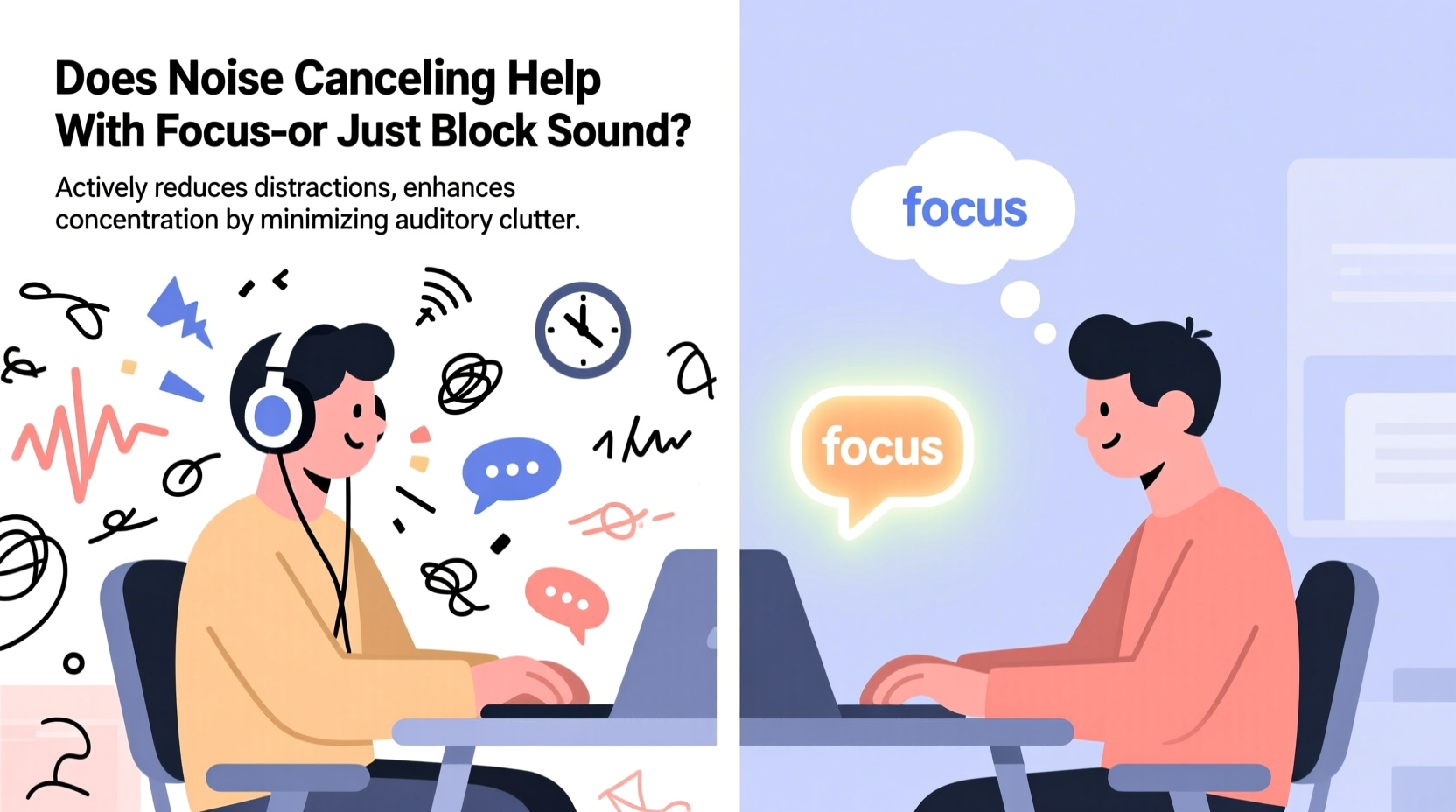
Noise-cancelling technology operates on the principle of destructive interference. Microphones on the exterior of the headphones pick up ambient sounds, particularly low-frequency, consistent noises like airplane engines, HVAC systems, or traffic hum. The headphones then generate an \"anti-noise\" wave—a sound signal with the same amplitude but inverted phase—to cancel out the incoming sound before it reaches the ear.
This process, known as active noise cancellation (ANC), is most effective against predictable, steady background noise. It's less effective against sudden, sharp sounds—like a colleague’s laugh or a phone notification—which is where passive isolation (physical sound blocking via earcup design) plays a supporting role.
But eliminating sound doesn’t automatically mean improved focus. The brain doesn't just respond to volume; it reacts to meaning, rhythm, and emotional valence in sound. A whisper might be ignored, but your name spoken across a room triggers immediate attention—a phenomenon called the \"cocktail party effect.\" ANC can reduce overall auditory load, but it can’t filter relevance.
The Cognitive Science of Sound and Focus
Attention is a limited resource. When the brain processes irrelevant auditory input, even subconsciously, it consumes cognitive bandwidth. This is especially true for tasks requiring working memory, logical reasoning, or deep reading—activities vulnerable to disruption by background noise.
A 2021 study published in the Journal of Environmental Psychology found that office workers exposed to moderate background speech made 37% more errors on reading comprehension tasks than those in quiet conditions. Interestingly, participants wearing ANC headphones performed nearly as well as those in silence, suggesting that reducing auditory clutter directly supports cognitive accuracy.
However, not all noise is harmful. Some individuals thrive with ambient sound—particularly non-lyrical music or nature recordings—which can induce a state of relaxed alertness conducive to creativity. This highlights a key nuance: noise cancellation helps focus primarily by removing *distracting* noise, not *all* noise.
“Silence isn’t always golden for cognition. The right kind of background sound can support flow states. The goal is control over auditory input, not total elimination.” — Dr. Lena Patel, Cognitive Neuroscientist, MIT Human Perception Lab
When Noise Cancelling Enhances Focus: Real-World Scenarios
The value of noise cancellation becomes clearest in specific environments where unwanted sound is both unavoidable and disruptive.
Open Offices
Modern workplaces often prioritize collaboration over concentration, leading to acoustically chaotic environments. Speech, keyboard clicks, and phone calls create a fragmented soundscape. ANC headphones act as a psychological boundary, signaling “do not disturb” while reducing sensory overload.
Remote Work with Household Distractions
For people working from home, children, pets, or construction noise can break focus repeatedly. ANC won’t eliminate a barking dog, but it can dampen the low rumble of lawnmowers or distant appliances, minimizing their intrusion.
Study Environments
Students in dorms, libraries, or cafes benefit from reduced ambient chatter. A 2023 meta-analysis in Educational Psychology Review concluded that students using ANC during self-study sessions reported higher task completion rates and lower perceived stress.
Commuting and Travel
Long flights or train rides are classic use cases. The constant drone of engines fatigues the nervous system over time. By neutralizing this low-frequency stressor, ANC preserves mental energy for tasks upon arrival.
Limitations: When Silence Isn’t Enough
Noise cancellation is powerful, but it’s not a magic bullet for focus. Several limitations must be acknowledged:
- It doesn’t stop cognitive distractions. Internal thoughts, emotional stress, or digital notifications still disrupt concentration—even in perfect silence.
- Over-reliance may reduce resilience. Constantly filtering out noise can make users more sensitive to minor disruptions when ANC isn’t available.
- Social disconnection. Wearing closed headphones signals unavailability, which may hinder spontaneous collaboration or awareness of surroundings.
- Physical discomfort. Prolonged use can cause ear fatigue or pressure sensations due to the vacuum-like seal required for optimal ANC performance.
Moreover, some research suggests that complete silence can feel unnerving or even increase anxiety in certain individuals. The absence of expected background cues may trigger hypervigilance, counteracting the intended calming effect.
Case Study: A Remote Developer’s Workflow Transformation
Jamal, a software engineer based in Austin, struggled with inconsistent productivity while working remotely. His neighborhood underwent frequent street repairs, and his apartment shared a wall with a daycare. Despite strict schedules, he averaged only 2–3 hours of deep work per day.
After experimenting with various solutions, he invested in premium ANC headphones and paired them with a playlist of lo-fi electronic music. Within two weeks, his focused coding blocks increased to 5–6 hours daily. He noted that while the music helped, it was the removal of intermittent hammering and children’s voices that made sustained concentration possible.
“It wasn’t about hearing nothing,” Jamal said. “It was about controlling what I heard. Before, my brain was constantly switching contexts. Now, I decide when to engage with the outside world.”
This case illustrates a broader truth: noise cancellation supports focus not by creating silence, but by restoring agency over attention.
Comparison Table: ANC vs. Passive Isolation vs. Open Audio
| Feature | Active Noise Cancelling (ANC) | Passive Isolation | Open-Ear Audio |
|---|---|---|---|
| Best For | Constant low-frequency noise (planes, AC) | High-frequency sounds (keyboard taps, voices) | Situational awareness (walking, cycling) |
| Focus Benefit | High – reduces cognitive load from ambient noise | Moderate – blocks some distractions | Low – minimal sound control |
| Battery Required | Yes | No | No |
| Situational Awareness | Low – isolates user | Low to moderate | High – hears environment |
| Ideal Use Case | Flying, open offices, studying | Gyms, short commutes | Outdoor activities, quick calls |
Actionable Checklist: Maximizing Focus with Noise Cancelling
- Identify your primary distraction sources (e.g., HVAC, speech, traffic).
- Choose headphones with strong ANC performance in low-to-mid frequencies.
- Use ANC selectively—reserve it for deep work sessions, not all-day wear.
- Pair with non-distracting audio (instrumental, ambient, or white noise).
- Take regular breaks without headphones to reset auditory sensitivity.
- Adjust fit to ensure proper seal without excessive pressure.
- Combine with visual cues (e.g., a “focus” sign) to reinforce boundaries.
Frequently Asked Questions
Can noise-cancelling headphones improve concentration in children?
For children with sensory processing sensitivities or ADHD, ANC headphones can reduce auditory overload and support task engagement. However, they should be used under supervision and not replace structured behavioral strategies. Consult a pediatric specialist before regular use.
Do noise-cancelling headphones work for tinnitus sufferers?
While they don’t treat tinnitus, ANC can provide relief by masking external noise that exacerbates perception of ringing. Many users find that combining ANC with gentle background sound (like pink noise) reduces the contrast between internal and external auditory experiences, making symptoms less intrusive.
Is there a downside to using noise cancellation too much?
Yes. Overuse may lead to auditory hypersensitivity, where normal environmental sounds feel jarring when not filtered. Additionally, prolonged isolation can impact social connection and situational awareness. Balance is key—use ANC as a tool, not a permanent state.
Conclusion: Control, Not Cancellation, Is the Key to Focus
Noise-cancelling technology does more than block sound—it restores control over one of our most vulnerable senses. In environments saturated with distraction, the ability to curate auditory input is a form of cognitive self-defense. But focus isn’t just the absence of noise; it’s the presence of intention.
The real power of noise-cancelling headphones lies not in silence, but in enabling deliberate attention. When used wisely—paired with good habits, ergonomic practices, and mindful scheduling—they become instruments of productivity rather than mere accessories.
If you’ve dismissed ANC as a luxury for frequent flyers, reconsider. Whether you're writing, coding, studying, or simply trying to think clearly, the right auditory environment can be the difference between scattered effort and sustained progress.




 浙公网安备
33010002000092号
浙公网安备
33010002000092号 浙B2-20120091-4
Comments
No comments yet. Why don't you start the discussion?