
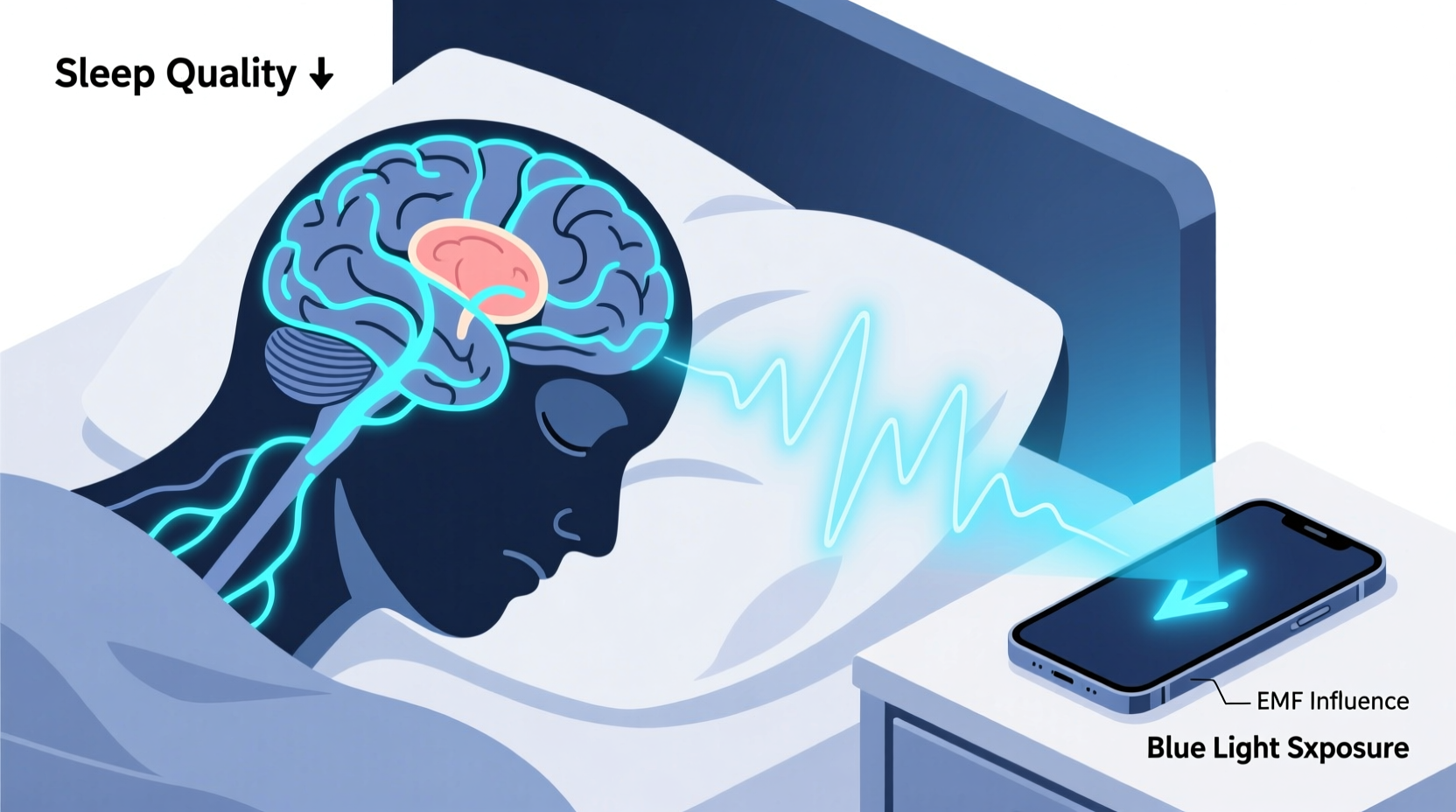
Many people fall asleep with their smartphones within arm’s reach—sometimes even under the pillow. The convenience of having immediate access to alarms, messages, or late-night entertainment is hard to resist. However, growing evidence suggests that keeping your phone close while you sleep could interfere with brain activity, disrupt sleep quality, and potentially impact long-term neurological health. This article examines the science behind electromagnetic fields (EMFs), blue light exposure, and psychological triggers linked to nighttime phone use, offering actionable steps to minimize risks without sacrificing modern connectivity.
The Science of Sleep and Brain Waves
Sleep is a complex physiological process involving multiple stages, each marked by distinct patterns of brain activity. These stages include light sleep (N1 and N2), deep sleep (N3), and rapid eye movement (REM) sleep. During these phases, the brain cycles through different wave frequencies: delta waves dominate deep sleep, theta waves appear in light sleep, and beta/gamma waves increase during REM.
Any external disruption—such as noise, light, or electromagnetic interference—can alter this rhythm. The brain remains highly sensitive during sleep, continuously processing environmental stimuli even when unconscious. This sensitivity raises concerns about prolonged exposure to devices emitting radiofrequency radiation and artificial light, especially when placed near the head for hours each night.
“Even subtle disruptions during sleep can impair memory consolidation, emotional regulation, and cognitive performance the next day.” — Dr. Lena Patel, Neurologist and Sleep Researcher at Stanford University
Electromagnetic Fields (EMFs) and Brain Function
Smartphones emit low levels of non-ionizing radiation in the form of radiofrequency electromagnetic fields (RF-EMFs). While not powerful enough to break chemical bonds like ionizing radiation (e.g., X-rays), RF-EMFs are absorbed by body tissues closest to the device—especially the brain when the phone is held or kept near the head.
A 2020 review published in *Environmental Health Perspectives* analyzed over 30 studies on mobile phone radiation and neural activity. It found consistent but small increases in cortical excitability and altered alpha-wave patterns during sleep following nighttime EMF exposure. Although these changes were not immediately harmful, researchers cautioned against chronic exposure due to potential cumulative effects on neuronal stability.
One notable study conducted at the University of California, Berkeley, used EEG monitoring on participants who slept with phones either powered on beside them or turned off across the room. Those exposed to active phones showed reduced slow-wave (delta) activity during deep sleep—a critical phase for physical restoration and immune function.
Blue Light and Circadian Rhythm Disruption
Perhaps the most well-documented effect of sleeping near a phone is the impact of blue light emitted from screens. Blue wavelengths suppress melatonin production—a hormone essential for regulating the sleep-wake cycle. Exposure just 30 minutes before bed can delay melatonin onset by up to 90 minutes, according to research from Harvard Medical School.
But the problem doesn’t end once you put the phone down. Notifications lighting up the screen throughout the night—even briefly—can fragment sleep architecture. Each time the brain detects light, it interprets it as a signal to remain alert, reducing overall sleep efficiency.
A real-world example illustrates this clearly: Sarah, a 32-year-old marketing manager, struggled with unrefreshing sleep despite going to bed at 10:30 PM consistently. After tracking her habits, she realized her phone received an average of seven notifications per night—mostly emails and social media alerts. When she began charging her phone outside the bedroom and using a traditional alarm clock, her self-reported sleep quality improved within two weeks. Follow-up sleep tracking revealed a 22% increase in deep sleep duration.
How Blue Light Affects Melatonin Levels
| Exposure Duration | Melatonin Suppression | Sleep Onset Delay |
|---|---|---|
| 15 minutes | ~15% | 10–15 minutes |
| 30 minutes | ~30% | 30–45 minutes |
| 60+ minutes | Up to 50% | 60+ minutes |
Data derived from clinical trials measuring salivary melatonin levels after evening screen exposure.
Psychological Triggers and Sleep Fragmentation
Beyond biological factors, the mere presence of a smartphone introduces psychological stressors that affect brain activity. The anticipation of incoming messages creates a state of hyper-vigilance known as \"sleep texting\" or \"phantom vibration syndrome,\" where individuals wake up believing their phone has buzzed—even when it hasn’t.
This conditioned response activates the limbic system, particularly the amygdala, which governs emotional reactions. Repeated micro-arousals prevent the brain from entering sustained periods of restorative sleep. Over time, this can contribute to increased anxiety, lower mood resilience, and impaired daytime focus.
A 2022 study from the University of Toronto followed 120 adults over six months, comparing those who kept phones in the bedroom versus those who didn’t. Participants with phones nearby reported higher nighttime awakenings (average 2.7 vs. 1.2 times per night) and scored worse on morning cognitive tests assessing attention and working memory.
Do’s and Don’ts: Phone Habits Before Bed
| Do | Don't |
|---|---|
| Use blue light filters after sunset | Scroll social media in bed |
| Set a digital curfew 60 minutes before sleep | Sleep with phone under pillow |
| Enable “Do Not Disturb” mode | Check work emails late at night |
| Charge phone in another room | Use phone as primary alarm |
Minimizing Risk: A Step-by-Step Guide
If you're concerned about how your phone might be affecting your brain during sleep, consider implementing the following routine. Small, consistent changes can lead to measurable improvements in both sleep quality and mental clarity.
- Establish a Digital Curfew: Choose a cutoff time—ideally 60 minutes before bed—to stop using all screens. Replace scrolling with reading, journaling, or gentle stretching.
- Relocate Your Phone: Charge your device in another room. If you need an alarm, invest in a standalone alarm clock.
- Enable Airplane Mode: If you must keep the phone nearby (e.g., for emergencies), switch it to airplane mode to disable RF emissions and Wi-Fi signals.
- Turn Off Notifications: Disable non-essential alerts, especially those unrelated to safety or health.
- Use Night Settings: Activate built-in features like Night Shift (iOS) or Blue Light Filter (Android) to reduce screen intensity in the evening.
- Practice Mindful Detachment: Reflect on your dependency on constant connectivity. Ask yourself: Is immediate access worth compromised rest?
Frequently Asked Questions
Can phone radiation cause brain tumors?
Current scientific consensus, including reviews by the World Health Organization (WHO) and the American Cancer Society, indicates no conclusive evidence linking normal mobile phone use to brain tumors. However, the International Agency for Research on Cancer classifies RF-EMFs as \"possibly carcinogenic\" based on limited findings, warranting precautionary measures—especially among children and adolescents whose brains are still developing.
Is airplane mode enough to protect my brain during sleep?
Airplane mode significantly reduces RF-EMF emissions by disabling cellular, Wi-Fi, and Bluetooth connections. While it doesn’t eliminate all electronic fields (the device still uses minimal power), it lowers exposure to nearly negligible levels. For maximum protection, combine airplane mode with distance—placing the phone several feet away or across the room.
What if I need my phone nearby for emergencies?
In cases where medical conditions or caregiving responsibilities require immediate access, keep the phone on airplane mode and manually enabled for emergency calls. Alternatively, use a secondary device like a smartwatch set to vibrate only for urgent contacts. You can also designate a family member to call repeatedly if needed—the first ring won’t disturb sleep, but persistent ringing will eventually wake you.
Expert Insight on Long-Term Implications
While short-term effects of sleeping near phones are relatively mild, experts warn that decades of nightly exposure could have unforeseen consequences. As Dr. Rajiv Mehta, a neuroscientist at Johns Hopkins, explains:
“We’re conducting an uncontrolled global experiment with wireless technology. We know EMFs interact with neural tissue. We know sleep is foundational for brain detoxification via the glymphatic system. Interfering with either—especially over years—could accelerate neurodegenerative risks we don’t yet fully understand.” — Dr. Rajiv Mehta, PhD, Neuroscience Division, Johns Hopkins Medicine
He emphasizes that prevention is key: “It’s not about fear-mongering. It’s about applying the precautionary principle—simple behavioral tweaks today may safeguard cognitive health tomorrow.”
Conclusion and Call to Action
Sleeping with your phone nearby may seem harmless, but the combined effects of electromagnetic fields, blue light, and psychological arousal can subtly reshape brain activity and degrade sleep quality over time. While more long-term human studies are needed, existing evidence supports minimizing nighttime exposure as a sensible, low-cost strategy for better rest and brain health.
You don’t need to give up your smartphone entirely—just reframe its role in your sleep environment. Start tonight: charge your phone in the kitchen, read a book instead of browsing, and let your brain enter sleep without digital interference. Small shifts compound into lasting wellness. Share your experience in the comments below—how has changing your phone habits affected your sleep? Your story could inspire someone else to make the same empowering change.




 浙公网安备
33010002000092号
浙公网安备
33010002000092号 浙B2-20120091-4
Comments
No comments yet. Why don't you start the discussion?