
For many aspiring Japanese learners, anime is more than entertainment—it’s a gateway to the language. With its vivid dialogue, cultural nuances, and emotional storytelling, anime offers an engaging alternative to traditional textbooks. But does it genuinely contribute to language acquisition? The answer isn't a simple yes or no. While anime can be a valuable supplement in language learning, its effectiveness depends on how it's used, the learner’s level, and the learning strategy applied.
Immersion through media has long been recognized as a powerful tool in language education. However, anime presents unique challenges and opportunities. Unlike formal instruction, anime uses exaggerated expressions, slang, archaic phrases, and regional dialects that may not reflect everyday spoken Japanese. At the same time, consistent exposure to native speech patterns, intonation, and vocabulary in context can accelerate listening comprehension and cultural understanding.
This article examines whether watching anime truly improves Japanese language skills, explores best practices for leveraging it effectively, and provides actionable insights for learners at all levels.
The Cognitive Benefits of Immersive Media
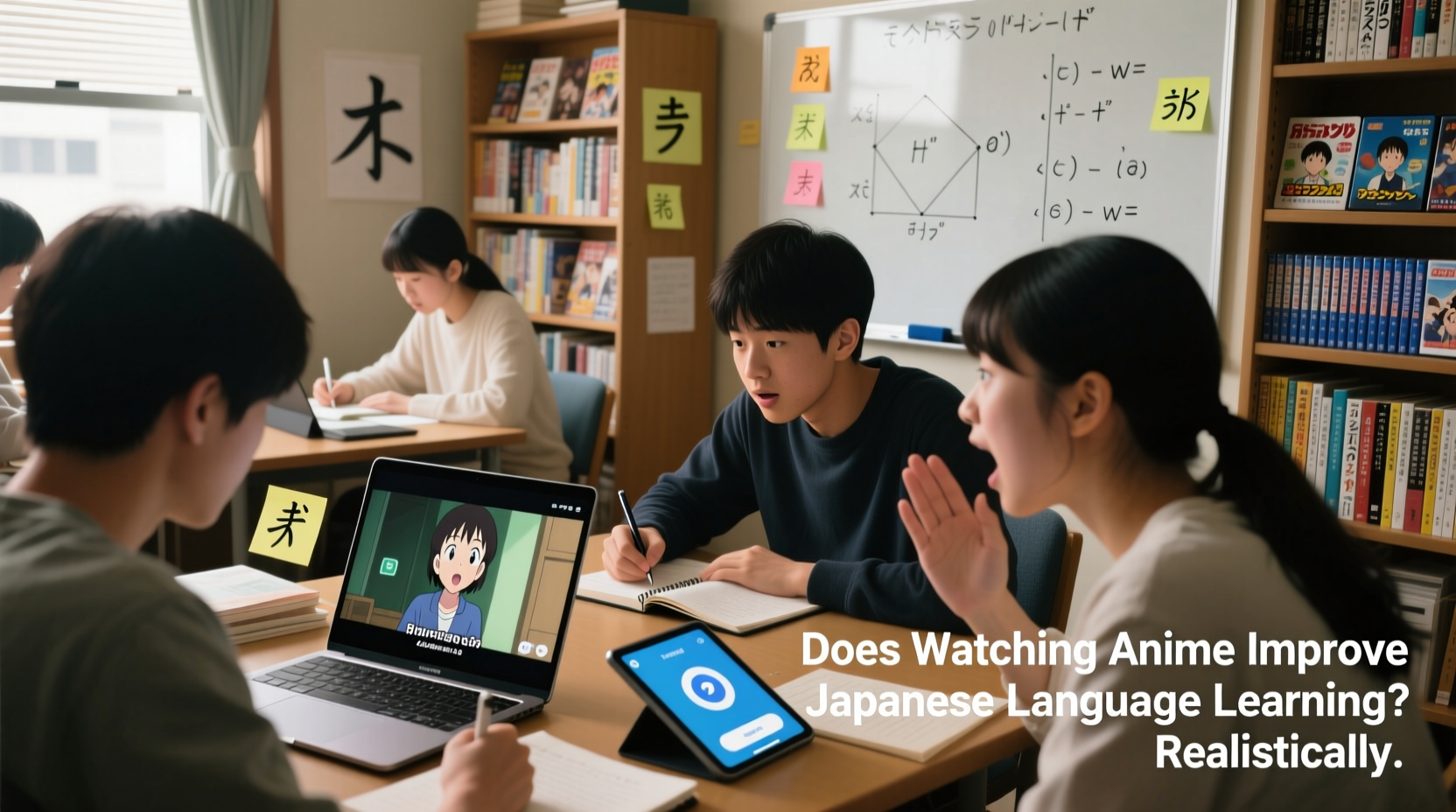
Language learning isn’t just about memorizing grammar rules and vocabulary lists—it’s about developing the ability to process and produce meaningful communication. Immersive media like anime stimulate multiple cognitive pathways: auditory processing, contextual inference, and pattern recognition. When learners hear Japanese spoken naturally—even in fictional settings—they begin subconsciously absorbing sentence structures, common particles, and conversational rhythms.
Research supports the idea that passive exposure to a target language enhances implicit learning. A 2019 study published in *Language Learning & Technology* found that learners who regularly consumed authentic audiovisual content showed measurable gains in listening comprehension and vocabulary retention over time. Anime, when paired with active learning techniques, can function as a form of “soft immersion,” especially for beginners and intermediate learners without access to native-speaking environments.
However, passive viewing alone rarely leads to fluency. Without deliberate engagement—such as note-taking, repetition, or shadowing—the brain treats anime more like background noise than a learning resource. The key lies in transforming passive consumption into active practice.
How Anime Helps—and Where It Falls Short
Anime offers several advantages for language learners, but it also comes with significant caveats. Understanding both sides allows learners to use it strategically rather than relying on it exclusively.
Advantages of Using Anime for Learning
- Natural speech patterns: Native speakers voice characters, exposing learners to authentic pronunciation, pitch accent, and rhythm.
- Contextual vocabulary: Words are tied to visual cues and situations, aiding memory retention.
- Cultural literacy: Learners absorb social norms, honorifics, humor, and idioms embedded in dialogue.
- Motivation boost: Enjoyable content increases consistency, which is critical for long-term progress.
Limits and Risks of Relying on Anime
- Non-standard language: Characters often use dramatic, archaic, or gender-specific speech not common in daily conversation.
- Overuse of slang and contractions: Phrases like “baka” or “teme” are frequent but socially inappropriate in real-life interactions.
- Poor audio clarity: Background music, sound effects, or fast delivery can hinder comprehension.
- Lack of feedback: Without correction, learners may internalize incorrect grammar or pronunciation.
“Anime can spark interest and build listening stamina, but it should complement—not replace—structured study.” — Dr. Yuki Tanaka, Applied Linguist at Osaka University
Strategic Use: Turning Anime Into a Learning Tool
To maximize the educational value of anime, learners must shift from passive viewers to active participants. This involves setting clear goals, selecting appropriate content, and integrating supplementary activities.
Selecting the Right Anime
Not all anime are created equal for language learning. Choose series with:
- Everyday settings (e.g., school, workplace, family life)
- Clear, natural dialogue (avoid fantasy-heavy shows with made-up terms)
- Moderate speaking pace
- Minimal use of onomatopoeia or niche jargon
Recommended beginner-friendly titles include *Shirokuma Cafe* (The Polar Bear Café), *Chi’s Sweet Home*, and *Manabi Line*. These feature simple language, realistic scenarios, and slower pacing ideal for comprehension building.
Active Viewing Techniques
Passive watching yields minimal results. Instead, adopt these methods:
- Use dual subtitles: Watch with Japanese subtitles (if available) alongside English to connect written and spoken forms.
- Pause and repeat: Stop after key lines, replay them, and try to mimic pronunciation and intonation.
- Take notes: Jot down new words, phrases, or grammar points. Review them later.
- Shadowing: Speak along with characters in real time to improve fluency and rhythm.
- Summarize scenes: After each episode, write or speak a short summary in Japanese.
| Technique | Best For | Frequency |
|---|---|---|
| Dual Subtitles | Vocabulary acquisition, reading-listening sync | Every session |
| Shadowing | Pronunciation, fluency, pitch training | 3–4 times per week |
| Note-Taking | Retention, grammar observation | Per episode |
| Episode Summary | Output practice, comprehension check | Once per episode |
Realistic Case Study: From Beginner to Intermediate via Anime
Consider the case of Alex, a university student in Canada with no prior Japanese knowledge. Motivated by a love for Studio Ghibli films, Alex began studying Japanese formally using textbooks and apps. After three months, progress plateaued due to limited listening practice.
Alex then incorporated *Doraemon* episodes into daily routines—watching one 10-minute segment every morning with Japanese subtitles. He paused frequently to repeat lines and recorded five new words per episode in a digital flashcard app. Every weekend, he rewrote the plot of one episode in simple Japanese.
After six months, Alex noticed marked improvement in listening comprehension. He could follow basic conversations in beginner podcasts and understood common classroom instructions without translation. His vocabulary grew by over 600 words, many learned through repeated exposure in anime contexts. While he still struggled with kanji and complex grammar, his confidence in speaking and understanding spoken Japanese increased significantly.
This example illustrates that anime, when integrated systematically, can bridge the gap between textbook learning and real-world comprehension. However, success stemmed not from watching alone, but from structured reinforcement.
Actionable Checklist: How to Learn Japanese Effectively with Anime
To ensure your anime habit translates into real language growth, follow this checklist:
- ✅ Choose anime with everyday dialogue and realistic settings
- ✅ Limit viewing sessions to 20–30 minutes for focused learning
- ✅ Enable Japanese subtitles whenever possible
- ✅ Keep a dedicated notebook or digital document for new vocabulary
- ✅ Shadow at least three key lines per episode
- ✅ Rewatch episodes weekly to reinforce retention
- ✅ Supplement with grammar study and writing practice
- ✅ Avoid relying solely on romaji; transition to kana and kanji early
- ✅ Track progress monthly with self-assessments or recordings
- ✅ Join online communities to discuss episodes in Japanese
Frequently Asked Questions
Can I become fluent just by watching anime?
No. While anime improves listening skills and vocabulary, fluency requires balanced development in reading, writing, speaking, and formal grammar. Relying only on anime leads to gaps in practical communication and may reinforce unnatural speech patterns.
Should I watch anime with English or Japanese subtitles?
Start with English subtitles to grasp context, but transition to Japanese subtitles as soon as possible. Reading hiragana, katakana, and kanji while hearing the audio strengthens literacy and listening simultaneously. Avoid watching without any subtitles until you’re at an intermediate level.
What if I don’t understand anything at first?
This is normal. Begin with children’s anime or slice-of-life genres that use simpler language. Pair viewing with beginner resources like NHK Easy Japanese or graded readers. Focus on catching small phrases—like “arigatou” or “daijoubu”—and build from there.
Conclusion: A Valuable Tool, Not a Shortcut
Watching anime can indeed improve Japanese language learning—but only when done intentionally. It excels as a motivational tool and a source of authentic input, helping learners tune their ears to native speech and absorb cultural context. However, treating anime as a standalone method sets unrealistic expectations.
The most successful learners combine anime with structured study: vocabulary drills, grammar exercises, speaking practice, and writing. They treat each episode as a mini-language lab, extracting value through repetition, note-taking, and active recall. Over time, this layered approach transforms entertainment into education.
If you're passionate about Japanese and enjoy anime, leverage that passion wisely. Pick one show, apply the techniques outlined here, and track your progress over the next 90 days. You might be surprised at how much further you go—not because you watched more, but because you engaged deeply.




 浙公网安备
33010002000092号
浙公网安备
33010002000092号 浙B2-20120091-4
Comments
No comments yet. Why don't you start the discussion?