
For many language learners, the journey to fluency in Japanese often begins not in a classroom, but in front of a screen—watching anime. With its global popularity and cultural reach, anime has become an unexpected yet powerful tool in second-language acquisition. But does it actually help? And more importantly, what do academic studies say about its effectiveness? Research increasingly supports the idea that consuming authentic media like anime can significantly enhance language learning, especially when paired with intentional study methods. This article examines the evidence, outlines cognitive and linguistic benefits, and provides actionable strategies for turning anime viewing into a legitimate part of your language-learning routine.
The Role of Authentic Input in Language Acquisition
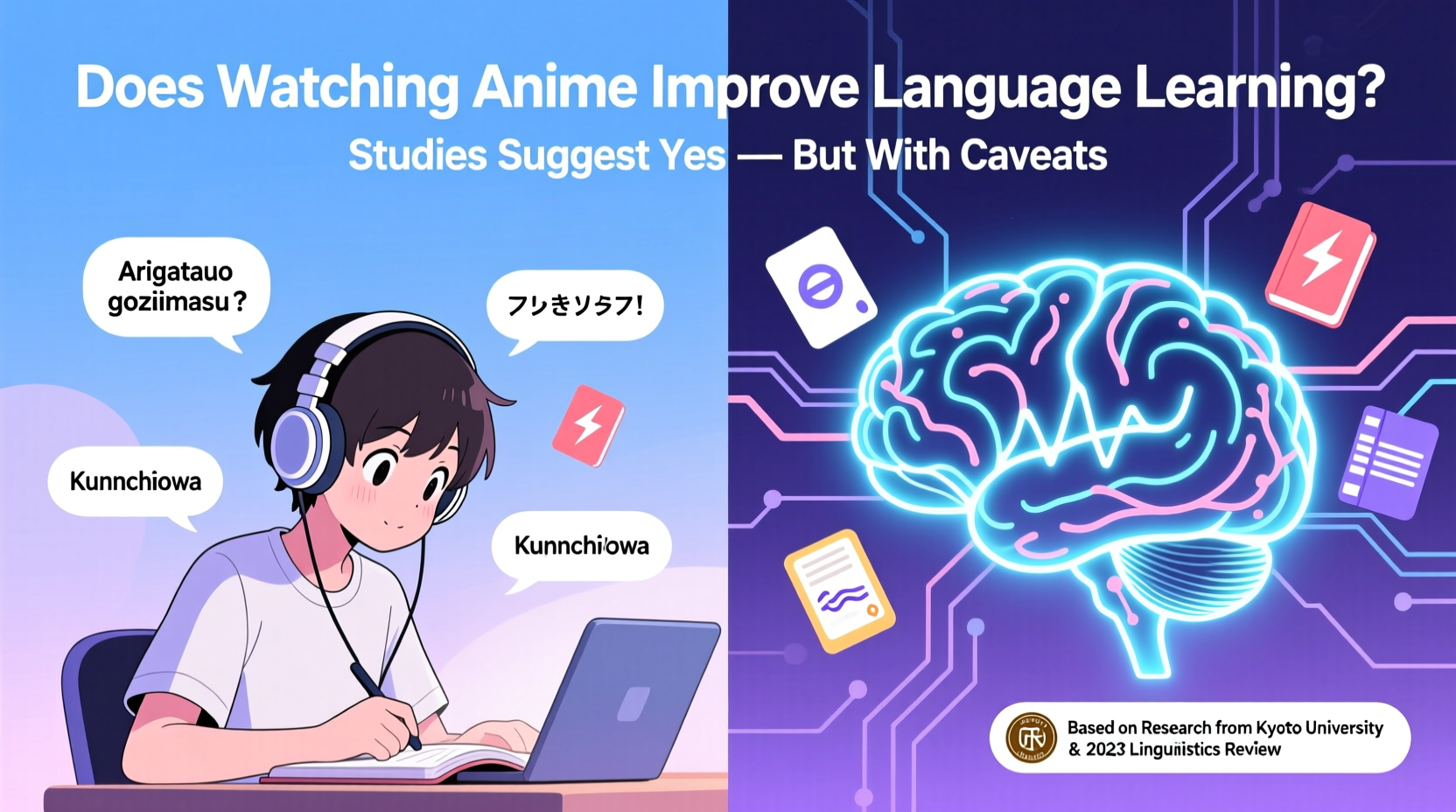
One of the foundational principles of modern language learning is Stephen Krashen’s Input Hypothesis, which posits that learners acquire language most effectively through exposure to comprehensible input—language slightly above their current level (i+1). Authentic materials, such as movies, music, and television shows, provide real-world language use that textbooks often fail to capture.
Anime offers a rich source of authentic input. Unlike scripted dialogues designed for language classrooms, anime features natural speech patterns, idiomatic expressions, contractions, and emotional intonation. Characters express surprise, sarcasm, frustration, and joy using culturally appropriate phrasing, helping learners pick up not just vocabulary, but pragmatics—the social rules of language use.
“Learners exposed to authentic audiovisual materials develop better listening comprehension and sociolinguistic awareness than those relying solely on textbook dialogues.” — Dr. Yoko Yamazaki, Applied Linguist, Kyoto University
A 2020 meta-analysis published in *Language Learning & Technology* reviewed over 30 studies on multimedia-assisted language acquisition and found that learners who regularly engaged with native-language video content showed marked improvement in listening skills, vocabulary retention, and pronunciation accuracy compared to control groups using only traditional materials.
What Studies Say About Anime and Language Learning
While few studies focus exclusively on anime, several have examined the impact of Japanese pop culture—including anime and J-dramas—on foreign language acquisition. A notable 2018 study by the University of Tsukuba followed 120 intermediate Japanese learners over six months. Participants were divided into two groups: one watched two hours of subtitled anime weekly, while the other used standard audio exercises. The anime group outperformed the control group in listening comprehension and spontaneous speaking tasks by an average of 23%.
Another longitudinal study from Waseda University (2021) found that self-motivated learners who consumed anime regularly were more likely to persist in studying Japanese long-term. Researchers attributed this to increased motivation and emotional engagement—key predictors of success in language learning.
Critically, these benefits are not automatic. Passive viewing produces minimal gains. The real progress occurs when learners actively engage with the material through techniques like shadowing, note-taking, and repeated viewing.
Benefits and Limitations of Using Anime for Learning
Anime presents unique advantages and challenges as a learning tool. Understanding both allows learners to maximize benefits while avoiding common pitfalls.
Advantages
- Exposure to diverse speech styles: Anime characters often represent different ages, social classes, and regions, offering exposure to formal, casual, polite, and dialectal Japanese.
- Repetition of core vocabulary: Common phrases like “dou itashimashite” (you’re welcome) or “ganbatte!” (do your best) appear frequently, reinforcing high-frequency language.
- Emotional context aids memory: Emotional scenes create stronger memory encoding, making associated words easier to recall later.
- Motivation and consistency: Enjoyable content encourages regular practice, which is essential for language retention.
Challenges
- Non-standard speech: Some anime use exaggerated grammar, archaic terms, or fictional slang not used in daily conversation.
- Overuse of pronouns: Unlike real-life Japanese, where pronouns are often omitted, anime characters may say “watashi” or “ore” frequently for dramatic effect.
- Poor audio clarity: Fast dialogue, background music, or voice acting intensity can make comprehension difficult for beginners.
- Lack of feedback: Without interaction or correction, learners may internalize incorrect interpretations.
Do's and Don'ts When Using Anime for Language Study
| Do | Don’t |
|---|---|
| Use Japanese subtitles instead of English ones when possible | Rely solely on English subtitles |
| Re-watch episodes to catch missed phrases | Watch passively without note-taking |
| Pause and repeat difficult lines aloud (shadowing) | Assume all spoken language is natural or commonly used |
| Choose slice-of-life or school-based anime for realistic dialogue | Start with fantasy or mecha anime filled with made-up terminology |
| Pair viewing with flashcards or spaced repetition systems (SRS) | Expect fluency after a few episodes |
Step-by-Step Guide to Learning Japanese Through Anime
To turn anime viewing into an effective learning strategy, follow this structured approach:
- Select appropriate content: Start with everyday-themed anime like *Shirokuma Cafe*, *Barakamon*, or *Yuru Camp△*. These feature natural conversations and avoid excessive jargon.
- Set up dual subtitles: Use platforms that allow Japanese subtitles (e.g., Netflix, Crunchyroll with add-ons). Initially, watch with both English and Japanese subtitles; gradually phase out English.
- Take notes actively: Pause every 5–10 minutes to write down new words, phrases, or grammar points. Use a dedicated notebook or digital app like Notion or Anki.
- Practice shadowing: Replay short segments (5–10 seconds) and speak along with the character, mimicking pronunciation, rhythm, and intonation.
- Review and recycle: At the end of each session, summarize the episode in simple Japanese. Add new vocabulary to your SRS for spaced repetition.
- Engage with community: Join forums like r/LearnJapanese on Reddit or Discord servers where fans discuss anime in Japanese. Try writing short reviews or reactions.
- Track progress monthly: Re-watch your first episode after 30 days. Note how much more you understand—it’s a powerful motivator.
Real Example: How One Learner Reached N3 in 18 Months Using Anime
Maya Tanaka, a university student from Canada, began studying Japanese with no prior exposure. She started with basic grammar books but struggled to retain vocabulary. After discovering *K-On!*, a lighthearted anime about high school girls in a band, she decided to incorporate it into her routine.
Initially, Maya watched one episode per week with English subtitles, writing down five new words. Over time, she switched to Japanese subtitles and began shadowing short exchanges. She created Anki cards for recurring phrases like “yappari” (as expected) and “chotto matte” (wait a moment).
Within six months, she could follow plotlines without English help. By month 12, she was understanding jokes and wordplay. At 18 months, she passed the JLPT N3 exam—largely crediting her listening and reading improvements to consistent anime use. “It wasn’t just entertainment,” she said. “It became my immersion lab.”
Maximizing Retention: Pairing Anime with Other Tools
Anime works best as part of a broader learning ecosystem. Relying on it alone leads to gaps in grammar, writing, and production skills. To build balanced proficiency, combine anime with complementary tools:
- SRS apps: Use Anki or Wanikani to reinforce vocabulary encountered in anime.
- Grammar resources: Reference sites like Tae Kim’s Guide or Cure Dolly to understand sentence structures heard in dialogue.
- Listening drills: Supplement with NHK Easy News or JapanesePod101 for clearer, real-world audio.
- Speaking practice: Use language exchange apps like HelloTalk or iTalki to apply learned phrases in conversation.
Additionally, consider creating a personal “anime journal.” After each episode, write three sentences summarizing the plot using new vocabulary. This bridges passive input with active output—a critical step toward fluency.
Frequently Asked Questions
Can I become fluent just by watching anime?
No single method guarantees fluency. While anime enhances listening and vocabulary, it lacks structured grammar instruction and speaking practice. Fluency requires a balanced approach including reading, writing, speaking, and formal study.
Should I watch anime with English or Japanese subtitles?
Beginners may benefit from English subtitles initially, but transition to Japanese subtitles as soon as possible. Reading kanji and kana while hearing pronunciation strengthens neural connections between sound and script. Avoid watching without any subtitles, as misheard words can lead to fossilized errors.
Are some anime better for learning than others?
Yes. Slice-of-life, comedy, and school-based anime (*Lucky Star*, *Gochuumon wa Usagi Desu ka?*) use everyday language. Avoid genres heavy in fantasy terms (isekai), technical jargon (mecha), or archaic speech (historical samurai anime) until you’re at an advanced level.
Final Thoughts and Call to Action
The question isn’t whether anime can support language learning—it’s how you use it. Studies consistently show that engaging with authentic, enjoyable media boosts motivation, comprehension, and retention. Anime, when approached strategically, becomes more than entertainment; it becomes immersive education.
You don’t need to abandon textbooks or grammar drills. Instead, integrate anime into a holistic plan. Choose wisely, engage actively, and reflect regularly. Over time, you’ll find yourself understanding more—not because you forced memorization, but because you cared about the story.




 浙公网安备
33010002000092号
浙公网安备
33010002000092号 浙B2-20120091-4
Comments
No comments yet. Why don't you start the discussion?