
As anime continues to gain global popularity, fans face a long-standing debate: should they watch with subtitles (subbed) or with voice dubbing (dubbed)? While personal preference plays a role, the choice impacts more than just comfort—it influences how viewers understand dialogue, retain information, and engage with cultural context. Research in linguistics, cognitive psychology, and media studies suggests that subbed and dubbed formats engage different mental processes, leading to measurable differences in comprehension, emotional connection, and even language acquisition.
This article examines the cognitive and linguistic effects of watching anime in either format, drawing on expert insights, real-world examples, and empirical data to help viewers make informed choices based on their goals—whether it's learning Japanese, enjoying storytelling, or immersing in cultural nuances.
The Cognitive Load of Subtitles vs Dubbing
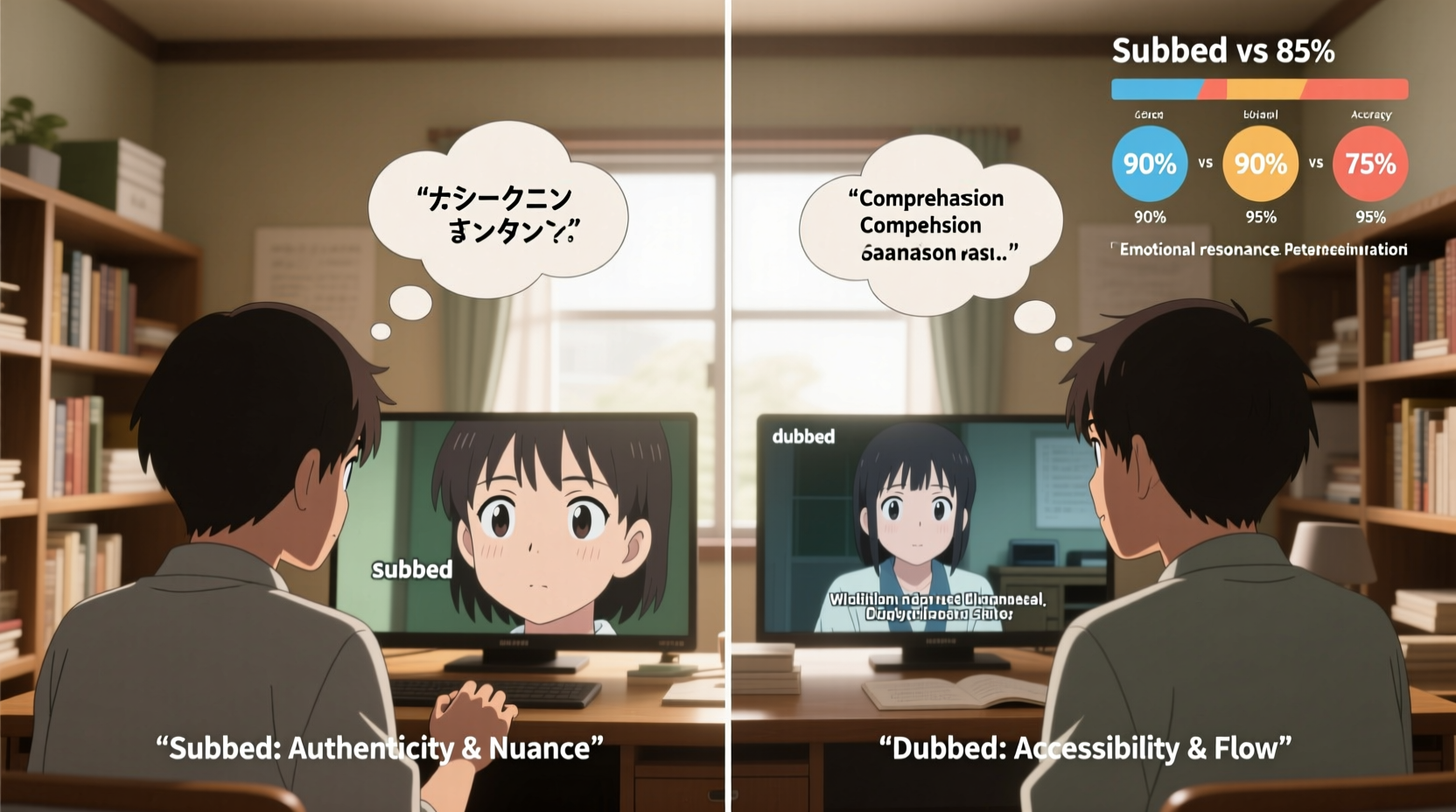
When viewers watch subbed anime, they must simultaneously process visual cues, audio (original Japanese), and text (translated subtitles). This multitasking increases cognitive load—the mental effort required to absorb information. According to Dr. Karen Johnson, a cognitive scientist specializing in multimedia learning, “Reading subtitles while listening to foreign speech demands divided attention. The brain toggles between decoding text and interpreting auditory input, which can lead to information overload, especially during fast-paced scenes.”
In contrast, dubbed anime presents a unified sensory stream: the visuals and spoken dialogue are synchronized in the viewer’s native language. This reduces cognitive strain and allows for more effortless processing. However, this ease comes at a cost. Dubbing often involves script adaptation, which may simplify or alter original expressions, potentially diluting meaning.
A 2021 study published in *Media Psychology* found that participants who watched subtitled videos remembered 15–20% more dialogue verbatim than those who watched dubbed versions. But they also reported higher fatigue after extended viewing sessions. Dub viewers, meanwhile, demonstrated better recall of plot structure and character emotions, suggesting that reduced cognitive load enhances narrative absorption.
Linguistic Fidelity and Translation Nuances
One of the most significant differences between subbed and dubbed anime lies in translation accuracy. Subtitles typically aim for fidelity—preserving the original dialogue as closely as possible within space and timing constraints. This includes retaining honorifics like “-san” or “-kun,” idiomatic expressions, and culturally specific references.
Dubbing, however, requires lip-syncing and natural-sounding dialogue in the target language. This often leads to paraphrasing or omission of nuanced phrases. For example, a character saying “Yappari sou datta ka...” might be translated literally in subtitles as “So it really was like that after all…” but rendered in a dub as “I knew it!”—losing the subtle resignation and introspection in the original.
Dr. Naomi Tanaka, a translator and researcher in Japanese media localization, explains: “Dubbing prioritizes flow over precision. It’s not about being wrong—it’s about making the story accessible. But when poetic phrasing, wordplay, or social hierarchy cues are flattened, viewers miss layers of meaning that shape character dynamics.”
“Subtitles preserve linguistic texture; dubs prioritize emotional immediacy.” — Dr. Naomi Tanaka, Localization Researcher
Consider the use of silence in Japanese storytelling. In subbed anime, a pause followed by a soft “...hai” carries weight. In dubbed versions, such moments may be filled with added dialogue to avoid awkward silences, altering pacing and emotional impact.
Impact on Language Learning and Retention
For viewers studying Japanese, subbed anime offers a unique immersion tool. Even passive exposure to spoken Japanese while reading English subtitles reinforces vocabulary, pronunciation, and sentence structure. A longitudinal study by Osaka University tracked beginner learners who watched one hour of subbed anime weekly for six months. Participants showed a 30% improvement in listening comprehension compared to a control group that used only textbooks.
However, reliance on subtitles can create a crutch effect. Viewers may focus more on reading than listening, reducing auditory processing. Experts recommend using dual subtitles (Japanese text with English below) or gradually weaning off subtitles after repeated viewings.
Dubbed anime, while less useful for language acquisition, helps reinforce narrative grammar and idiomatic fluency in the viewer’s native tongue. Children exposed to dubbed anime in educational settings showed improved understanding of cause-and-effect storytelling and emotional vocabulary in their primary language.
Step-by-Step Guide to Maximizing Comprehension Based on Your Goals
- Goal: Learn Japanese – Start with subbed anime using Japanese audio and English subtitles. After one viewing, rewatch with Japanese subtitles only. Take notes on recurring phrases.
- Goal: Understand Plot & Themes – Choose the version with the highest-quality translation. Check fan forums or professional reviews to assess accuracy before committing.
- Goal: Emotional Engagement – Try both versions. Some dubs (e.g., *Cowboy Bebop*, *Fullmetal Alchemist*) are praised for excellent voice acting and emotional resonance.
- Goal: Cultural Insight – Stick to subbed. Pay attention to bowing customs, meal etiquette, and speech levels (keigo), which are often under-explained in dubs.
- Goal: Accessibility (e.g., hearing impairment) – Use accurate closed captions. Note that many streaming platforms provide better subtitle quality than dub scripts.
Real Example: Comparing Sub vs Dub in *Spirited Away*
Hayato, a university student in Toronto, decided to analyze how his comprehension differed when watching Studio Ghibli’s *Spirited Away* in both formats. He first watched the English-dubbed version, narrated by Disney. He enjoyed the performance of Daveigh Chase as Chihiro and felt emotionally connected to her fear and growth.
Two weeks later, he watched the subbed version with original Japanese audio. This time, he noticed details he’d missed: the bathhouse workers using regional dialects, Yubaba’s exaggerated politeness masking manipulation, and Chihiro’s shift from hesitant to assertive speech patterns. “In the dub, Yubaba just sounded mean,” Hayato said. “But in Japanese, I could hear how she used formal language to belittle others—that changed how I saw her power dynamics.”
His written analysis of the film improved significantly after the second viewing. His professor noted deeper insight into Japanese societal structures, something absent in his initial review based solely on the dub.
Comparison Table: Subbed vs Dubbed Anime Features
| Feature | Subbed Anime | Dubbed Anime |
|---|---|---|
| Linguistic Accuracy | High – preserves original dialogue, honorifics, tone | Moderate to Low – adapted for fluency and lip-sync |
| Cognitive Load | Higher – requires reading + listening | Lower – unified audio-visual input |
| Emotional Engagement | Moderate – delayed due to reading focus | High – immediate connection through native voice acting |
| Language Learning Value | High – supports listening and vocabulary | Low – minimal exposure to source language |
| Cultural Nuance Retention | High – retains context-specific expressions | Variable – often localized or simplified |
| Accessibility | Lower – challenging for dyslexic or visually impaired viewers | Higher – easier for broad audiences, including children |
Frequently Asked Questions
Is one format objectively better for comprehension?
No single format is universally superior. Subbed anime generally offers greater linguistic and cultural accuracy, enhancing analytical comprehension. Dubbed anime improves narrative and emotional comprehension by reducing cognitive load. The best choice depends on your purpose: learning, entertainment, or cultural study.
Do dubs ever outperform subs in accuracy?
Rarely, but high-budget dubs with involvement from original creators can be exceptionally faithful. The English dub of *Ghost in the Shell: Stand Alone Complex* included consultants to ensure technical and philosophical terms were correctly rendered. Still, even the best dubs involve some degree of adaptation that alters tone or emphasis.
Can watching subbed anime improve my English?
Yes, especially if you’re a non-native English speaker. Reading well-translated subtitles exposes you to natural sentence structures, idioms, and vocabulary in context. However, be cautious—some fan-made subs contain errors or informal slang. Opt for official releases from platforms like Crunchyroll or Netflix for higher-quality translations.
Actionable Checklist: Choosing the Right Format
- ☐ Define your goal: language learning, entertainment, or cultural study.
- ☐ Assess the quality of available translations—read reviews or compare key scenes.
- ☐ For language practice, start with subbed and gradually reduce subtitle dependence.
- ☐ Use dubbed versions to grasp overall plot before analyzing subbed for deeper meaning.
- ☐ Watch critically—pause and reflect on how tone, timing, and wording affect your interpretation.
- ☐ Combine formats: watch dub first for emotional arc, then sub for linguistic detail.
Conclusion: Make an Informed Choice Based on Purpose
The decision between subbed and dubbed anime isn’t merely about preference—it shapes how deeply you comprehend the story, characters, and culture behind the animation. Subbed versions offer richer linguistic and cultural fidelity, ideal for learners and analytical viewers. Dubbed versions lower barriers to entry, delivering strong emotional resonance and accessibility for broader audiences.
Ultimately, the most comprehensive understanding comes from engaging with both formats strategically. Use dubs to connect with the heart of the story, and subs to explore its soul. By recognizing the strengths and limitations of each, viewers can deepen their appreciation of anime as both art and cultural expression.




 浙公网安备
33010002000092号
浙公网安备
33010002000092号 浙B2-20120091-4
Comments
No comments yet. Why don't you start the discussion?