
In the quiet hours after dark, many of us reach for our phones without thinking. A quick glance turns into ten minutes. Ten becomes thirty. Before we know it, we’re deep in a spiral of negative headlines, social media outrage, or endless streams of crisis updates. This habit—known as doomscrolling—is more than just procrastination. It’s a psychological trap that undermines sleep, heightens anxiety, and distorts our perception of reality. Understanding why we do it is the first step toward breaking free. The second is implementing practical changes that protect your mind, especially in the crucial hour before bedtime.
The Psychology Behind Doomscrolling
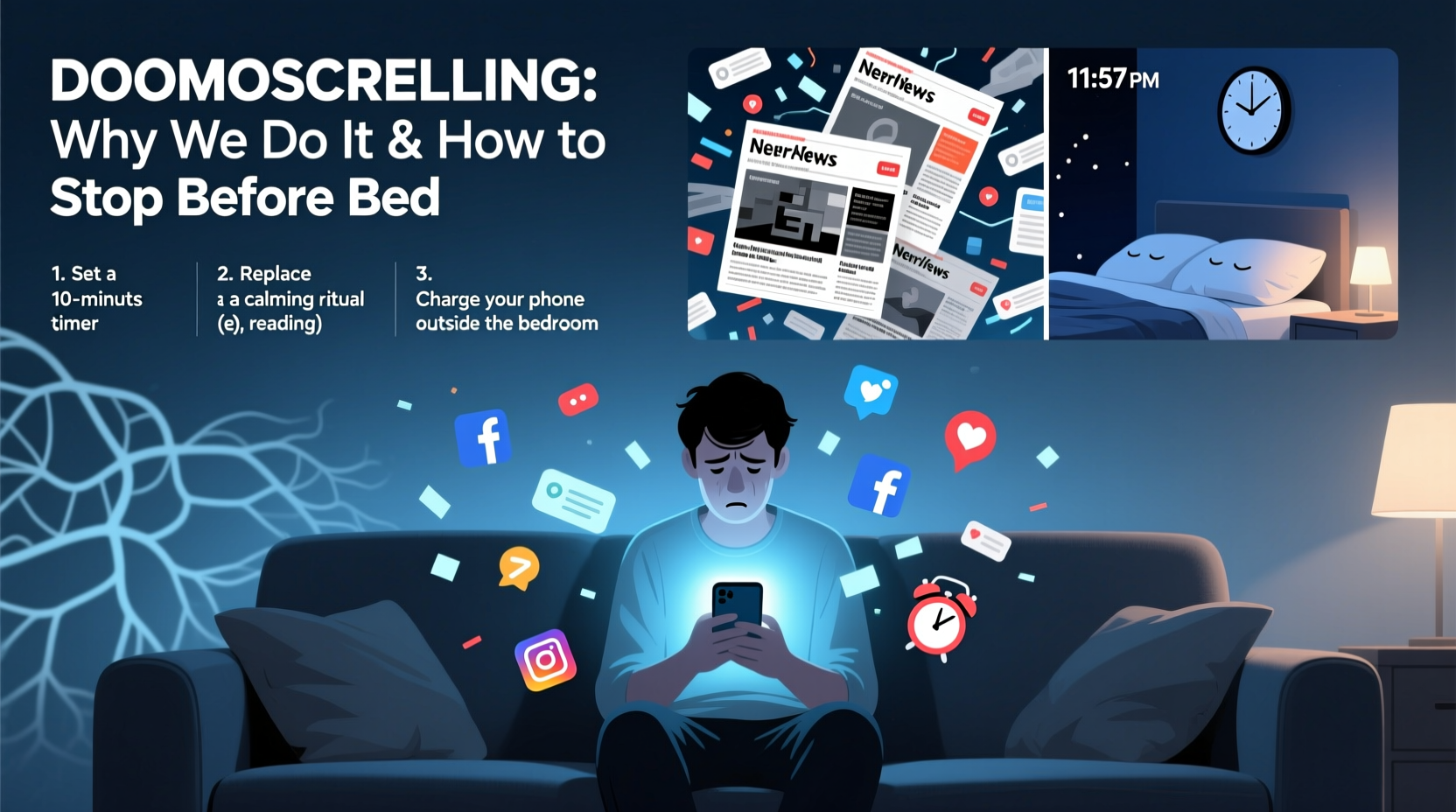
Doomscrolling isn’t a character flaw—it’s a response to how modern digital platforms are engineered. Our brains are wired to pay attention to threats. In evolutionary terms, noticing danger kept us alive. Today, that same survival instinct gets hijacked by algorithms designed to maximize engagement. Bad news spreads faster because it triggers emotional arousal. Platforms reward this with more visibility, creating a feedback loop: the more you engage with alarming content, the more you see.
Neuroscientist Dr. Anna Lembke, author of *Dopamine Nation*, explains: “The brain doesn’t distinguish between real-world threats and digital ones when it comes to stress response. Every alarming headline activates the amygdala, putting us in a state of low-grade fear.” Over time, this constant exposure conditions the brain to expect negativity, making it harder to disengage—even when we want to.
Additionally, doomscrolling often fills an emotional void. Loneliness, uncertainty, or unresolved stress can drive people toward passive consumption of information as a form of distraction. But instead of relief, the content amplifies distress. It’s not curiosity that keeps us scrolling; it’s a mix of anxiety, habit, and the illusion of being informed.
“Doomscrolling gives the false impression of control. We tell ourselves we’re staying updated, but in reality, we’re feeding a cycle of helplessness.” — Dr. Sarah Thompson, Clinical Psychologist
Why Bedtime Is the Most Vulnerable Time
The period before sleep is uniquely susceptible to doomscrolling for several reasons. First, it’s often the first time during the day when external demands pause. Work ends, kids are asleep, chores are done. That mental space, meant for relaxation, instead becomes a vacuum filled with digital noise.
Second, fatigue reduces cognitive control. Willpower is a finite resource, and by evening, most people have depleted theirs. Resisting the pull of the phone requires executive function—the very thing compromised by tiredness. What starts as “just one more post” quickly escalates because self-regulation is weakest at night.
Third, blue light from screens suppresses melatonin, the hormone responsible for sleep onset. But beyond biology, the emotional weight of consumed content disrupts mental calm. Reading about global crises or interpersonal drama right before bed primes the nervous system for alertness, not rest.
Practical Strategies to Break the Cycle
Stopping doomscrolling isn’t about willpower alone. It requires structural changes to your environment, routines, and mindset. Below are actionable steps grounded in behavioral psychology and sleep science.
1. Create a Digital Curfew
Set a fixed time—ideally 60 to 90 minutes before bed—when all screens are turned off. Use phone features like Focus Mode, Screen Time limits, or third-party apps (e.g., Freedom, StayFree) to enforce boundaries. Treat this curfew like a medical prescription: non-negotiable and essential for recovery.
2. Design a Replacement Ritual
Habits persist when they serve a purpose. Doomscrolling often replaces unwinding. So, build a new routine that fulfills the same need—relaxation, distraction, or closure. Examples include:
- Reading fiction under warm lighting
- Light stretching or breathing exercises
- Brewing herbal tea and reflecting on the day
- Listening to a calming podcast (offline, if possible)
The key is consistency. After several repetitions, your brain will begin to associate these activities with sleep preparation.
3. Audit Your Feed Aggressively
You don’t have to quit social media entirely. Instead, curate it ruthlessly. Unfollow accounts that consistently trigger anxiety or outrage. Mute keywords like “crisis,” “collapse,” or “outrage” in platform settings. Follow creators who share solutions, humor, or beauty—content that restores balance.
4. Charge Your Phone Outside the Bedroom
If your phone is within arm’s reach, temptation wins. Charge it in another room. Use a traditional alarm clock if needed. This single change removes the physical temptation and reinforces the bedroom as a tech-free sanctuary.
5. Practice the 5-Minute Rule
When you feel the urge to scroll, wait five minutes. Sit quietly, breathe, or jot down what you’re feeling. Often, the impulse passes. If it doesn’t, allow yourself two minutes—no more—to check what you need. The delay disrupts automatic behavior and reintroduces conscious choice.
| Do | Don’t |
|---|---|
| Keep a notebook by your bed for late-night thoughts | Use your phone to “quickly check” the news |
| Wear blue-light-blocking glasses if using devices | Scroll in the dark with brightness maxed |
| Use grayscale mode at night to reduce visual appeal | Engage with emotionally charged content before sleep |
| Practice a 4-7-8 breathing technique to calm the mind | Respond to messages or comments that provoke stress |
A Real-Life Example: How Mark Reduced Nighttime Anxiety
Mark, a 34-year-old project manager, noticed he was waking up exhausted despite sleeping eight hours. He’d fall asleep late, usually after an hour of scrolling through political debates and pandemic updates. His dreams were tense, and mornings began with dread.
After learning about doomscrolling, he implemented three changes: he set a digital curfew at 9:30 PM, moved his phone charger to the kitchen, and started reading short stories before bed. Within a week, he fell asleep faster. By the second week, he stopped reaching for his phone entirely. “I didn’t realize how much mental clutter I was absorbing,” he said. “Now, my mind feels quieter. I’m not solving the world’s problems at midnight anymore.”
Step-by-Step Guide to a Doomscroll-Free Evening
Breaking the habit works best with a clear sequence. Follow this timeline for seven nights to reset your routine:
- 8:00 PM: Begin winding down. Dim overhead lights and switch to lamps.
- 8:30 PM: Close work-related tabs and silence email notifications.
- 9:00 PM: Engage in a screen-free activity—knitting, journaling, or gentle yoga.
- 9:30 PM: Prepare your phone for offline mode. Enable Do Not Disturb and place it outside the bedroom.
- 10:00 PM: Read a physical book or listen to soft music. Avoid plots with high tension.
- 10:30 PM: Lights out. Practice slow breathing: inhale for four counts, hold for seven, exhale for eight.
Stick to this schedule even on weekends. Consistency trains your circadian rhythm and reduces decision fatigue.
FAQ: Common Questions About Doomscrolling
Is doomscrolling a sign of anxiety?
It can be both a symptom and a cause. People with existing anxiety may be more prone to doomscrolling, but the behavior itself increases cortisol levels and rumination, worsening anxiety over time. It creates a self-reinforcing loop that benefits neither mental clarity nor emotional stability.
Can I still stay informed without doomscrolling?
Absolutely. Set specific times during the day—such as mid-morning or early afternoon—to check reliable news sources. Limit sessions to 15–20 minutes. Avoid autoplay features and infinite feeds. Choose outlets that emphasize context over sensationalism. Being informed doesn’t require constant monitoring.
What if I use my phone for work emails at night?
Establish boundaries. If urgent communication is necessary, use a separate device or app with limited access. Better yet, communicate availability windows to colleagues. Chronic after-hours work correlates with burnout and poor sleep quality. Protecting your downtime isn’t unprofessional—it’s sustainable productivity.
Checklist: Building a Healthier Nightly Routine
Use this checklist each evening to reinforce positive habits:
- ✅ Turn off non-essential notifications after 8 PM
- ✅ Charge phone in another room
- ✅ Engage in a screen-free activity for at least 30 minutes
- ✅ Avoid news or social media after dinner
- ✅ Practice a calming ritual (reading, tea, breathing)
- ✅ Stick to a consistent bedtime
- ✅ Reflect on one positive moment from the day
Conclusion: Reclaim Your Nights, Restore Your Mind
Doomscrolling thrives in the gaps left by exhaustion, loneliness, and uncertainty. But those moments don’t have to belong to algorithms and anxiety. By understanding the forces behind the behavior and taking deliberate, structured action, you can reclaim your evenings. Sleep isn’t just downtime—it’s restoration. And what you feed your mind before bed shapes the quality of that rest.
Start small. Pick one strategy from this article—whether it’s moving your phone charger or setting a digital curfew—and commit to it for a week. Notice the shift in your mood, your focus, your peace. You don’t need to fix everything at once. You just need to begin.




 浙公网安备
33010002000092号
浙公网安备
33010002000092号 浙B2-20120091-4
Comments
No comments yet. Why don't you start the discussion?