
When it comes to bathroom fixtures, few changes have stirred as much quiet debate as the shift from traditional toilet levers to modern dual flush buttons. Once a novelty found only in high-end homes or eco-conscious builds, dual flush systems are now standard in many new constructions. But for homeowners still using — and perfectly content with — their classic metal levers, the question remains: is upgrading worth it, or is this just another overhyped trend?
The answer isn’t as simple as “yes” or “no.” It depends on your priorities: water conservation, long-term savings, maintenance habits, and even aesthetic preferences. Let’s break down both systems with real-world insights, performance data, and practical advice to help you decide whether the switch makes sense for your home.
How Each System Works
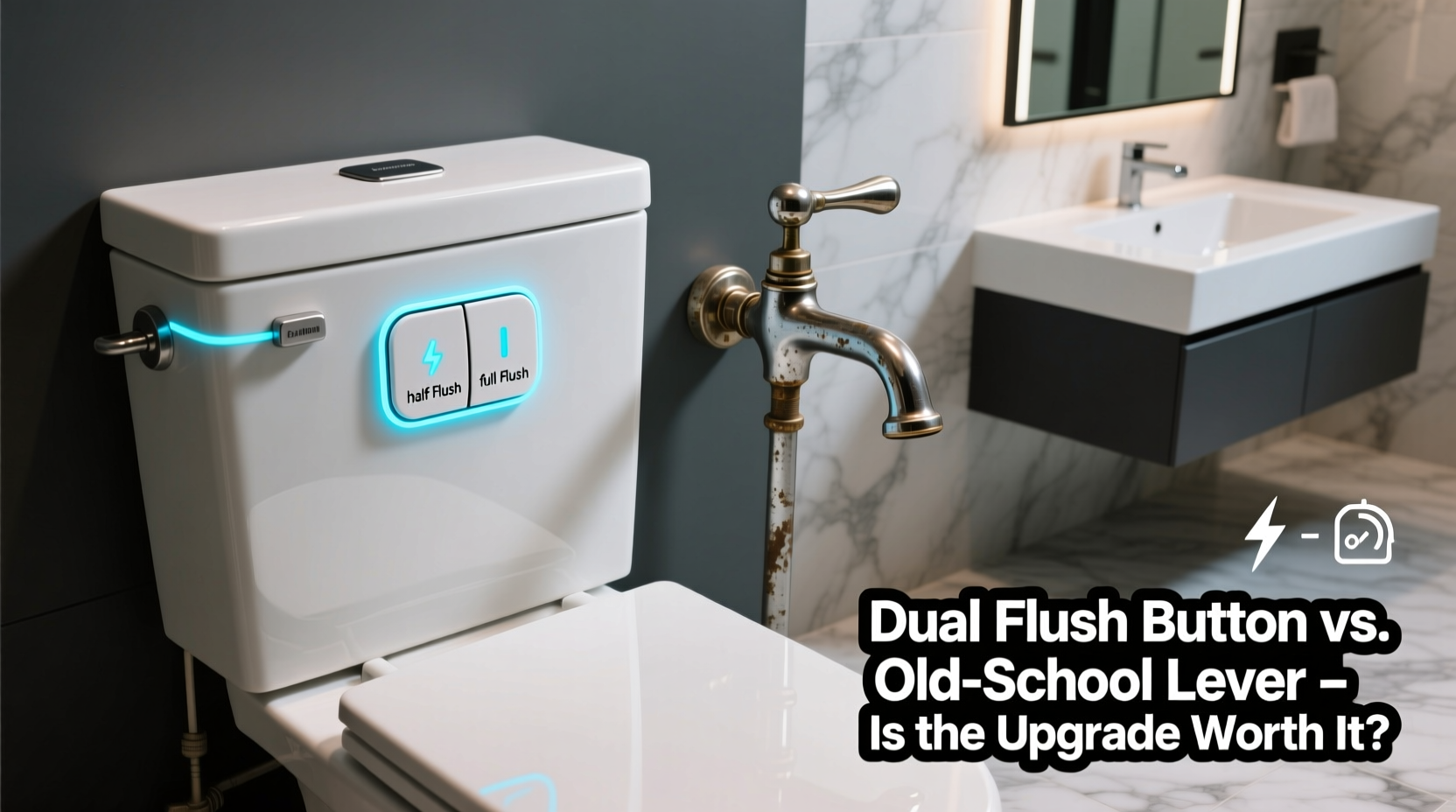
The fundamental difference between a dual flush button and an old-school lever lies in how they manage water flow during flushing.
Old-School Lever: This design uses a single handle connected via a chain or rod to the flapper inside the tank. When pulled, it lifts the flapper, releasing all the stored water into the bowl at once. The volume is fixed—typically 1.6 gallons per flush (gpf) in modern models, though older ones used up to 3.5 gpf. There’s no option to adjust the flush volume.
Dual Flush Button: Usually located on the top or front of the tank lid, these buttons offer two flush options: a half-flush (around 0.8–1.1 gpf) for liquid waste and a full flush (1.2–1.6 gpf) for solid waste. Internally, the system uses a larger trapway and a redesigned flush valve that allows partial or complete drainage depending on which button is pressed.
Water Efficiency and Environmental Impact
Water conservation is the biggest argument in favor of dual flush toilets. According to the U.S. Environmental Protection Agency (EPA), the average person flushes a toilet about five times per day. Over a year, that adds up to thousands of gallons.
A household of four using a pre-1994 toilet (3.5 gpf) could consume over 25,000 gallons annually just from flushing. In contrast, a dual flush system averaging 1.1 gpf across mixed usage can cut that by nearly two-thirds.
“Dual flush technology alone has helped reduce residential water use by 20% in retrofit homes over the past decade.” — Dr. Lena Torres, Urban Water Conservation Researcher, Pacific Institute
The EPA’s WaterSense program certifies toilets that use 1.28 gpf or less. Many dual flush models meet or exceed this standard, especially when users consistently choose the half-flush for appropriate waste.
Performance Comparison: Reliability vs. Precision
While dual flush systems win on paper, real-world performance tells a more nuanced story.
Traditional levers are mechanical, simple, and rarely fail. Pull the lever, water flows. The mechanism is easy to repair—often with a $5 flapper kit and 10 minutes of time. They’re also consistent: every flush delivers the same power, minimizing clogs in well-maintained systems.
Dual flush systems, while innovative, introduce complexity. The internal seals and dual-valve mechanisms can degrade unevenly. Some users report that the half-flush doesn’t always clear the bowl, leading to double-flushing—which negates water savings. Others complain about stiff buttons or inconsistent actuation.
However, newer models from brands like TOTO, Kohler, and American Standard have significantly improved reliability. Their engineered rim jets and wide trapways enhance siphoning power, making even low-volume flushes effective.
Cost Analysis: Upfront vs. Long-Term Savings
Replacing a working toilet isn’t cheap. Here’s a realistic breakdown:
| Factor | Old-School Lever Toilet | Dual Flush Toilet |
|---|---|---|
| Initial Cost (unit only) | $100–$200 | $250–$500+ |
| Installation Cost | $150–$300 | $150–$300 |
| Avg. Water Use (gpf) | 1.6 | 0.8–1.28 (depending on mode) |
| Annual Water Cost (4-person home) | ~$85 | ~$55–$70 |
| Expected Lifespan | 10–15 years | 10–15 years |
| Maintenance Complexity | Low | Moderate |
At first glance, the dual flush system costs more upfront. But consider long-term savings. Assuming a household saves 10,000 gallons per year and pays $0.005 per gallon (average U.S. rate), that’s $50 saved annually. Over 10 years, that’s $500—potentially offsetting the higher purchase price.
Real-World Example: The Martinez Family Retrofit
The Martinez family in Portland, Oregon, replaced two aging 3.5-gpf toilets with WaterSense-rated dual flush models in 2021. Before the switch, their water bill averaged $98/month. After installation, it dropped to $82/month—despite increased household usage due to a newborn.
They initially struggled with the half-flush not clearing solids, but after adjusting usage habits (using full flush for solid waste), they saw consistent performance. Within 18 months, their water savings covered the cost of one toilet after factoring in a $75 city rebate.
“We didn’t do it for the money,” says Maria Martinez. “We did it because our old toilets were guzzling water. Now we feel like we’re doing our part—and the buttons are actually kind of satisfying to press.”
Common Misconceptions About Dual Flush Systems
- Myth: Dual flush means weak flush. Reality: Modern designs use pressure-assisted or gravity-boosted systems to maintain power even at lower volumes.
- Myth: You’ll always need to double-flush. Reality: Properly designed models clear waste effectively when used correctly.
- Myth: Levers are more durable. Reality: While simpler, levers can corrode or stick; dual flush components are often made of durable plastic and sealed against moisture.
Checklist: Should You Upgrade?
Use this checklist to determine if switching to a dual flush toilet is right for your situation:
- ✅ Is your current toilet older than 1994 (using >1.6 gpf)?
- ✅ Do you value water conservation or live in a drought-prone area?
- ✅ Are you planning a bathroom remodel or replacing a failing unit?
- ✅ Can you take advantage of rebates or tax incentives?
- ✅ Are household members willing to learn and use the two-flush system correctly?
- ✅ Do you prefer a cleaner, more modern bathroom aesthetic?
If you answered yes to three or more, an upgrade is likely worthwhile.
Frequently Asked Questions
Can I install a dual flush system on my existing toilet?
Yes, conversion kits are available that replace the internal mechanism of many standard tanks. Brands like Fluidmaster offer universal dual flush valves that retrofit into most 2-inch flush openings. However, results vary based on tank shape and water level, so research compatibility carefully.
Are dual flush toilets harder to repair?
Slightly. The dual-seal design means more parts can wear out, and replacement cartridges may be pricier than basic flappers. That said, most issues are user-fixable with online tutorials, and failure rates on reputable brands remain low.
Do hotels and commercial buildings use dual flush systems?
Increasingly, yes. Many LEED-certified buildings and eco-hotels have adopted dual flush toilets to meet sustainability benchmarks. However, some facilities disable the half-flush option to avoid maintenance issues from improper use.
Final Verdict: Worth It or Gimmick?
The dual flush toilet button is not a gimmick. For households committed to sustainability, facing high water costs, or replacing outdated plumbing, it’s a smart, forward-thinking upgrade. The water savings are real, the technology has matured, and the long-term financial math often works in its favor.
That said, if your current lever-operated toilet is functioning well and uses only 1.6 gpf, the urgency to switch diminishes. In that case, the upgrade becomes more about preference than necessity.
The true value of dual flush systems lies not in flashy design, but in behavioral precision—giving users control over resource use in a way that aligns with modern environmental standards.




 浙公网安备
33010002000092号
浙公网安备
33010002000092号 浙B2-20120091-4
Comments
No comments yet. Why don't you start the discussion?