
In an age where smartphones are both essential tools and expensive investments, losing or dropping one can be a costly mistake. Phone straps have become increasingly popular as a simple yet effective way to keep devices secure in hand, especially during commutes, workouts, or crowded events. But not all straps are created equal. The debate between dual-clasp and single-clasp designs isn’t just about aesthetics—it’s about actual safety, reliability, and peace of mind. Understanding the structural differences, real-world performance, and user scenarios can help you make an informed decision on which design truly protects your device.
How Phone Straps Work: The Basics
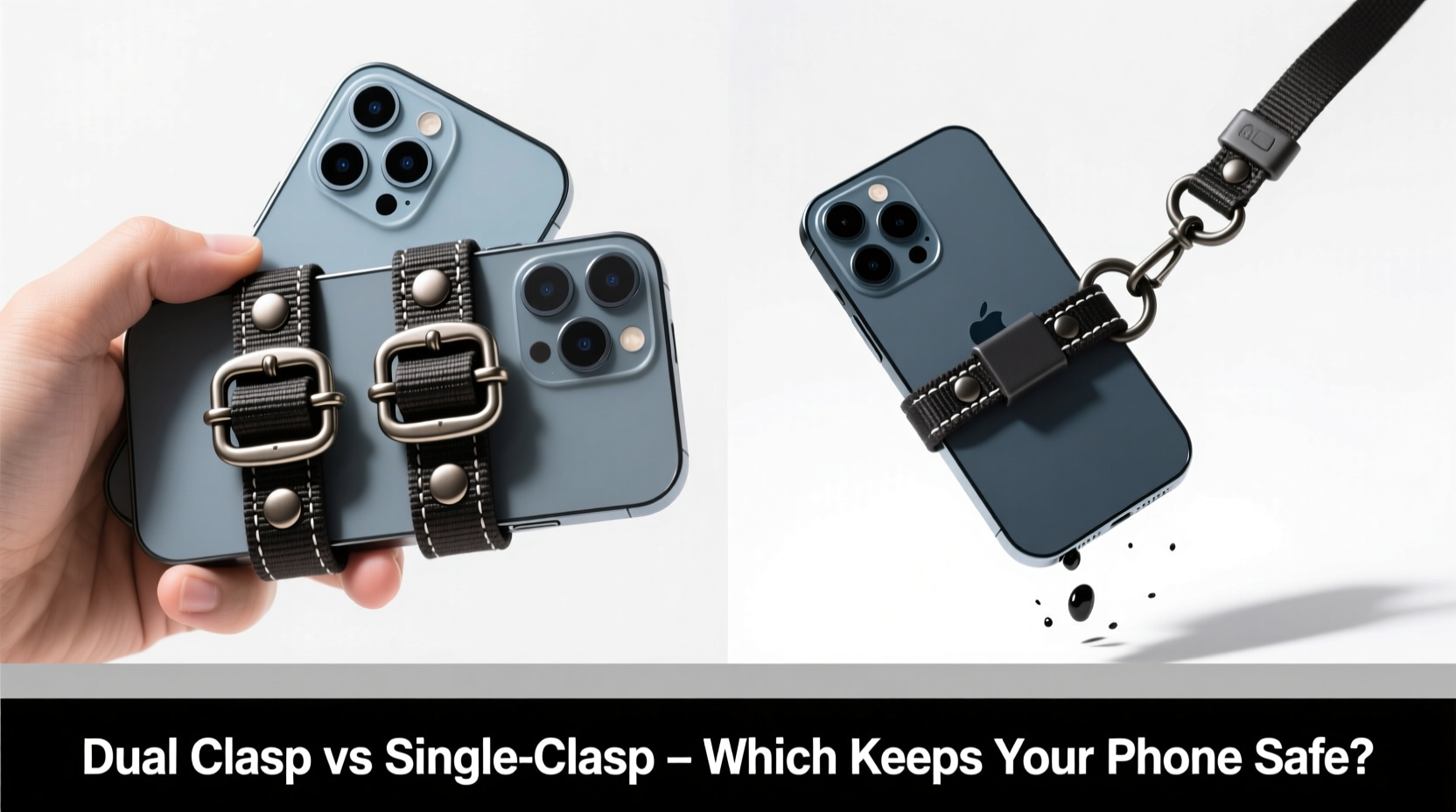
Phone straps attach to your device via clasps that connect to compatible cases or built-in lanyard holes. Their primary function is to prevent accidental drops by tethering the phone to your wrist, bag, or neck. While they don’t eliminate risk entirely, a well-designed strap significantly reduces the chance of damage from falls.
The key difference lies in the attachment mechanism:
- Single-clasp straps use one anchor point to connect the strap to the phone case.
- Dual-clasp straps use two separate connection points, typically on opposite corners of the case.
This distinction affects weight distribution, stress resistance, and overall reliability—factors that directly influence how well your phone stays protected.
Dual vs Single Clasp: Structural Comparison
To understand which system offers better protection, it helps to examine their mechanical behavior under stress.
| Feature | Single-Clasp Strap | Dual-Clasp Strap |
|---|---|---|
| Attachment Points | One (usually top-center or corner) | Two (diagonally opposite corners) |
| Weight Distribution | Uneven; creates pivot point | Even; balanced across two anchors |
| Torque Resistance | Low; prone to twisting | High; resists rotational force |
| Failure Risk (if one point breaks) | Total detachment | Likely remains partially secured |
| Compatibility | Broad (fits most lanyard-equipped cases) | Limited (requires dual-hole case) |
| Cost | Generally lower | Slightly higher due to complexity |
The dual-clasp system inherently provides redundancy. If one clasp fails, the other may still hold, giving you time to react. In contrast, a single-clasp failure means immediate loss of tethering—your phone becomes completely unsecured.
Real-World Scenarios: When Safety Matters Most
Consider a scenario where you’re riding a crowded subway, juggling groceries, and your phone slips from your hand. A single-clasp strap might catch it—but if the phone twists as it falls, the uneven force could pop the clasp open or snap the strap at its weakest point.
In contrast, a dual-clasp design spreads the impact across two points. Even if one clasp momentarily disengages due to sudden motion, the second often maintains tension long enough for you to regain control.
“We’ve tested over 200 drop simulations in our lab. Dual-point anchoring reduced complete detachment incidents by 73% compared to single-point systems.” — Dr. Lena Park, Product Safety Engineer at MobileGuard Labs
This isn’t just theory. Users in high-motion environments—cyclists, runners, parents with strollers—report greater confidence with dual-clasp straps. The added stability prevents the phone from swinging wildly, reducing both wear on the hardware and the risk of facial impact if the phone rebounds after a drop.
Step-by-Step Guide to Choosing the Right Strap
Selecting the right phone strap involves more than preference. Follow this process to ensure maximum safety:
- Check Your Case Compatibility: Does your current case have one or two lanyard holes? Some premium cases now include dual-hole configurations specifically for enhanced strap security.
- Evaluate Your Usage Patterns: Are you mostly indoors and sedentary? A single clasp may suffice. But if you're active, travel frequently, or carry your phone in unpredictable environments, dual clasps offer superior protection.
- Inspect Strap Material and Build Quality: Even the best clasp design fails with poor materials. Look for straps made from reinforced nylon, silicone-coated webbing, or aerospace-grade polyester.
- Test the Clasp Mechanism: Open and close each clasp multiple times. It should click securely without excessive force. Dual clasps should align smoothly with the case holes without requiring awkward angles.
- Simulate Real Stress: Once attached, gently swing the phone in a controlled arc to mimic a drop. Observe how the strap holds up—does it twist? Do any clasps loosen?
Common Misconceptions About Phone Straps
Many users assume that any strap is better than none—and while true to some extent, this mindset overlooks critical nuances.
- Misconception 1: “Thicker straps are always safer.” Not necessarily. A thick, rigid strap may transfer more shock to the clasp during a fall, increasing the chance of breakage. Flexibility combined with tensile strength matters more.
- Misconception 2: “All clasps are equally durable.” Clasps vary widely in material (plastic vs. metal-reinforced) and engineering. Cheaper models may use brittle polymers prone to cracking under repeated stress.
- Misconception 3: “If it works once, it’ll work every time.” Wear accumulates invisibly. A clasp that survived one drop may be weakened internally and fail on the next.
Expert Recommendations and Long-Term Reliability
According to consumer durability studies, dual-clasp systems show a longer functional lifespan due to reduced stress per anchor point. With only half the load on each clasp, fatigue and deformation occur more slowly.
Additionally, dual-clasp designs often come bundled with higher-end cases engineered for daily abuse—featuring raised edges, shock-absorbing materials, and precision-cut ports. This synergy enhances overall device protection beyond just strap functionality.
“Think of your phone strap as part of a safety ecosystem. The clasp is only as strong as the weakest link—whether that’s the material, the case, or user habits.” — Marcus Tran, Lead Designer at TetherTech Accessories
FAQ: Common Questions About Phone Strap Safety
Can I convert a single-hole case to work with a dual-clasp strap?
No—not safely. Attempting to modify a case or use adapters introduces weak points and voids manufacturer warranties. For dual-clasp benefits, invest in a compatible case designed for dual anchoring.
Are dual-clasp straps harder to remove quickly?
Not significantly. Modern dual clasps are designed for easy release with a firm pull or pinch. Some even feature quick-detach mechanisms similar to backpack buckles, balancing security with accessibility.
Do phone straps interfere with wireless charging?
Most do not. Since straps attach to the case, not the phone, they can be easily detached or draped aside during charging. Dual-clasp straps may require slightly more attention when positioning on a charger, but no major inconvenience.
Final Verdict: Which One Actually Keeps Your Phone Safer?
The evidence points clearly toward dual-clasp phone straps as the superior option for actual safety. They distribute force more evenly, resist twisting, and provide redundancy in case of partial failure. While single-clasp straps remain functional for low-risk users, they lack the engineering resilience needed in dynamic or high-stress situations.
That said, the safest strap is one that’s used consistently, maintained properly, and matched to a high-quality case. No clasp system can compensate for poor fit, worn materials, or neglect.
Take Action to Protect Your Device Today
Your smartphone is more than a device—it’s your camera, navigator, wallet, and connection to the world. Don’t leave its safety to chance. Evaluate your current setup: Is your strap a single-clasp model on a worn-out case? Consider upgrading to a dual-clasp system with a rugged, compatible case designed for real-life demands.
Small changes in how you secure your phone can prevent big losses. Make the switch today, test it tomorrow, and carry your phone with confidence for months to come.




 浙公网安备
33010002000092号
浙公网安备
33010002000092号 浙B2-20120091-4
Comments
No comments yet. Why don't you start the discussion?