
When it comes to at-home hair styling tools, two names dominate the conversation: the Dyson Airwrap and the Revlon One Step Volumizer. The former retails for over $500; the latter typically costs less than $70. That’s a sevenfold price gap. But does the Dyson deliver seven times the performance? Or is the Revlon offering most of the benefits at a fraction of the cost? To answer this, we need to look beyond price tags and examine build quality, technology, usability, results, and long-term value.
The Dyson Airwrap emerged as a luxury innovation in 2018, promising salon-quality curls, waves, and smooth blowouts without extreme heat. Its Coanda effect technology and sleek design quickly made it a viral sensation. Meanwhile, the Revlon One Step, launched around the same time, gained traction through social media for delivering professional-looking blowouts with minimal effort—especially for thick or frizzy hair. Both tools promise efficiency and ease, but their approach and execution differ significantly.
Technology & Engineering: What Sets Them Apart?
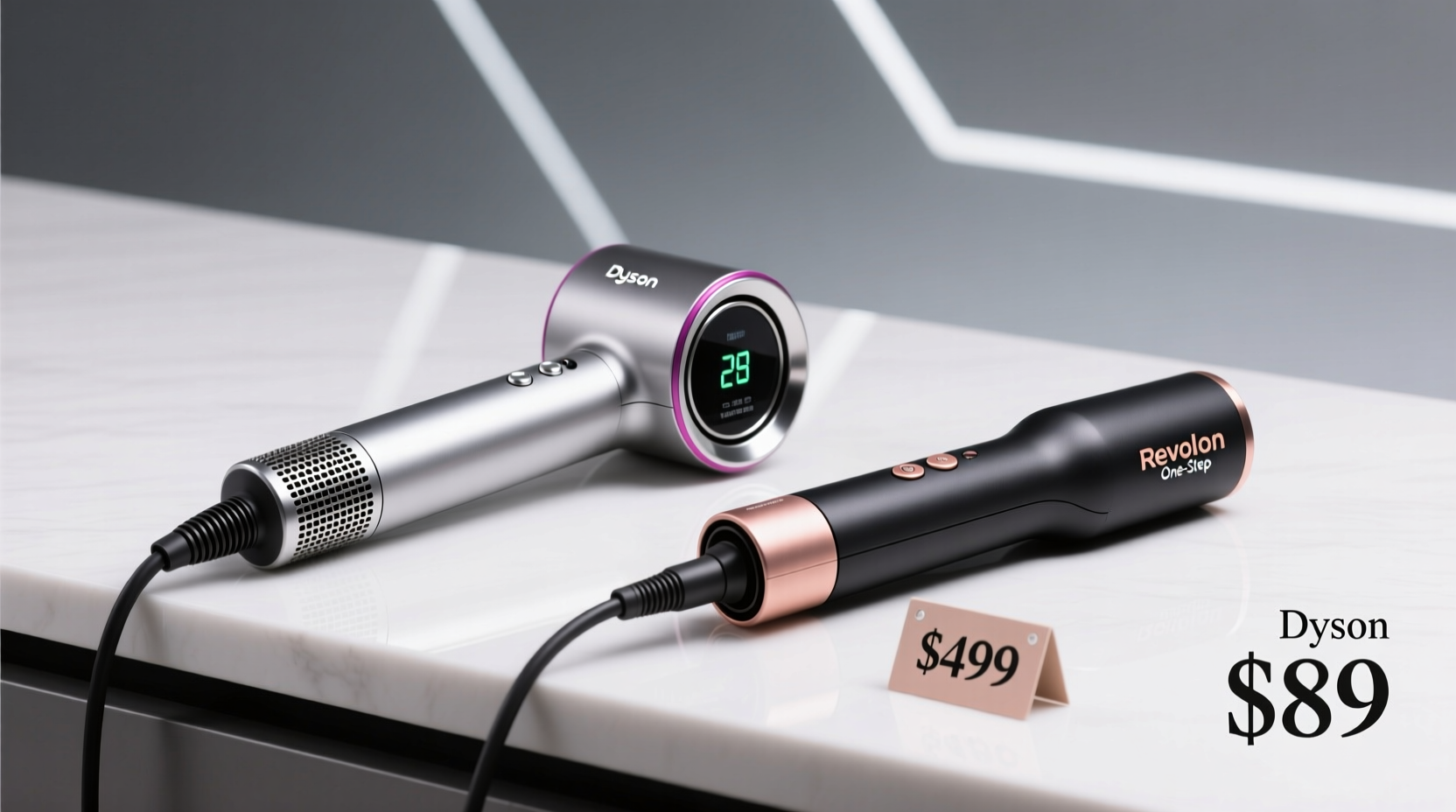
The core distinction between these two devices lies in how they style hair. The Dyson Airwrap uses Dyson’s patented Coanda airflow technology. Instead of relying solely on clamping heat like traditional curling irons, it draws hair toward the barrel using air pressure, wrapping it automatically. This reduces direct heat contact and minimizes damage. It also includes multiple attachments: firm and soft smoothing brushes, a round volumizing brush, and curling barrels for left and right directions (in both 1.2” and 0.7”)—giving users full control over styling options.
In contrast, the Revlon One Step is a hybrid tool: part blow dryer, part hot brush. It combines drying and straightening into one motion. The rotating bristles pass through damp hair while warm air dries and smooths simultaneously. It doesn’t curl hair automatically—users must manually wrap sections around the barrel—but it excels at creating sleek, shiny blowouts reminiscent of professional salon finishes.
Dyson’s engineering goes further with intelligent heat control. A built-in sensor measures air temperature 40 times per second, preventing extreme heat exposure. The motor is housed in the handle, making it lighter in the hand during use. The Revlon, while effective, lacks such precision. It has basic heat settings (usually two or three), no real-time monitoring, and a bulkier front-heavy design that can cause wrist fatigue during extended styling sessions.
“Tools that reduce heat exposure without sacrificing performance are the future of hair care. The Dyson Airwrap represents a shift from brute force to smart engineering.” — Dr. Lena Patel, Trichologist & Hair Health Researcher
Performance Comparison: Real Results Across Hair Types
To assess whether the price gap is justified, we need to evaluate actual performance across different hair textures and lengths. Here’s how each device performs under real-world conditions:
- Fine, Straight Hair: The Dyson Airwrap creates soft volume and subtle bends with minimal frizz. The low-heat setting preserves shine. The Revlon One Step works well too, but can sometimes over-flatten fine hair if not used carefully.
- Thick, Wavy Hair: This is where both tools shine. The Revlon delivers fast drying and impressive smoothness in one pass. However, it may struggle with tighter waves or kinks unless pre-dried thoroughly. The Dyson handles moisture better thanks to its focused airflow and offers more versatility with curl customization.
- Curly or Coily Hair: Neither tool is ideal for tightly coiled textures without prior stretching or detangling. However, the Dyson’s smoothing brushes provide gentle definition and frizz control when used on second-day curls. The Revlon tends to disrupt natural curl patterns and can cause dryness if overused.
- Long Hair: The Dyson’s attachments make sectioning easier and allow consistent styling from root to tip. The Revlon requires more passes and careful handling to avoid tangles, especially near the ends.
Detailed Feature Comparison
| Feature | Dyson Airwrap | Revlon One Step |
|---|---|---|
| Price Range | $549–$650 | $55–$70 |
| Heat Control | Intelligent sensor (40x/sec), 3 settings | Manual dial, 2–3 settings |
| Attachments | 6 (smoothing brushes, volumizing brush, dual curlers) | 1 (integrated brush/dryer) |
| Auto-Wrap Function | Yes (Coanda effect) | No (manual wrapping required) |
| Drying Efficiency | High (focused airflow) | Moderate to high |
| Weight & Balance | Well-balanced, lightweight handle | Front-heavy, heavier overall |
| Cord Length | ~9.8 ft | ~6.5 ft |
| Runtime (Cordless models) | Up to 30 minutes (on some versions) | N/A (corded only) |
| Lifespan (Estimated) | 5+ years with proper care | 2–3 years average |
User Experience: Daily Use and Long-Term Value
While initial performance matters, daily usability and durability play a major role in justifying cost. The Dyson Airwrap offers a premium experience: quieter operation, smoother glide, and consistent results even after repeated use. Its magnetic attachment system makes switching tools effortless. Cleaning is simple—brushes detach easily, and filters are accessible. Over time, users report fewer issues with overheating or motor failure.
The Revlon One Step, while effective, shows signs of wear sooner. Some users report bristle shedding after several months, inconsistent heating, or switch malfunctions. The cord is shorter, limiting mobility, and the lack of attachments means you can’t adapt your styling technique without additional tools. However, for someone who primarily wants a quick blowout 2–3 times a week, it remains a strong budget-friendly option.
A mini case study illustrates this well: Sarah, a marketing executive with shoulder-length wavy hair, purchased the Revlon One Step in 2020 for $65. She used it 4–5 times weekly and loved the smooth results. By mid-2022, the bristles began loosening, and the heat output became uneven. She upgraded to the Dyson Airwrap and found the learning curve minimal. Despite the high upfront cost, she now styles faster, experiences less frizz, and feels her hair is healthier after six months of use. “I was skeptical,” she said, “but the difference in hair condition alone made the Dyson worth it.”
Step-by-Step: How to Maximize Results with Each Tool
Regardless of which device you choose, technique matters. Follow this timeline for optimal outcomes:
- Prep (5 min): Wash and towel-dry hair until damp. Apply a heat protectant and a light mousse or volumizing spray for hold.
- Sectioning (3 min): Clip hair into 4–6 sections. Smaller sections yield better results, especially with the Revlon.
- Drying Base Layer (5–8 min): Use the lowest heat setting to remove excess moisture before styling.
- Styling (10–15 min):
- Dyson: Select attachment. Hold tool vertically, guide hair into airflow. Let Coanda effect wrap hair automatically. Hold 8–12 seconds per section.
- Revlon: Comb through a section, then slowly pull the brush downward while rolling it inward for volume or outward for flip. Repeat until smooth.
- Finishing (2 min): Cool shot (if available), light serum for shine, and flexible-hold hairspray for longevity.
Is the Price Difference Justified? A Value Breakdown
The $480+ gap between the Dyson Airwrap and Revlon One Step raises a fair question: does it translate into proportional value? The answer depends on your priorities.
If you value versatility, long-term durability, reduced heat damage, and multi-functional styling (curls, waves, volume, smoothness), the Dyson is a worthwhile investment. It replaces multiple tools—flat iron, round brush, curling wand—and does so with advanced engineering that protects hair integrity. Over five years, used 3–4 times weekly, the cost per use drops below $0.30—comparable to a single salon visit every few months.
On the other hand, if your goal is a fast, sleek blowout once or twice a week and you’re comfortable with manual styling, the Revlon delivers impressive results for its price. It’s an excellent entry-level tool, particularly for beginners or those testing the waters of heated styling.
Consider this checklist when deciding:
- ✅ Do you want salon-like curls without a curling iron?
- ✅ Are you styling daily or frequently?
- ✅ Is minimizing heat damage a priority?
- ✅ Do you have multiple hair goals (volume, curl, smoothness)?
- ✅ Are you willing to invest in a tool that lasts 5+ years?
If most answers are yes, the Dyson Airwrap justifies its cost. If you answered mostly no, the Revlon One Step offers exceptional value.
FAQ
Can the Revlon One Step create curls like the Dyson Airwrap?
Not automatically. While you can manually wrap hair around the Revlon barrel to create loose waves, it lacks the Coanda airflow that auto-wraps hair. Results are less consistent and require more skill.
Does the Dyson Airwrap work on short hair?
Yes, especially with the smaller 0.7” curler. Short bobs and lobs respond well to the Airwrap’s controlled airflow and lower heat settings, allowing for defined bends without excessive volume.
Is the Revlon One Step damaging to hair?
Like any heated tool, it can cause damage if misused—especially on high heat or over-dry hair. However, when used correctly (on damp hair, with heat protectant, and moderate heat), it’s no more damaging than other hot air brushes.
Final Verdict: Making the Right Choice for Your Lifestyle
The Dyson Airwrap and Revlon One Step serve overlapping needs but cater to different users. The Dyson is a high-performance, multifunctional appliance designed for long-term hair health and styling flexibility. Its price reflects cutting-edge engineering, durable construction, and thoughtful design. The Revlon is a focused, budget-efficient solution for achieving smooth, voluminous blowouts with minimal hassle.
The price difference isn’t just about branding—it’s about technology, material quality, functionality, and longevity. For professionals, frequent stylers, or those with hard-to-manage hair, the Dyson pays for itself in time saved and improved results. For occasional users or those on a tight budget, the Revlon remains one of the best values in hair tools today.
Ultimately, the choice isn’t about which tool is “better” in absolute terms, but which aligns with your routine, expectations, and hair goals. Both have earned their place in modern beauty arsenals—one as a luxury innovation, the other as a democratic breakthrough.




 浙公网安备
33010002000092号
浙公网安备
33010002000092号 浙B2-20120091-4
Comments
No comments yet. Why don't you start the discussion?