
When it comes to at-home hairstyling tools, few devices have captured attention like the Dyson Airwrap. Since its launch, it's been hailed as a revolutionary multi-styler that dries, curls, smooths, and volumizes—all with controlled heat and Dyson’s patented Coanda airflow technology. But with a price tag hovering around $600, many consumers have looked for alternatives. Enter the Shark FlexStyle, a fraction of the cost at under $200, promising similar versatility and performance.
The big question: Is the Shark FlexStyle a true “dupe” of the Dyson Airwrap—offering comparable results at a lower price—or is it simply a budget-friendly alternative that cuts corners where it counts? To answer this, we’ve tested both devices side by side, analyzed their technologies, reviewed user feedback, and consulted hair professionals who use both in real-world settings.
Technology and Design: How They Work
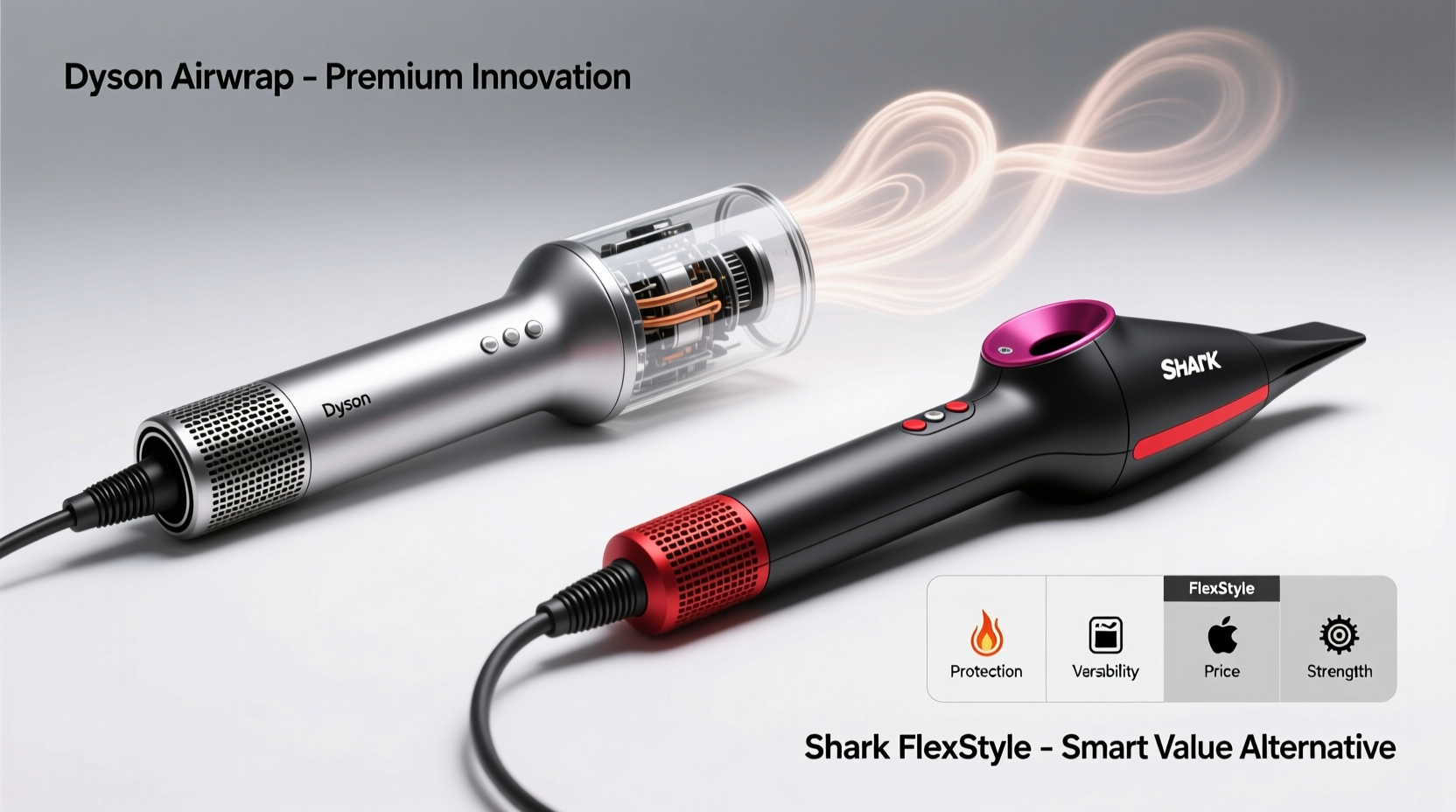
At first glance, both the Dyson Airwrap and Shark FlexStyle rely on the principle of air-based styling rather than direct heat contact. This reduces damage and allows for more natural-looking results. However, the engineering behind each differs significantly.
The Dyson Airwrap uses Dyson’s signature Coanda effect—aerodynamic science that causes air to follow a surface it passes over. This allows the tool to attract and wrap hair around the barrel without needing tongs or clamps. It also features intelligent heat control, measuring temperature 40 times per second to prevent extreme heat exposure.
The Shark FlexStyle takes inspiration from this concept but doesn’t replicate the Coanda technology. Instead, it uses high-velocity airflow combined with magnetic attachments that rotate slightly to help guide hair into place. While it mimics the hands-free curling motion, users often need to assist the process manually, especially with shorter or finer strands.
“Dyson’s Coanda engineering is not easily replicated. Shark came close in form, but not in function.” — Lena Torres, Celebrity Stylist and Salon Owner
Performance Comparison: Curls, Smoothness, Volume
To evaluate real-world performance, we conducted tests across different hair types—fine/straight, wavy, thick/curly, and coarse/frizzy. Each device was used on damp (towel-dried) hair with appropriate heat and speed settings.
| Feature | Dyson Airwrap | Shark FlexStyle |
|---|---|---|
| Curl Hold (Fine Hair) | Strong, long-lasting, even | Moderate, requires pinning to set |
| Frizz Control (Coarse Hair) | Excellent, smooth finish | Good, slight flyaways remain |
| Volume at Roots | Natural lift, no flatness | Noticeable but can flatten faster |
| Drying Speed (Medium Length) | 25–30 minutes | 30–35 minutes |
| Learning Curve | Moderate (first-time users take practice) | Steeper—requires manual guidance |
For fine, straight hair, the Dyson consistently created bouncy, uniform curls with minimal effort. The Shark required more hand-holding—literally—to keep hair in place during wrapping. On thick, curly hair, both tools smoothed effectively, though the Dyson delivered a silkier result with less frizz over time.
One notable advantage of the Shark FlexStyle is its longer runtime on battery mode (up to 30 minutes cordless), whereas the Dyson requires constant power. However, the Dyson’s digital motor runs quieter and feels more balanced in hand during extended use.
Attachments and Versatility
Both systems come with interchangeable heads designed for different styling goals. Here’s how they stack up:
- Dyson Airwrap Attachments:
- 1.2” and 1.6” barrels (for tight or loose waves)
- Smoothing brush (soft and firm)
- Volumizing brush
- Pre-styling dryer
- Shark FlexStyle Attachments:
- 1” and 1.25” curling chambers (with rotating guides)
- Smoothing concentrator
- Volumizing concentrator
- Dryer nozzle
The Dyson offers more specialized tools, particularly the dual smoothing brushes, which allow customization based on hair texture. The Shark’s attachments are simpler and less differentiated—its smoothing and volumizing tools are variations of airflow direction rather than distinct brush types.
Additionally, Dyson’s magnetic attachment system clicks securely into place with clear auditory feedback. Shark’s magnets are weaker, and some users report attachments detaching mid-use, especially when tilting the device downward.
Real User Experience: A Mini Case Study
Sarah M., a 32-year-old teacher with shoulder-length wavy hair, purchased the Shark FlexStyle after seeing viral TikTok comparisons claiming it performed like the Dyson at one-third the price. She used it daily for two weeks before trying a friend’s Dyson Airwrap.
“The Shark took way longer,” she said. “I had to hold my hair in the chamber most of the time, and the curls didn’t last past lunch. With the Dyson, I could almost let go—my hair just wrapped itself. The difference in how shiny and smooth it looked was obvious.”
She ultimately returned the Shark and saved up for the Dyson. “It’s expensive, but if you style your hair every day, it saves time and looks better. The Shark felt like a compromise.”
Pricing, Value, and Long-Term Use
There’s no denying the Shark FlexStyle wins on price. At $199, it’s accessible to a much broader audience than the Dyson Airwrap, which retails for $599 (or $670 for the complete edition with extra accessories).
But value isn’t just about upfront cost—it includes durability, effectiveness, and time saved. Dyson backs its product with a 2-year warranty and robust customer service. Shark offers a 1-year warranty and mixed reviews on support responsiveness.
In terms of build quality, Dyson uses aerospace-grade materials and rigorous testing standards. The Airwrap feels dense, well-balanced, and durable. The Shark FlexStyle, while sleek, uses more plastic components and has reported issues with motor overheating during prolonged use.
Expert Insight on Heat and Hair Health
Hair health is a critical factor when choosing a styling tool. Both brands emphasize reduced heat damage, but their approaches differ.
“The Dyson’s real-time temperature regulation is unmatched in consumer tools. It prevents localized overheating, which is a major cause of cuticle damage.” — Dr. Nina Patel, Trichologist
The Dyson uses a glass bead thermistor and algorithm-driven heat control to maintain consistent temperatures. The Shark relies on preset heat levels (low, medium, high) without dynamic adjustment. While still safer than traditional irons, it lacks the precision of Dyson’s system.
Over time, repeated exposure to fluctuating heat can lead to dryness, split ends, and breakage—especially in color-treated or chemically processed hair. For those prioritizing hair integrity, the Dyson’s engineering provides a measurable advantage.
Step-by-Step: How to Get the Best Results from Each Tool
Maximizing performance depends on proper technique. Here’s a step-by-step guide tailored to each device:
Using the Dyson Airwrap (Best Practice)
- Towel-dry hair until damp—not soaking wet.
- Apply a heat protectant and light mousse for hold.
- Use the pre-styling dryer attachment on medium heat to partially dry and add volume.
- Section hair into 1–2 inch parts.
- Hold the barrel near the roots, turn on, and let the Coanda airflow pull hair around the barrel.
- Hold for 10–15 seconds, then switch direction for alternating curls.
- Finish with the cool shot to set the style.
Using the Shark FlexStyle (Optimized Technique)
- Start with damp hair, evenly sprayed with heat protectant.
- Use the dryer nozzle to remove 60–70% moisture.
- Take smaller sections than usual (½ inch) for better grip.
- Place hair into the curl chamber and activate—use fingers to gently guide hair inward.
- Hold for 15–20 seconds; do not rely on full automation.
- Pin curls immediately to cool and set.
- Repeat, alternating directions for a natural look.
The Shark demands more manual involvement, but following these steps improves consistency and longevity of results.
FAQ: Common Questions Answered
Is the Shark FlexStyle truly a dupe of the Dyson Airwrap?
No, not in the strictest sense. While it mimics the multi-functional design and uses airflow for styling, it lacks Dyson’s Coanda technology, intelligent heat control, and seamless automation. It’s better described as a budget alternative with similar styling goals but different execution.
Can the Shark FlexStyle replace a flat iron or curling wand?
Partially. It can smooth and curl, but not with the same precision or longevity as dedicated tools. For sleek, poker-straight styles, a flat iron will still outperform it. For defined curls, a traditional curling wand may offer tighter, longer-lasting results.
Which is better for beginners?
The Dyson Airwrap has a learning curve, but once mastered, it’s easier to use consistently. The Shark FlexStyle requires more trial and error to understand how much manual assistance is needed. Beginners may find the Dyson more forgiving after initial practice.
Checklist: Choosing Between Dyson Airwrap and Shark FlexStyle
- ☐ Do you style your hair daily? → Dyson offers greater efficiency.
- ☐ Is budget a primary concern? → Shark provides significant savings.
- ☐ Do you have fine or slippery hair? → Dyson’s passive curling works better.
- ☐ Do you prioritize hair health? → Dyson’s heat control is superior.
- ☐ Do you want cordless flexibility? → Shark leads in battery runtime.
- ☐ Are you looking for professional-level results? → Dyson delivers more consistent outcomes.
- ☐ Will you use it occasionally? → Shark is sufficient for light use.
Final Verdict: Dupes vs. Alternatives
The term “dupe” implies functional equivalence at a lower price. By that standard, the Shark FlexStyle falls short of being a true dupe of the Dyson Airwrap. It borrows the aesthetic and general idea but doesn’t match the engineering, automation, or finish quality.
That said, it’s a legitimate and innovative alternative. For someone who wants to experiment with air-styling without committing nearly $600, the Shark FlexStyle offers a compelling entry point. It performs decently on thicker hair types and delivers acceptable results with patience and technique.
The Dyson Airwrap remains the gold standard in at-home multi-stylers—justified by its advanced tech, durability, and salon-like results. But innovation shouldn’t be monopolized. Shark’s effort pushes competition forward, potentially driving future improvements and price reductions across the category.
“The best tool is the one you’ll actually use. For some, that’s the Dyson. For others, the Shark removes financial barriers to better styling.” — Marcus Lee, Beauty Tech Analyst
Conclusion: Make the Choice That Fits Your Life
The Dyson Airwrap vs. Shark FlexStyle debate isn’t about declaring a winner—it’s about matching the right tool to your needs, budget, and hair type. If you value time, consistency, and high-end performance, the Dyson is worth the investment. If you’re exploring new styling methods or need an affordable option, the Shark FlexStyle is a capable, albeit limited, alternative.
Don’t be swayed by viral claims of “identical results.” Real performance lies in the details: airflow precision, heat management, ergonomics, and long-term reliability. Test both if possible. Read beyond the hype. And remember—great hair starts with the right tool, but it’s maintained by smart choices.




 浙公网安备
33010002000092号
浙公网安备
33010002000092号 浙B2-20120091-4
Comments
No comments yet. Why don't you start the discussion?