
When Dyson launched the V11, it was positioned as a major leap forward in cordless vacuum technology. But for owners of the still-capable V8, the question remains: does the V11 deliver enough meaningful improvements to justify the price jump? After extensive testing and real-world use across homes with pets, carpets, and mixed flooring, the answer isn’t as straightforward as marketing might suggest.
The V8 remains one of the most popular cordless vacuums ever made—affordable, powerful, and reliable. The V11 builds on that foundation with smarter tech, longer run time, and refined ergonomics. But whether those upgrades matter depends heavily on your cleaning habits, home size, and expectations.
Power and Suction: A Noticeable Step Up
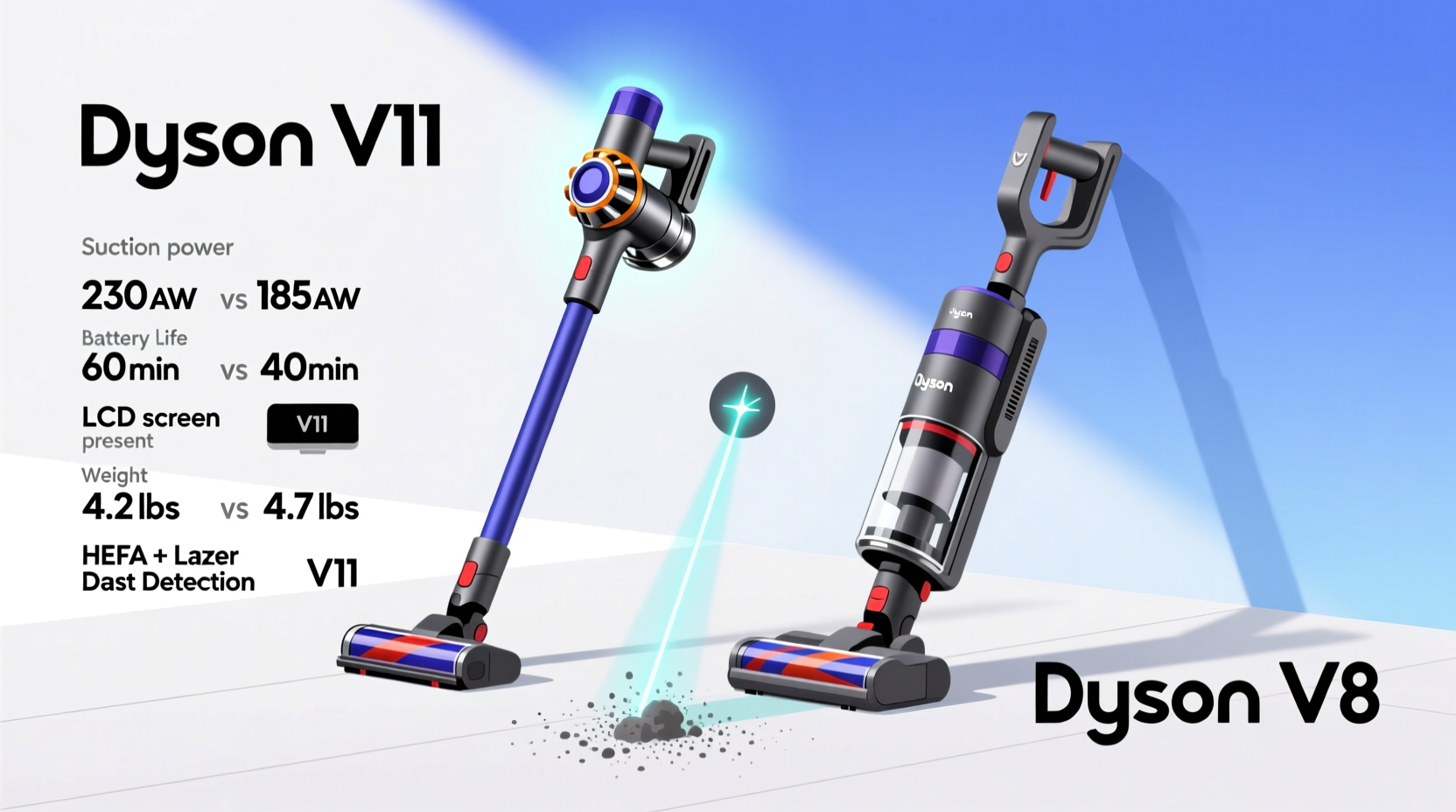
Dyson’s digital motor is at the heart of both models, but the V11 uses a slightly more advanced version—the Dyson Digital Motor V11 (yes, same name). This iteration spins faster and delivers up to 185 air watts compared to the V8’s 115 air watts. In practical terms, this means stronger suction, especially on high-pile carpets or embedded pet hair.
The difference is most noticeable when switching between modes. The V8 has two power settings: standard and max. Max drains the battery quickly—often within six minutes—but is necessary for deep carpet cleaning. The V11 introduces an automatic mode that adjusts suction based on floor type using a built-in load sensor. On hard floors, it sips power; on thick rugs, it ramps up seamlessly.
Battery Life and Runtime: Real Gains Where It Counts
Battery life is where many V8 owners feel limited. On max power, you’re lucky to get 7 minutes. Even on standard mode, 30–40 minutes is typical. The V11 improves significantly here, offering up to 60 minutes in eco mode and around 10–12 minutes on max—still short, but 40% more than the V8.
More importantly, the V11 includes a predictive runtime display on its LCD screen. It shows remaining minutes based on current power mode, not just battery percentage. This helps avoid mid-clean surprises and lets you plan larger jobs efficiently.
For small apartments or quick pickups, the V8’s battery may still suffice. But if you have a multi-level home or hate recharging mid-session, the V11’s extended cycle and intelligent monitoring offer tangible benefits.
Smart Features and User Interface
The V11 introduces an LCD screen that displays real-time performance data: suction level, battery status, blockage alerts, and maintenance reminders. While not “smart” in the IoT sense, this feedback loop helps users maintain peak performance and troubleshoot issues before they become problems.
In contrast, the V8 relies on a simple LED indicator—three lights show approximate charge, but no granular details. You won’t know if there’s a blockage until suction drops noticeably. The V11 alerts you immediately.
“User feedback through real-time diagnostics changes how people interact with their tools. It shifts cleaning from reactive to proactive.” — Dr. Lena Patel, Human-Device Interaction Researcher, MIT Media Lab
Design and Usability Improvements
Both models share Dyson’s familiar stick design, but the V11 refines the ergonomics. The handle is reshaped for better grip, and the dustbin release button is larger and easier to press. The bin capacity is also increased—from 0.54 liters on the V8 to 0.76 liters on the V11—meaning fewer emptying stops during large cleanups.
The motorized cleaner head on the V11 Torque Drive model is heavier and more robust, with improved brush bar engineering. It automatically adjusts stiffness based on resistance, reducing wear on delicate floors while maintaining deep-cleaning power on carpets.
However, the V11 is heavier—3.08 kg vs. 2.58 kg—which some users notice during prolonged overhead cleaning or stair use. If you frequently clean ceilings or upholstery, the V8’s lighter frame may be preferable.
Direct Comparison: Key Differences at a Glance
| Feature | Dyson V8 | Dyson V11 |
|---|---|---|
| Max Suction (Air Watts) | 115 AW | 185 AW |
| Battery Runtime (Max Mode) | ~7 minutes | ~12 minutes |
| Battery Runtime (Eco Mode) | ~40 minutes | ~60 minutes |
| Display | LED Charge Indicator | LCD with Runtime & Alerts |
| Dustbin Capacity | 0.54 L | 0.76 L |
| Weight | 2.58 kg | 3.08 kg |
| Auto-Adjusting Cleaner Head | No | Yes (on Torque Drive models) |
Real-World Example: A Pet Owner’s Experience
Sarah, a dog owner in Manchester with two shedding spaniels and a mix of hardwood and wool rugs, upgraded from a V8 Animal to a V11 Absolute after two years. She initially hesitated due to cost but found the V11’s auto mode particularly useful.
“On the V8, I had to switch to max every time I hit the living room rug, and the battery would die halfway. With the V11, it senses the transition and boosts power automatically. I finish whole-floor cleans without swapping batteries or charging. Plus, the bigger bin means I don’t empty it after every room.”
For her, the upgrade paid off in efficiency and reduced frustration—especially during seasonal shedding peaks.
Step-by-Step: How to Decide If You Should Upgrade
- Assess your current pain points: Does your V8 die too quickly on max? Do you struggle with carpets? If you’re satisfied with its performance, upgrading may not add value.
- Evaluate your home size and layout: Homes over 1,200 sq ft benefit more from the V11’s longer runtime and larger bin.
- Consider flooring types: If you have mostly hard floors, the V8 is likely sufficient. For thick carpets or mixed surfaces, the V11’s adaptive head shines.
- Weigh the cost: The V11 typically costs 60–80% more than the V8. Determine if the gains justify the premium.
- Check compatibility: Both use similar accessories, so your existing tools will work. However, the V11’s wall dock is redesigned—ensure it fits your space.
Frequently Asked Questions
Can I use my V8 attachments on the V11?
Yes. All Dyson V8 tools are fully compatible with the V11. The hose connection and click mechanism are identical, making accessory transitions seamless.
Is the V11 worth it for allergy sufferers?
Absolutely. Both models feature whole-machine HEPA filtration, but the V11’s stronger suction captures more fine dust and allergens from deep within fibers. Its sealed system ensures 99.97% of particles 0.3 microns and larger are trapped.
Does the V11 require special maintenance?
No. Maintenance is nearly identical: regular filter washing (monthly), bin emptying, and brush roll checks. The V11’s LCD will remind you when filters need cleaning, which the V8 does not.
Upgrade Checklist: Are You Ready for the V11?
- ✅ Your home is larger than 1,000 sq ft
- ✅ You clean thick carpets or high-pile rugs regularly
- ✅ You’ve outgrown the V8’s battery life
- ✅ You want real-time feedback during cleaning
- ✅ You’re willing to pay a premium for incremental gains
- ❌ You only clean small areas or hard floors
- ❌ You’re happy with your V8’s performance
Conclusion: Is the Upgrade Worth It?
The Dyson V11 is undeniably more advanced than the V8. It offers stronger suction, smarter operation, longer battery life, and a more informative user experience. But technological superiority doesn’t always translate to real-world necessity.
If you live in a compact space, clean infrequently, or find your V8 meets your needs, the upgrade may not be justified. However, for larger homes, carpet-heavy environments, or users who value precision and efficiency, the V11 delivers measurable improvements that enhance daily cleaning.
The V8 remains an excellent vacuum—one that many professionals still recommend. But the V11 represents the evolution of that formula: not revolutionary, but meaningfully refined. Whether it’s worth it comes down to how much you value intelligence, endurance, and convenience over raw value.




 浙公网安备
33010002000092号
浙公网安备
33010002000092号 浙B2-20120091-4
Comments
No comments yet. Why don't you start the discussion?