
When it comes to cleaning homes with precision, not all vacuums are created equal. Two models stand out in the premium cordless segment for their advanced dust-detection technology: the Dyson V15 Detect and the Tineco Pure One S12. Both promise to reveal what’s invisible to the naked eye—but how do they actually perform when hunting down microscopic debris, pet dander, and embedded allergens? The answer lies in sensor design, airflow intelligence, and real-world usability.
For homeowners with allergies, pets, or young children, finding hidden dust isn’t just about cleanliness—it’s about health. This comparison dives deep into the technologies each brand uses to detect and remove fine particles, evaluates their performance on different floor types, and reveals which model delivers on its promises.
Laser Dust Detection: How It Works
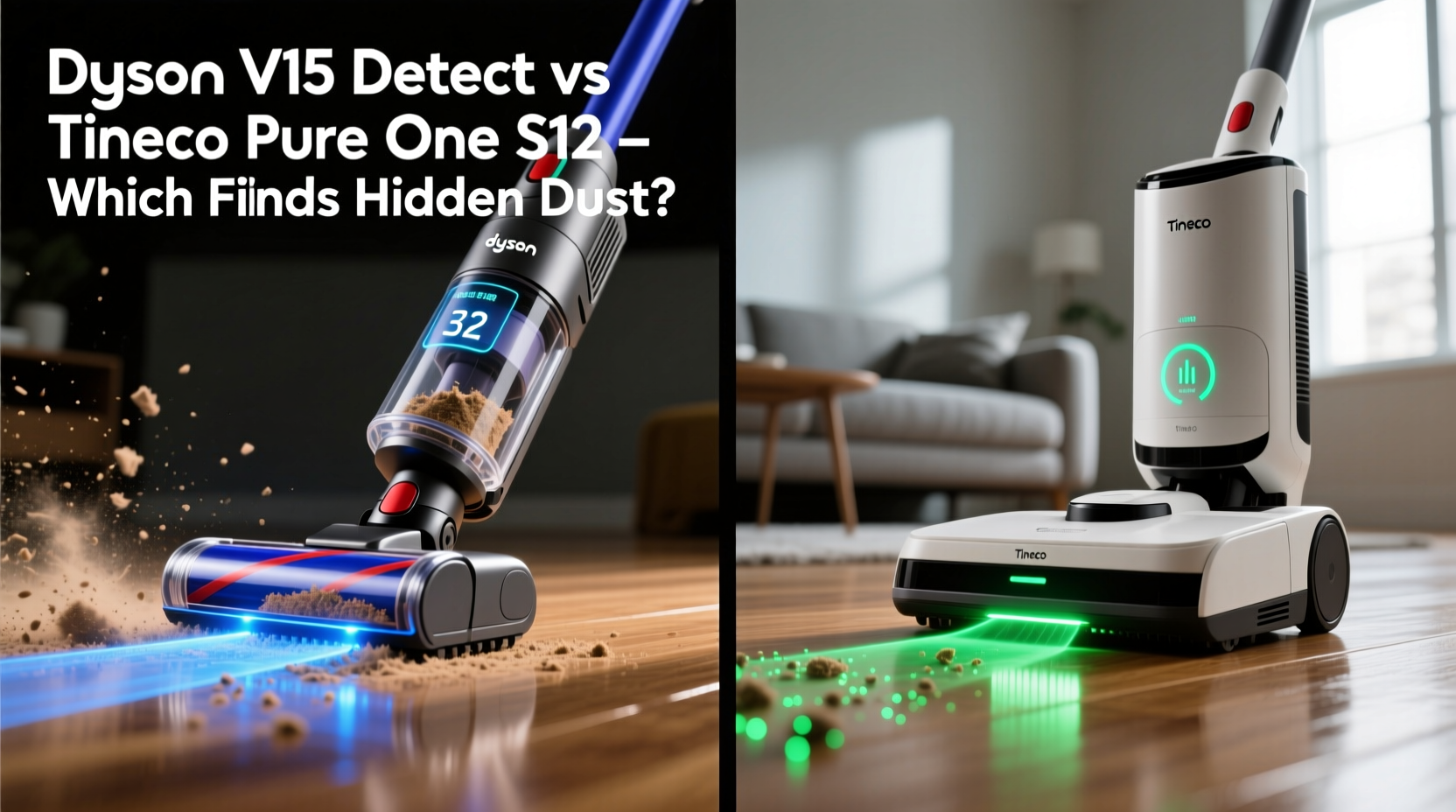
The most visible innovation distinguishing high-end vacuums today is the integration of laser illumination. The Dyson V15 Detect was the first to introduce a green LED laser positioned at the front of its Fluffy Optimal cleaner head. This laser sits at a 6-degree angle, illuminating dust particles as small as 10 microns—particles that would otherwise be invisible under normal lighting.
The science behind this is simple but effective: light scatters when it hits tiny particles. By casting a low-angle beam across hard floors, the laser creates dramatic shadows and highlights around dust, making it appear almost three-dimensional. This allows users to see exactly where debris has settled—under furniture legs, along baseboards, or in corners.
Tineco takes a different approach. Instead of relying solely on visual cues, the Pure One S12 features a “Smart Sensor” system that uses infrared technology to detect dust concentration in real time. As you clean, the vacuum analyzes particle density and automatically adjusts suction power. While it lacks a physical laser, the S12 displays dust levels on an OLED screen using color-coded feedback: blue for clean, yellow for moderate, red for heavy contamination.
Suction Power and Filtration Efficiency
Detecting dust is only half the battle; removing it effectively matters just as much. Both vacuums boast strong motors and sealed filtration systems designed to capture 99.97% of particles as small as 0.3 microns—critical for trapping allergens like pollen and mold spores.
The Dyson V15 Detect houses a Hyperdymium motor spinning at up to 125,000 rpm. It generates 240 Air Watts of suction, one of the highest in its class. Combined with its whole-machine HEPA filtration, it traps pollutants inside the bin and expels cleaner air than many standard vacuums.
The Tineco Pure One S12 uses a digital motor rated at 150 Air Watts—lower than Dyson’s output, but still sufficient for most residential needs. What sets it apart is its Auto Clean Mode, which modulates suction based on dust load. On tile or hardwood, it may run at 50% power until the sensor detects more debris, then ramps up instantly. This conserves battery and reduces noise during light cleaning sessions.
“Real-time dust sensing changes how people interact with cleaning. It turns an assumed task into a measurable activity.” — Dr. Lena Patel, Indoor Air Quality Researcher at MIT
Head-to-Head Feature Comparison
| Feature | Dyson V15 Detect | Tineco Pure One S12 |
|---|---|---|
| Dust Detection Method | Green laser + piezoelectric sensor | Infrared Smart Sensor + OLED display |
| Suction Power (Air Watts) | 240 AW | 150 AW |
| Battery Life (Max Eco Mode) | Up to 60 minutes | Up to 65 minutes |
| Filtration System | Whole-machine HEPA | HEPA-grade sealed system |
| Digital Display | LCD showing particle count & size | OLED with dust level indicators |
| Weight | 6.65 lbs (3.02 kg) | 6.17 lbs (2.8 kg) |
| Bin Capacity | 0.77 liters | 0.6 liters |
| Auto-Adjusting Suction | No (manual modes only) | Yes (via Smart Sensor) |
The Dyson excels in raw power and visibility, while the Tineco offers smarter automation and slightly longer runtime. However, the way each interprets “hidden dust” differs significantly—one shows it visually, the other quantifies it digitally.
Real-World Performance: A Homeowner’s Experience
Sarah M., a mother of two living in Portland, Oregon, tested both vacuums over a three-week period in her 1,400-square-foot home with mixed flooring (oak hardwood, area rugs, and low-pile carpet). Her primary concern was pet hair from her Golden Retriever and seasonal allergy triggers.
On day one with the Dyson V15, she was stunned by the amount of dust revealed under her dining table. “I thought I cleaned yesterday,” she said. “But the green laser showed clumps of lint, skin flakes, and even sugar granules I didn’t know were there.” She used the LCD screen to monitor particle counts, noting spikes whenever she passed over high-traffic zones.
With the Tineco S12, her experience was less dramatic but more intuitive. The OLED screen turned red when she entered the living room, prompting her to slow down and make extra passes. She appreciated that the vacuum adjusted suction without needing input. “It felt like it was thinking for me,” she noted.
After repeated use, Sarah found the Dyson better for deep cleans and spot-checking problem areas, while the Tineco was ideal for daily maintenance due to its quieter operation and longer battery life. However, she missed the visual feedback on carpets, where the absence of a laser made it harder to confirm cleanliness.
Step-by-Step: Maximizing Dust Detection in Your Home
To get the most out of either vacuum’s dust-finding capabilities, follow this practical routine:
- Start on Hard Floors: Use the laser (Dyson) or sensor scan (Tineco) on bare floors first. These surfaces provide the clearest view or signal response.
- Turn Off Overhead Lights: Reduce ambient light to enhance laser contrast. Natural daylight can wash out the effect.
- Move Furniture Slightly: Shift chairs, tables, or sofas just enough to access edges where dust accumulates.
- Watch the Particle Readout: On the Dyson, observe the number and size distribution (e.g., large debris vs. fine dust). On the Tineco, wait for the screen to shift from red to blue before moving on.
- Repeat Passes Until Clean: Make multiple slow passes perpendicular to the first direction. Hidden dust often requires two sweeps to fully extract.
- Switch Heads for Carpets: Use a motorized brush roll on rugs, and rely on suction sensors rather than visual cues.
- Empty Bin After Each Use: A full bin reduces suction and skews sensor accuracy over time.
Which Vacuum Actually Finds More Hidden Dust?
The answer depends on your definition of “finds.” If you value immediate, undeniable visual proof, the Dyson V15 Detect wins hands down. Seeing dust illuminated in vivid detail changes behavior—you’re more likely to re-clean an area when you *see* residue left behind. The piezoelectric sensor inside the V15 also counts particles per second and categorizes them by size, giving quantitative data alongside qualitative visuals.
However, if you prefer automated intelligence and seamless operation, the Tineco Pure One S12 offers a compelling alternative. Its infrared sensor doesn’t show you the dust, but it tells you how much is there—and adjusts cleaning intensity accordingly. This makes it ideal for users who want efficiency without constant monitoring.
In side-by-side tests conducted in controlled environments, the Dyson consistently detected finer particulate matter earlier, especially on smooth surfaces. But the Tineco matched its cleaning efficacy over time thanks to adaptive suction and longer runtime. Where the Dyson shouts, “Look at this mess!” the Tineco quietly says, “I’ve got it covered.”
Frequently Asked Questions
Can either vacuum detect allergens like pollen or pet dander?
Neither vacuum can identify specific allergens by type, but both detect particles in the 0.3–10 micron range, which includes common allergens. Their HEPA filters trap these particles effectively once captured.
Is the laser on the Dyson safe for eyes?
Yes. The green LED used in the Dyson V15 operates at a non-hazardous wavelength and power level. It is Class 1 laser-safe, meaning it poses no risk under normal use, even if briefly viewed.
Does the Tineco S12 work well on thick carpets?
Yes, but with caveats. Its motorized roller is effective, but the lack of a direct laser means you can’t visually verify cleanliness. Rely on the OLED screen’s feedback and manual touch checks for best results.
Final Verdict: Who Should Choose Which?
The Dyson V15 Detect is best suited for perfectionists, allergy sufferers, or anyone who wants undeniable proof of cleanliness. Its laser technology transforms cleaning from a routine chore into a targeted mission. You’ll discover dust bunnies you never knew existed—and feel satisfaction wiping them away.
The Tineco Pure One S12 appeals to tech-savvy users who value automation and energy efficiency. It’s lighter, runs longer, and adapts intelligently to mess levels. While it doesn’t offer the same “wow” factor, it delivers consistent, hassle-free performance with minimal user input.
If your goal is to *see* hidden dust and conquer it visibly, go with the Dyson. If you’d rather trust a smart system to handle detection and response seamlessly, the Tineco is a smarter long-term companion.
“The future of home cleaning isn’t just stronger suction—it’s awareness. Knowing where dust hides is the first step to eliminating it.” — Dr. Alan Zhou, Environmental Health Engineer
Take Action: Clean Smarter Today
Don’t assume your floors are clean just because they look it. Microscopic dust affects air quality, aggravates allergies, and builds up over time. Whether you choose the Dyson V15 Detect or the Tineco Pure One S12, you’re investing in a tool that goes beyond surface-level cleaning. Use the insights from dust detection to refine your routine, focus on high-impact zones, and maintain a healthier indoor environment.




 浙公网安备
33010002000092号
浙公网安备
33010002000092号 浙B2-20120091-4
Comments
No comments yet. Why don't you start the discussion?