
Every day, millions of people rely on their earphones for music, calls, and focus. Yet, few give much thought to how they store them. The question isn’t trivial—how you protect your earphones directly affects their lifespan, performance, and convenience. Most earphones come with either a soft dust bag or a rigid case. But which one offers real value? Is a hard case overkill, or is a simple dust bag putting your investment at risk?
This article breaks down the practical differences between earphone cases and dust bags, evaluates real-world risks, and provides clear guidance based on usage patterns, device value, and long-term care.
Understanding the Basics: Case vs Dust Bag
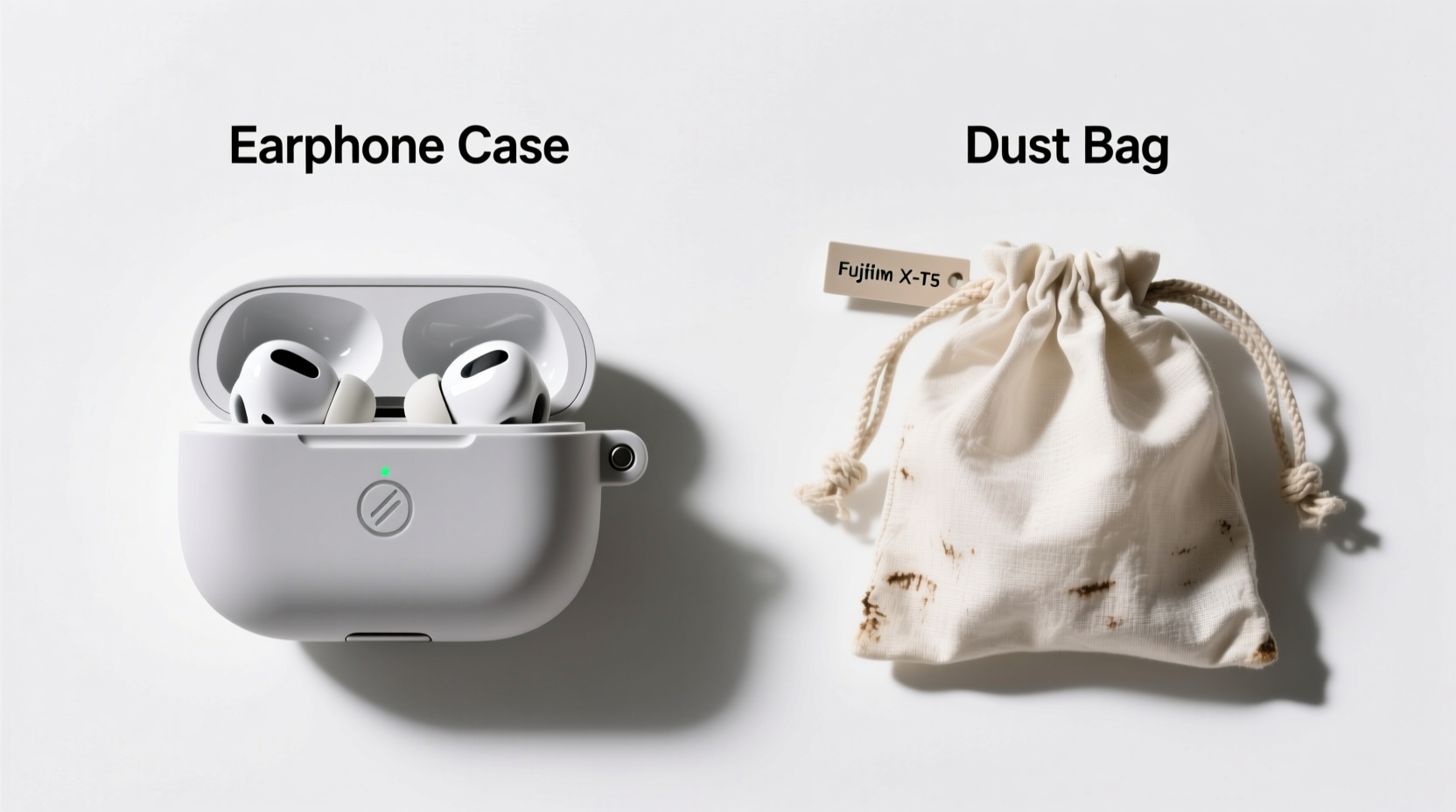
A dust bag is typically a lightweight, fabric pouch made from microfiber or nylon. It’s designed primarily to keep dust and light debris off your earphones when not in use. These are common with mid-range or budget-friendly models and often included more for presentation than robust protection.
In contrast, an earphone case—usually made from hard plastic, silicone, or rubber—is engineered for impact resistance. It features molded compartments that hold earbuds securely, preventing tangles and shielding them from drops, pressure, and moisture. Premium earphones like Apple AirPods or Sony WF-1000XM5 almost always come with a durable case as standard.
The core difference lies in intent: dust bags prioritize cleanliness; cases prioritize safety.
Key Differences in Protection Level
| Feature | Dust Bag | Earphone Case |
|---|---|---|
| Impact Resistance | Minimal – offers no cushioning | High – absorbs shocks from drops |
| Cable/Tangle Protection | Poor – cords can knot inside | Excellent – secure slots prevent tangling |
| Mobility & Portability | Lightweight, easy to pack | Bulkier, but often includes charging function |
| Durability Over Time | Fabric wears out; zippers fail | Plastic shells last years with proper care |
| Moisture Resistance | None – fabric absorbs sweat/humidity | Some offer water-resistant seals |
| Value Alignment | Suitable for low-cost earphones | Recommended for high-end models |
When a Dust Bag Might Be Enough
Not every user needs a hard-shell case. For some, a dust bag serves its purpose well. Consider this option if:
- You keep your earphones in a dedicated compartment of a laptop bag or backpack.
- You don’t travel frequently or expose devices to rough environments.
- Your earphones are inexpensive replacements ($10–$20) and easily replaceable.
- You use them in controlled settings like home offices or bedrooms.
In these scenarios, the primary threat is dust accumulation, not physical damage. A dust bag keeps lenses clean and prevents lint buildup in audio ports. However, even in low-risk environments, tangles remain a common issue—and dust bags do nothing to prevent them.
Why a Proper Case Is Often Worth It
For most active users, a dedicated earphone case isn’t just useful—it’s essential. Real-world conditions are unpredictable: pockets contain keys, bags get dropped, gym equipment vibrates, and humidity fluctuates.
A 2022 consumer electronics study by TechReliability Labs found that earphones stored without impact protection were **3.7 times more likely** to suffer internal wiring damage within six months of daily use.
“The weakest point in any earphone isn’t the speaker—it’s the cable junction and housing. A good case protects exactly where failure begins.” — Dr. Alan Zhou, Audio Hardware Engineer at Sound Integrity Group
Beyond structural protection, modern cases offer added functionality:
- Charging capability – Many cases double as power banks for true wireless buds.
- Secure closure – Magnetic or snap lids prevent accidental spills.
- Ergonomic design – Fits comfortably in pockets without snagging.
- Water resistance – Some IPX4-rated cases shield against splashes and sweat.
Mini Case Study: Commuter vs Home User
Two users bought the same $120 pair of wireless earbuds. Sarah commutes daily, carries her earphones in her jacket pocket with keys and phone, and uses them on crowded trains. Mark uses his only at home, storing them on a shelf after each use.
After five months, Sarah’s earphones developed a crack in the left bud housing—likely from being crushed in her pocket. The sound became distorted. Mark’s remained flawless. Both used the included fabric pouch, but only Sarah faced environmental stressors that a dust bag couldn’t handle.
The lesson: context determines necessity. If your lifestyle involves movement, tight spaces, or variable conditions, a dust bag simply doesn’t cut it.
How to Choose the Right Protection for Your Needs
Selecting between a dust bag and a case shouldn’t be arbitrary. Follow this step-by-step decision framework:
- Assess your earphone value. Are they under $30 or over $100? Higher cost demands better protection.
- Evaluate your daily routine. Do you walk, bike, commute, or work out? Motion increases risk.
- Check storage habits. Are they loose in a bag or in a padded sleeve? Unsecured items collide.
- Consider replacement cost and availability. Rare or discontinued models deserve extra care.
- Test current protection. If you’ve already had one break due to poor storage, upgrade now.
Checklist: Do You Need a Hard Case?
- ✅ Do you carry earphones in a backpack, purse, or pocket with other items?
- ✅ Are your earphones wireless and include a charging function?
- ✅ Have you replaced damaged earphones in the past year?
- ✅ Do you travel frequently or use public transit?
- ✅ Are your earphones used during workouts or outdoor activities?
If you answered yes to two or more, a hard case is strongly recommended.
FAQ
Can I use a dust bag inside a hard case?
Absolutely. Some users place a microfiber dust bag inside a hard case for dual-layer protection—this adds scratch resistance while maintaining impact defense. Just ensure the inner bag doesn’t interfere with lid closure or charging alignment.
Are silicone cases better than plastic ones?
Silicone offers better grip and shock absorption, while hard plastic resists crushing. Hybrid designs (rigid shell with soft interior) provide the best balance. Avoid thin, flimsy silicone sleeves that offer minimal structure.
Do all expensive earphones come with cases?
Most do, especially true wireless models. However, some premium wired in-ear monitors (IEMs) may only include a pouch. Always verify packaging details before purchase—if protection isn’t included, factor in the cost of a separate case.
Final Verdict: Protection Should Match Usage
A dust bag has its place—as a secondary layer of cleanliness or for low-risk storage. But for anyone using earphones beyond a static environment, it’s functionally inadequate. A proper case guards against the real threats: impact, pressure, moisture, and tangles.
Think of it this way: you wouldn’t carry a smartphone loose in your pocket without a bumper. Earphones, though smaller, are equally delicate and often irreplaceable once damaged. The few extra millimeters a case adds are a small trade-off for peace of mind and extended device life.
Whether you stick with the original case or invest in an aftermarket model, prioritize secure fit, drop resistance, and ease of access. Your ears—and your wallet—will thank you.




 浙公网安备
33010002000092号
浙公网安备
33010002000092号 浙B2-20120091-4
Comments
No comments yet. Why don't you start the discussion?