
Sitting for hours in front of a screen is part of the gaming lifestyle—but it doesn’t have to mean chronic back pain, rounded shoulders, or neck strain. Many gamers develop poor posture from prolonged sitting, forward head positioning, and weak postural muscles. Over time, this can lead to reduced lung capacity, headaches, joint degeneration, and even diminished reaction times due to muscle fatigue. The good news: posture isn’t fixed. With targeted exercises, awareness, and consistency, gamers can reverse the damage and build a stronger, more resilient body that supports long sessions without compromising health.
The key lies not in drastic changes but in integrating small, effective movements into daily routines. These exercises strengthen underused muscles, stretch over-tightened ones, and retrain movement patterns that have been compromised by hours spent hunched over keyboards and controllers.
Why Gamers Are at Risk of Poor Posture
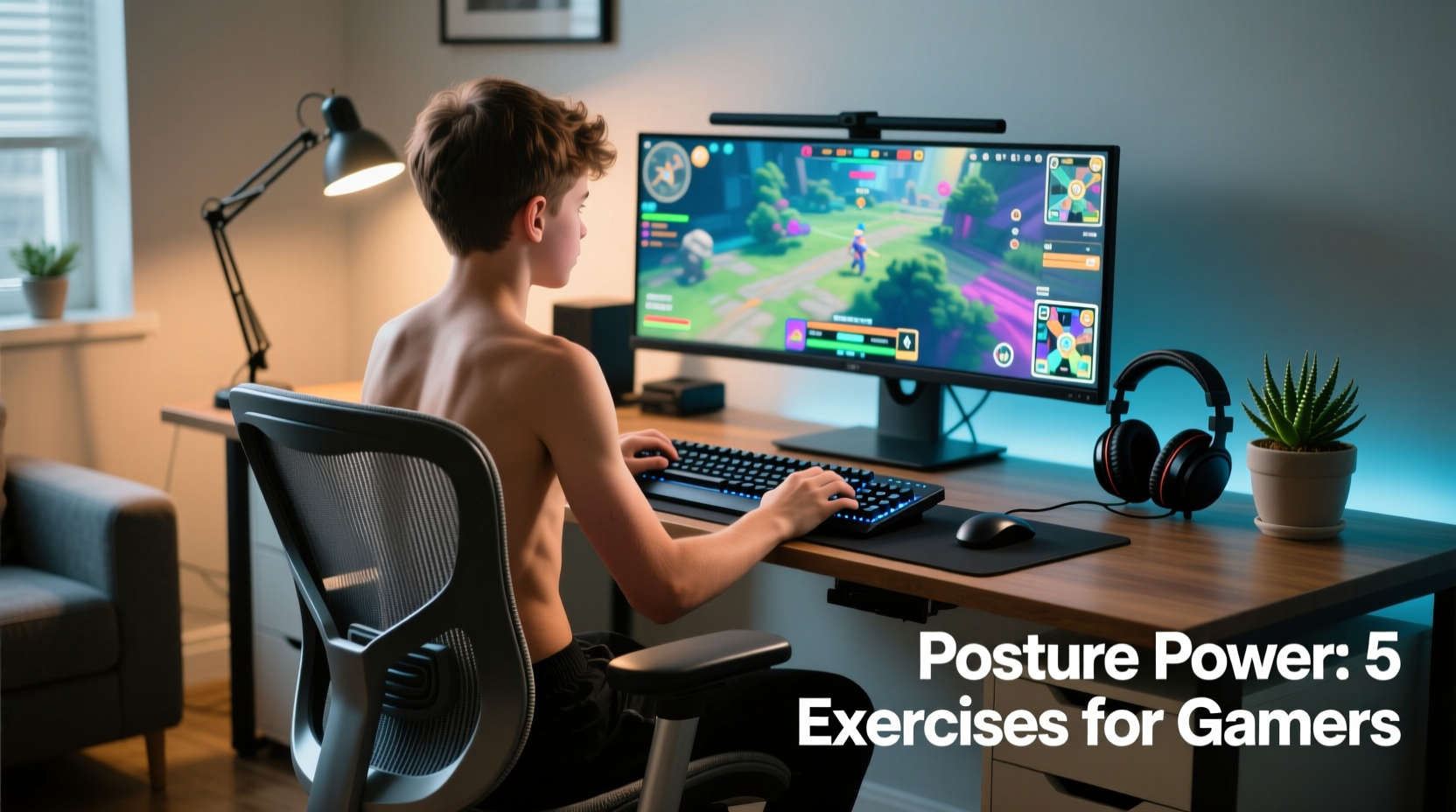
Gamers often fall into what’s known as “gamer posture”—a combination of forward head tilt, rounded shoulders, and a collapsed thoracic spine. This position reduces the natural curvature of the spine and places excessive stress on the cervical vertebrae. Studies show that for every inch the head moves forward from its neutral position, the effective weight on the neck increases by up to 10 pounds. That means a head jutting forward 3 inches effectively weighs 30+ pounds instead of its actual 10–12.
This misalignment doesn’t just cause discomfort—it affects performance. Restricted breathing limits oxygen flow to the brain, reducing concentration and reflex speed. Tight chest muscles limit shoulder mobility, increasing injury risk during quick mouse movements or controller flicks. Weak core and back muscles make sustained sitting uncomfortable, leading to fidgeting and distraction.
“Postural dysfunction in young adults who game extensively mirrors what we used to see only in office workers in their 40s.” — Dr. Lena Torres, Physical Therapist & Ergonomics Consultant
Core Principles Behind Posture Correction for Gamers
Effective posture correction isn’t about holding yourself rigidly upright. It’s about restoring balance between opposing muscle groups—particularly the anterior (front) and posterior (back) chains. Most gamers suffer from tight anterior muscles (chest, front shoulders, hip flexors) and weak posterior ones (upper back, glutes, deep neck flexors).
To counteract this imbalance, a successful routine includes:
- Stretching tight muscles – especially pectorals, upper trapezius, and hip flexors.
- Strengthening weak muscles – particularly the lower trapezius, serratus anterior, rhomboids, and deep neck flexors.
- Improving neuromuscular control – training your brain to engage the right muscles automatically during sitting.
- Integrating movement breaks – interrupting static positions before stiffness sets in.
Top 5 Exercises to Improve Posture for Gamers
These exercises are chosen for their effectiveness, minimal equipment needs, and ease of integration into a gamer’s routine. Perform them daily—or at least 4–5 times per week—for best results.
1. Chin Tucks (Neck Alignment Reset)
This simple yet powerful movement retrains the deep neck flexors and counters forward head posture.
- Sit or stand with your back against a wall, feet slightly forward.
- Keep your gaze level—do not tilt your chin up or down.
- Gently glide your head straight backward, creating a “double chin” effect.
- Hold for 3–5 seconds, then release slowly.
- Repeat 10–15 times, 2–3 sets.
Perform this hourly during long sessions to reset neck position.
2. Wall Angels (Shoulder Mobility & Scapular Control)
Wall angels activate the muscles that pull your shoulders back and down—critical for undoing rounded shoulders.
- Stand with your back against a wall, arms bent at 90 degrees (like a goalpost).
- Press your wrists, elbows, and upper arms flat against the wall.
- Slowly slide your arms upward, keeping contact with the wall.
- If you lose contact, stop and return. Do not force range.
- Lower back down with control. Repeat 10–12 reps, 2 sets.
Do this twice daily—once in the morning and once after gaming.
3. Prone Y-T-W Raises (Upper Back Strengthening)
Lying face down on a mat, this sequence isolates the lower traps, rhomboids, and rear delts—muscles often dormant in gamers.
- Lie on your stomach with arms extended overhead in a “Y” shape (thumbs up).
- Lift arms 4–6 inches off the floor, squeezing shoulder blades together. Hold 3 seconds. Lower.
- Move arms to sides at 90 degrees (“T”). Lift again, hold, lower. 10 reps.
- Then bend elbows to 90 degrees, thumbs pointing up (“W”). Squeeze shoulder blades. 10 reps.
Start with no weights. Add light dumbbells (1–3 lbs) as strength improves.
4. Doorway Pec Stretch (Chest Release)
Tight pecs pull shoulders forward. This stretch resets chest tension.
- Stand in a doorway, elbow bent 90 degrees, forearm against the frame.
- Step gently forward until you feel a stretch across your chest.
- Hold 30 seconds per side. Keep core engaged—don’t arch your back.
- Repeat 2–3 times per side, ideally after gaming.
5. Dead Bug (Core Stability & Spinal Protection)
This core exercise teaches stability without straining the neck or lower back—common issues when slouching.
- Lie on your back, arms extended toward the ceiling, knees bent 90 degrees (tabletop).
- Press lower back into the floor. This is your neutral spine.
- Slowly extend one leg and the opposite arm, keeping back flat.
- Return and switch sides. Continue alternating for 10–12 reps per side.
Focus on control, not speed. This builds endurance in postural muscles.
Sample Daily Routine for Gamers (Timeline)
Integrate these exercises into your day with this practical timeline. Total time: under 15 minutes.
| Time | Action | Purpose |
|---|---|---|
| Morning (Pre-game) | Wall Angels (2 sets), Chin Tucks (1 set) | Activate postural muscles early |
| Every 60 min during play | Chin Tucks (10 reps), Stand & stretch doorway pec stretch (30 sec/side) | Break static posture |
| After Gaming Session | Prone Y-T-W (1 set each), Dead Bug (2 sets), Doorway Stretch (2 rounds) | Rebalance muscles post-session |
| Evening | Full routine (all exercises, 1–2 sets each) | Consolidate gains and prevent stiffness |
Common Mistakes to Avoid
Even well-intentioned efforts can backfire if technique is off. Watch out for these pitfalls:
- Overarching the lower back during prone exercises—keep pelvis tucked and ribs down.
- Using momentum instead of muscle control—slow down to maximize benefit.
- Skipping stretches because they don’t feel tight—tightness develops gradually; prevention matters.
- Only doing exercises once—consistency is critical. Postural change takes 4–8 weeks of daily effort.
- Ignoring workstation setup—no amount of exercise compensates for a poorly aligned monitor or chair.
Real Example: From Chronic Pain to Confident Posture
James, a 22-year-old competitive League of Legends player, began experiencing constant neck pain and tingling in his left hand after six-hour daily practice sessions. His coach noticed he was frequently adjusting his headset and leaning forward aggressively during team fights.
After a physical assessment, James was diagnosed with thoracic outlet syndrome—a condition caused by compressed nerves due to tight pec minor and forward shoulders. His treatment plan included daily chin tucks, wall angels, and doorway stretches, along with ergonomic adjustments to raise his monitor and use a lumbar roll.
Within three weeks, James reported reduced numbness and improved comfort. By week six, his pre-game warm-up included a full 10-minute posture routine. He now advocates for “posture breaks” among his teammates and has seen fewer fatigue-related mistakes during late-game scenarios.
Checklist: Your 7-Day Posture Kickstart Plan
Follow this checklist to build momentum and establish lasting habits.
- ✅ Perform chin tucks 3x daily (morning, midday, post-game)
- ✅ Do wall angels every morning and after gaming
- ✅ Stretch chest in doorway for 30 seconds per side, twice daily
- ✅ Complete one set of Y-T-W raises daily
- ✅ Practice dead bug for core stability, 2 sets every evening
- ✅ Set hourly phone reminder to check sitting posture
- ✅ Adjust chair so feet are flat, knees at 90°, and elbows supported
- ✅ Raise monitor so top of screen is at or slightly below eye level
- ✅ Use a small pillow or rolled towel for lumbar support
- ✅ Track progress: take a side-profile photo on Day 1 and Day 7
Expert Insight: Why Posture Matters Beyond Comfort
Posture influences more than just musculoskeletal health—it affects cognitive function and emotional state. Research from the University of San Francisco found that participants who sat upright reported higher self-esteem, more enthusiasm, and better mood compared to those slumped forward—even when asked to recall positive memories.
“Your posture sends signals to your brain about how safe and capable you feel. Sitting tall doesn’t just look confident—it makes you feel more alert and in control.” — Dr. Marcus Reed, Cognitive Psychologist & Human Performance Researcher
For gamers, this translates directly to mental resilience during high-pressure matches. A strong, aligned posture supports diaphragmatic breathing, which calms the nervous system and reduces tilt. It also allows for smoother, more precise movements by optimizing shoulder mechanics.
Frequently Asked Questions
How long does it take to see improvements in posture?
Most people notice reduced discomfort within 2–3 weeks of consistent exercise. Visible postural changes typically appear in 4–8 weeks. Long-term correction requires ongoing maintenance, much like dental hygiene.
Can I do these exercises during a gaming session?
Yes—some, like chin tucks and seated scapular squeezes (pull shoulder blades together without moving arms), can be done during loading screens or downtime. Avoid dynamic movements mid-match, but use breaks wisely.
Do I need special equipment?
No. All these exercises require only bodyweight and minimal space. A yoga mat, resistance band, or doorway are helpful but not essential. Focus on form first.
Conclusion: Build a Body That Supports Your Game
Slouching isn’t a badge of dedication—it’s a silent performance limiter. By integrating simple, effective exercises into your daily life, you’re not just protecting your spine; you’re enhancing your stamina, precision, and mental clarity. Strong posture means fewer distractions, less pain, and greater endurance during marathon sessions.
You don’t need to become a fitness guru. Just five minutes an hour, done consistently, can transform how you sit, move, and play. Start tonight: do a set of chin tucks, stretch your chest, and set a reminder for tomorrow. Your future self—pain-free, focused, and poised—will thank you.




 浙公网安备
33010002000092号
浙公网安备
33010002000092号 浙B2-20120091-4
Comments
No comments yet. Why don't you start the discussion?