
Moissanite has gained widespread popularity as a brilliant, durable, and ethical alternative to diamonds. With its high refractive index and fire, it can closely mimic the look of a diamond—sometimes too well. While professional gemological testing offers the most definitive results, consumers often need reliable ways to evaluate moissanite quality from the comfort of their homes. Understanding how to assess cut, clarity, color, brilliance, and authenticity empowers buyers to make informed decisions and verify what they’ve purchased.
This guide outlines practical, science-based techniques that require only common household items or affordable tools available online. Whether you’re evaluating a new purchase, verifying inherited jewelry, or comparing stones before buying, these methods provide meaningful insights into a moissanite’s true quality.
Understanding Moissanite Quality Factors
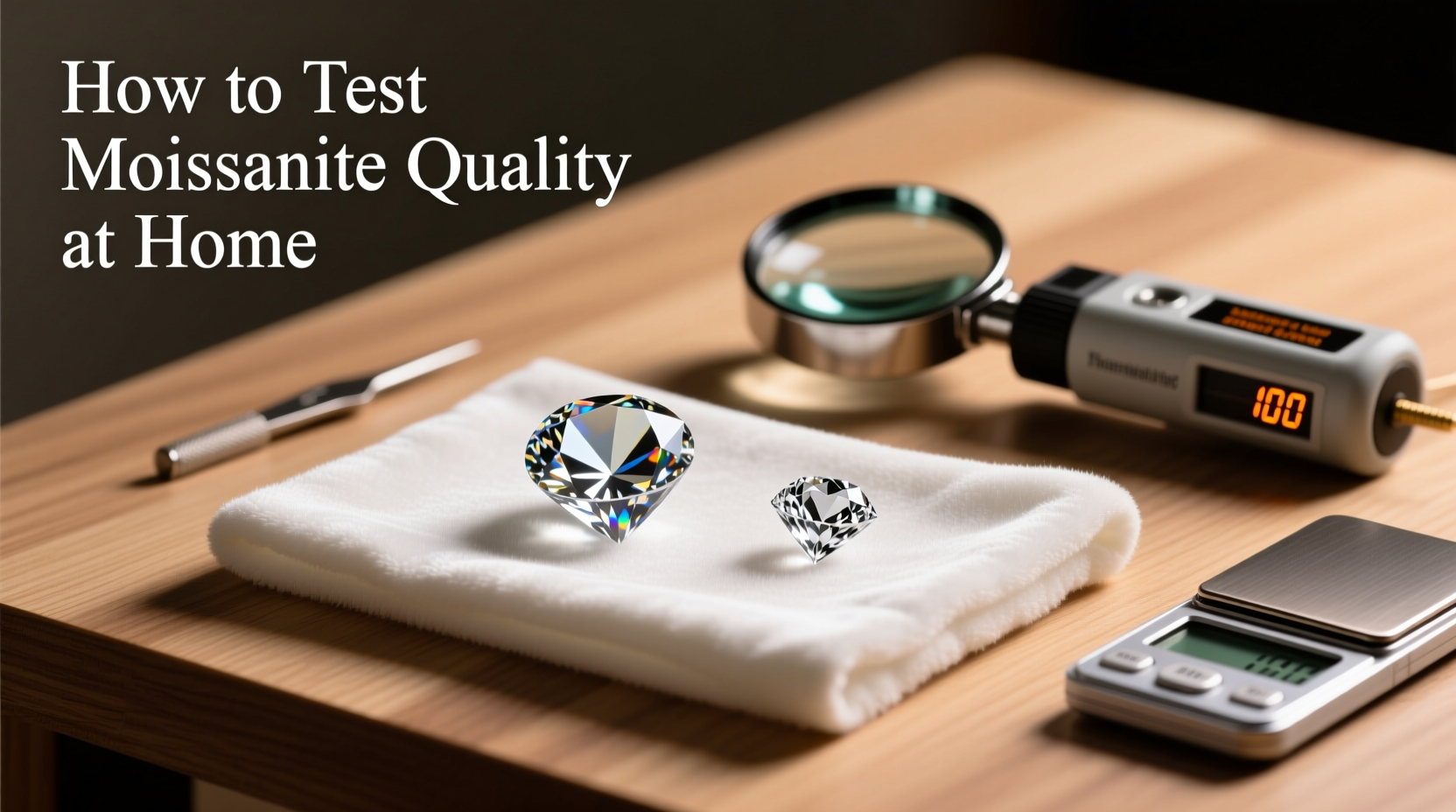
Like diamonds, moissanite is evaluated based on several key characteristics: cut, color, clarity, and carat weight. However, because moissanite is lab-created and nearly always internally flawless, clarity is less of a concern than in natural diamonds. Instead, visual performance—how the stone interacts with light—is the primary indicator of quality.
- Cut: A well-cut moissanite maximizes brilliance (white light return) and dispersion (rainbow flashes). Poorly cut stones may appear dull or exhibit dark areas.
- Color: Most moissanite ranges from colorless (D-F) to near-colorless (G-J), though some exhibit faint yellow or gray tints under certain lighting.
- Clarity: Virtually all commercial moissanite is eye-clean, but minor inclusions may be visible under magnification.
- Brilliance & Fire: Moissanite disperses more colored light than diamond, giving it a distinctive sparkle. Excessive fire, however, can signal lower optical precision.
Step-by-Step Guide to At-Home Testing Methods
Accurate assessment begins with controlled observation and basic tests. Follow this sequence for comprehensive evaluation:
- Prepare Your Environment: Work in a clean, well-lit space with minimal distractions. Use a white surface to avoid color contamination.
- Clean the Stone: Wipe the moissanite with a soft, lint-free cloth dampened with mild soapy water. Residue can distort light performance.
- Use a 10x Loupe or Jeweler’s Magnifier: Inspect the surface for scratches, chips, and polish quality. Check facet alignment—misaligned facets indicate poor cutting.
- Test Thermal Conductivity (Optional): Use a handheld diamond tester. Moissanite typically registers as “diamond” due to its high thermal conductivity, which can cause confusion. This isn’t a flaw—it confirms the stone is not glass or cubic zirconia.
- Evaluate Under UV Light: Genuine moissanite may show blue or green fluorescence under long-wave UV light. Lack of fluorescence doesn’t mean it’s fake—some batches are inert.
- Compare with a Diamond (if available):strong> Observe side-by-side in direct sunlight. Moissanite will display stronger fire (colored sparkle), while diamond shows more white brilliance.
Advanced Home Test: The Dot Test for Double Refraction
One of moissanite’s defining properties is double refraction—light passing through the stone splits into two rays. This can be observed at home:
- Place the stone table-down on a piece of paper with a small dot drawn on it.
- Look directly down through the crown (top) of the stone.
- If you see two distinct dots or a blurred double image, the stone is likely moissanite.
- Diamonds, being singly refractive, will show only one dot.
Note: This test works best on loose stones. Mounted settings may obstruct the view.
Comparison Table: Moissanite vs. Common Imitations
| Property | Moissanite | Diamond | Cubic Zirconia (CZ) | Glass Imitation |
|---|---|---|---|---|
| Refractive Index | 2.65–2.69 | 2.42 | 2.15–2.18 | 1.5–1.7 |
| Dispersion (Fire) | 0.104 (Very High) | 0.044 (Moderate) | 0.059 (High) | 0.010 (Low) |
| Hardness (Mohs) | 9.25 | 10 | 8–8.5 | 5–6 |
| Double Refraction | Yes | No | No | No |
| Diamond Tester Result | Positive (often reads as diamond) | Positive | Negative | Negative |
This table helps contextualize why certain tests yield specific results. For example, a stone that passes a diamond tester but shows double refraction is almost certainly moissanite.
Real Example: Identifying a Misrepresented Stone
Sarah purchased an engagement ring online labeled as a “lab-grown diamond.” Upon delivery, she noticed unusually vivid rainbow flashes under indoor lighting. Curious, she performed the dot test using a printed period from a magazine. Through the stone, she saw two distinct dots. She then borrowed a friend’s diamond tester—the device beeped, indicating “diamond.” Confused, she consulted a local jeweler who confirmed it was moissanite. The seller hadn’t lied about it being lab-created, but omitted the material identity. Armed with her observations, Sarah requested a refund and received it after providing photo evidence of the double refraction.
This case illustrates how combining simple tests prevents misrepresentation and supports consumer rights.
“Consumers don’t need a gem lab to spot inconsistencies. A loupe, a light source, and basic knowledge of optical properties go a long way.” — Dr. Lena Torres, GIA-Certified Gemologist
Checklist: At-Home Moissanite Assessment
Use this checklist to systematically evaluate any moissanite stone:
- ✅ Clean the stone thoroughly before inspection
- ✅ Examine under natural daylight and artificial light
- ✅ Use a 10x loupe to check facet symmetry and surface finish
- ✅ Perform the dot test for double refraction
- ✅ Use a diamond tester (note: moissanite may register as diamond)
- ✅ Shine UV light to observe fluorescence patterns
- ✅ Compare fire and brilliance with known diamond (if possible)
- ✅ Assess color grade by viewing face-up on white background
Frequently Asked Questions
Can a diamond tester tell moissanite apart from diamond?
Most basic diamond testers cannot. Moissanite conducts heat similarly to diamond, so it often triggers a “diamond” reading. Advanced testers with dual-mode (thermal + electrical conductivity) can distinguish between the two, as moissanite is electrically conductive and diamond is not (except blue type IIb).
Is high fire in moissanite a sign of low quality?
Not necessarily. High dispersion is inherent to moissanite. However, excessive “disco-ball” sparkle under normal light may indicate a shallow cut or poor light performance design. Premium cuts balance fire with white brilliance for a more diamond-like appearance.
Does moissanite lose its sparkle over time?
No, moissanite does not degrade or cloud like cubic zirconia. However, surface oils, lotions, and dirt can dull its appearance. Regular cleaning with mild soap and water restores full brilliance.
Conclusion: Empower Yourself with Knowledge
Testing moissanite at home doesn’t require expensive equipment—just attention to detail and an understanding of its unique properties. By leveraging simple tools and consistent observation, you can confidently assess quality, verify authenticity, and protect your investment. Whether you're a first-time buyer or a seasoned collector, these methods bridge the gap between professional grading and personal assurance.




 浙公网安备
33010002000092号
浙公网安备
33010002000092号 浙B2-20120091-4
Comments
No comments yet. Why don't you start the discussion?