
Moissanite has gained widespread popularity as an affordable, durable, and visually stunning alternative to diamond. Its brilliance, fire, and hardness make it a favorite among ethical jewelry buyers and budget-conscious consumers. However, its close resemblance to diamond—and the rise of synthetic diamonds—means accurate identification is essential. Using a moissanite tester correctly is one of the most reliable ways to confirm authenticity. This guide outlines proven techniques, tools, and best practices to help you confidently distinguish real moissanite from look-alikes.
Understanding Moissanite and Why Testing Matters
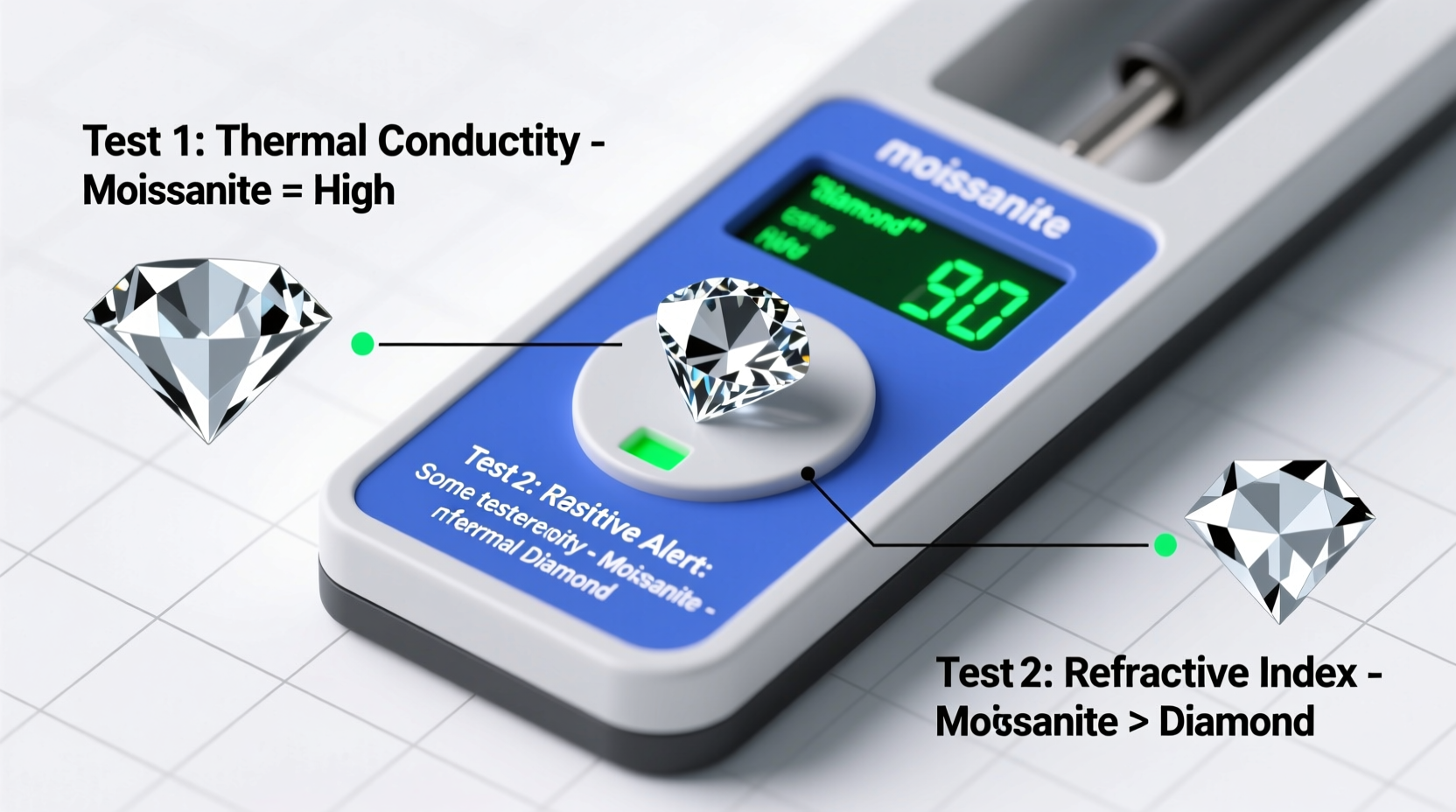
Moissanite is a silicon carbide mineral first discovered in meteorites by Dr. Henri Moissan in 1893. Today, all commercial moissanite is lab-created, offering consistent quality and ethical sourcing. While visually similar to diamonds, moissanite has distinct physical properties—most notably higher thermal and electrical conductivity—that allow testers to differentiate it.
Misidentification can lead to overpayment, incorrect insurance valuations, or unknowingly selling a different gemstone. Many standard diamond testers rely solely on thermal conductivity, which can mistake moissanite for diamond. Therefore, using a dual-mode tester that measures both thermal and electrical conductivity is critical.
“Moissanite conducts electricity—a trait diamonds lack. That single difference is the key to accurate testing.” — Dr. Alan Reed, Gemologist and Materials Scientist
How Moissanite Testers Work: The Science Behind Detection
Diamond testers detect how quickly heat or electricity moves through a stone. Traditional testers use thermal probes: diamonds dissipate heat rapidly, giving them a unique signature. However, moissanite also dissipates heat efficiently, so older testers often misidentify it as diamond.
Modern dual-mode testers solve this problem by adding electrical conductivity testing. Moissanite is electrically conductive; natural diamonds are not (with rare exceptions like blue boron-doped diamonds). When both tests are combined, results become highly accurate.
Step-by-Step Guide to Testing Moissanite Accurately
To ensure precise results, follow this systematic process every time you test a stone:
- Power on and calibrate the tester – Allow it to warm up and check battery level. Some models require calibration against a known diamond or moissanite.
- Clean the stone thoroughly – Oils, lotions, or residue can interfere with readings. Use a soft cloth and jewelry cleaner.
- Position the probe correctly – Place the tip perpendicular to the stone’s surface, ideally on a flat facet like the table. Avoid edges or settings.
- Apply gentle, consistent pressure – Too much force may damage the stone or probe; too little yields inaccurate contact.
- Observe the result – Dual-mode testers display separate indicators for diamond and moissanite. If the moissanite light activates, the stone is likely genuine moissanite.
- Test multiple points – Especially on mounted stones, test several facets to rule out false negatives due to metal interference.
- Verify with secondary methods if uncertain – Use magnification or consult a professional lab for confirmation.
Common Pitfalls and How to Avoid Them
Even experienced users can misread results due to environmental or technical factors. Awareness of these issues improves accuracy:
- Testing mounted stones near metal: Metal settings can conduct heat or electricity, skewing results. Isolate the stone as much as possible.
- Low battery: Weak power affects sensor sensitivity. Replace batteries regularly.
- Dirty or worn probe: Clean the tip with a soft brush or alcohol wipe monthly. A damaged probe should be replaced.
- Confusing lab-grown diamonds with moissanite: Lab diamonds have the same thermal profile as natural ones but do not conduct electricity. A dual-mode tester will still distinguish them from moissanite.
| Factor | Problem | Solution |
|---|---|---|
| Single-mode tester | Mistakes moissanite for diamond | Use only dual-mode testers |
| Oily stone surface | False negative | Clean with alcohol before testing |
| Thick metal setting | Interferes with electrical reading | Test exposed facets; reposition if needed |
| Old or damaged probe | Inconsistent results | Inspect monthly; replace when dull |
Real-World Example: Identifying Moissanite in a Vintage-Style Ring
A customer brought a vintage-cut solitaire ring to a local jeweler, believing it was a diamond heirloom. The jeweler used a basic thermal tester, which indicated “diamond.” Suspicious due to the stone’s strong double refraction (visible under magnification), they used a dual-mode tester. The electrical conductivity function lit up—confirming it was moissanite.
Further inspection revealed manufacturer lasering inside the girdle: “Charles & Colvard Created Moissanite,” a common mark on branded stones. The customer was surprised but pleased to learn their ring was authentic moissanite—valuable in its own right, especially given its excellent cut and clarity.
This case highlights why relying on technology alone isn’t enough. Combining tester results with visual inspection prevents costly errors.
Additional Verification Methods Beyond the Tester
While testers are fast and convenient, they’re not infallible. For high-value transactions or uncertainty, supplement testing with these methods:
- Loupe or microscope inspection: Look for double refraction—moissanite splits light into two rays, visible as doubled facet junctions under 10x magnification. Diamonds show no doubling.
- Refractometer test: Moissanite has a refractive index of 2.65–2.69, higher than diamond (2.42). Requires loose stones and expertise.
- UV fluorescence: Some moissanite exhibits green or yellow fluorescence under UV light, unlike most diamonds.
- Professional grading report: Reputable labs like GCAL or IGI offer certification specifying whether a stone is moissanite, including origin and quality.
FAQ: Common Questions About Moissanite Testing
Can a diamond tester detect lab-grown diamonds?
Yes—lab-grown diamonds have the same thermal conductivity as natural diamonds, so they register as diamond on thermal testers. However, since they don’t conduct electricity, dual-mode testers won’t confuse them with moissanite.
Is it possible to get a false positive for moissanite?
Rarely, but possible. Some rare conductive diamonds (like type IIb) may trigger the electrical sensor. These are extremely uncommon and usually identified by color (blue-gray) and professional analysis.
Do all moissanite brands test the same?
Yes. Whether it’s Charles & Colvard, Forever One, or generic silicon carbide, all moissanite shares the same electrical conductivity. Brand doesn’t affect tester response.
Essential Checklist for Confident Moissanite Identification
- ✅ Use a dual-mode (thermal + electrical) tester
- ✅ Clean the stone before testing
- ✅ Test multiple facets, especially on mounted pieces
- ✅ Check for double refraction under magnification
- ✅ Verify probe condition and battery strength
- ✅ Consult a gemological lab for high-value items
- ✅ Look for manufacturer inscriptions on the girdle
Conclusion: Empower Yourself with Knowledge and the Right Tools
Identifying genuine moissanite isn’t about suspicion—it’s about confidence. Whether you’re a buyer, seller, or collector, using a proper tester correctly ensures you make informed decisions. Moissanite is a beautiful, legitimate gemstone with its own market value and appeal. Knowing how to verify it protects your investment and builds trust in every transaction.




 浙公网安备
33010002000092号
浙公网安备
33010002000092号 浙B2-20120091-4
Comments
No comments yet. Why don't you start the discussion?