
Navigating time-off requests can be a delicate balance between personal needs and professional responsibilities. Whether it’s for vacation, family obligations, health reasons, or mental wellness, how you communicate your request significantly impacts whether it’s approved—and how it’s perceived by your manager and team. A well-timed, respectful, and clear request not only increases your chances of approval but also reinforces your reputation as a reliable employee.
This guide breaks down the most effective strategies for asking for time off, offering actionable advice, realistic examples, and ready-to-use templates that align with professional standards across industries.
Plan Ahead: The Foundation of a Successful Request
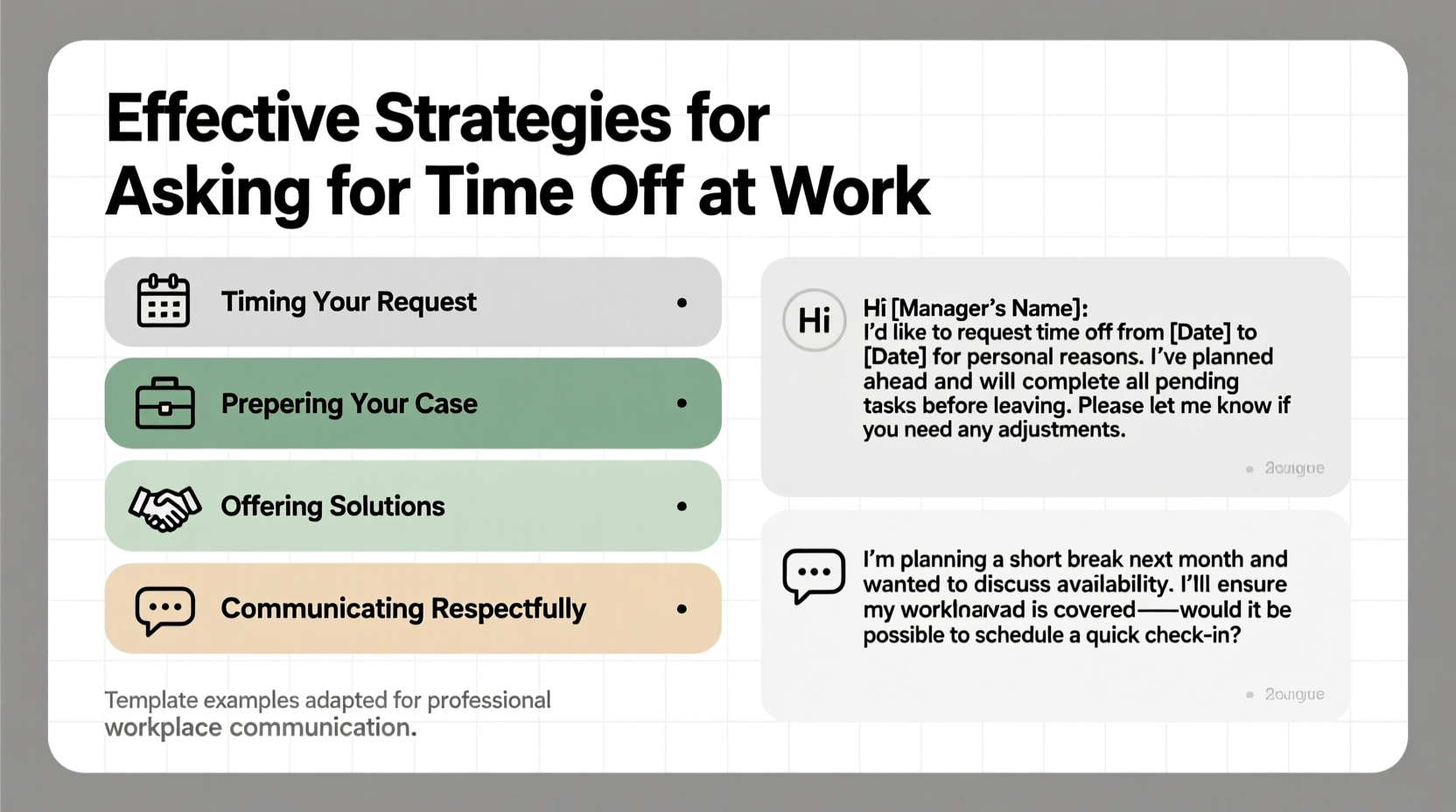
One of the most overlooked aspects of requesting time off is timing. Submitting a last-minute request—especially during busy periods—can strain team dynamics and reduce the likelihood of approval. Planning ahead demonstrates responsibility and respect for your team’s workload.
Consider these factors when scheduling your time off:
- Company policies: Review your organization’s leave policy, including blackout periods or required notice windows (e.g., two weeks for vacation).
- Workload cycles: Avoid peak seasons such as end-of-quarter reporting, product launches, or holiday rushes unless absolutely necessary.
- Team capacity: Ensure your absence won’t leave critical tasks unattended. If possible, coordinate with colleagues who can cover key responsibilities.
Communicate Clearly and Professionally
The way you phrase your request matters. Clarity, brevity, and professionalism go a long way in shaping how your request is received. Your message should include:
- The dates you’re requesting off.
- The reason (optional, but often helpful for context).
- How your responsibilities will be managed in your absence.
- Your availability, if any, during the leave.
Transparency builds trust. For example, saying “I’ll be fully offline to recharge” sets boundaries, while offering to check emails occasionally may be appropriate for urgent roles—but only if genuinely feasible.
Email Template: Standard Vacation Request
Subject: Time-Off Request – [Your Name] – [Start Date] to [End Date]

Hi [Manager's Name],

I’d like to request time off from [start date] to [end date] for a planned vacation. I’ve reviewed the upcoming deadlines and will complete all priority tasks before my departure.

During my absence, [Colleague's Name] has agreed to handle [specific duties], and I’ll provide a detailed handover by [date]. I’ll set an out-of-office message and will be fully offline to disconnect and return refreshed.

Please let me know if you’d like to discuss this further. I appreciate your consideration.

Best regards,
[Your Full Name]
[Job Title]
Know What to Avoid: Common Mistakes in Time-Off Requests
Even with good intentions, certain missteps can undermine your credibility or delay approval. Below is a comparison of do’s and don’ts when requesting time off.
| Do’s | Don’ts |
|---|---|
| Give at least two weeks’ notice for short leaves. | Submit a request the day before you plan to leave. |
| Offer a coverage plan for your responsibilities. | Assume someone else will figure it out. |
| Be honest about the reason (if comfortable). | Use vague excuses like “personal stuff” without context. |
| Follow up if you don’t hear back in 48 hours. | Send multiple follow-ups in one day. |
| Respect company policy on carryover or PTO caps. | Accrue excessive unused days then request a month off abruptly. |
Real-World Example: Handling a Family Emergency Leave
Sarah, a project coordinator at a mid-sized tech firm, needed to travel unexpectedly for a family medical emergency. She knew her sudden absence could impact an ongoing client rollout.
Instead of sending a panicked email, she called her manager first, explained the situation briefly, and followed up with a written request that included:
- A clear timeframe: “I need to leave tomorrow morning and expect to return in eight days.”
- A coverage plan: “I’ve briefed Alex on the client deliverables and shared updated documentation in the team drive.”
- An offer to assist remotely if stable: “I’ll have limited connectivity, but I can review critical updates if needed.”
Her proactive approach earned empathy and support. Her manager approved the leave immediately and praised her professionalism under pressure.
“Employees who plan thoughtfully—even during emergencies—show leadership and accountability. That’s what we value most.” — Jamal Reeves, HR Director at Nexa Solutions
Step-by-Step Guide to Requesting Time Off
Follow this five-step process to increase your chances of a smooth approval:
- Review company policy: Check PTO accrual, notice requirements, and any restrictions (e.g., no more than two people off during Q4).
- Choose the right moment: Bring it up after a successful project completion or during a calm period, not during a crisis.
- Prepare a coverage plan: Identify who will handle your tasks and document key processes.
- Submit formally: Use email or your company’s HR platform to create a paper trail.
- Confirm and follow up: Once approved, update your calendar, set an out-of-office message, and thank your manager.
Frequently Asked Questions
Can I request time off during a busy season?
Yes, but be prepared to justify the necessity and offer exceptional coverage. If it’s non-negotiable (e.g., surgery or family event), communicate early and empathetically. Approval isn’t guaranteed, but transparency improves outcomes.
Should I mention the reason for my leave?
It depends. For vacation or personal development, a brief explanation adds context. For medical or mental health leave, you’re not obligated to disclose details—just state it’s for personal health reasons. In the U.S., FMLA-eligible leaves require certification but protect privacy.
What if my request is denied?
Ask for feedback respectfully. You might say, “I understand the timing isn’t ideal. Would next month be a better window?” Use the conversation to learn about team priorities and reframe your request accordingly.
Special Cases: Mental Health Days and Unplanned Leaves
Mental health days are increasingly recognized as legitimate reasons for time off. When requesting one, frame it as part of sustainable performance.
Subject: Short-Term Leave for Personal Wellbeing

Hi [Manager's Name],

I’m feeling overwhelmed and need a day to reset and focus on my mental wellbeing. I’d like to take tomorrow, [date], as a personal day.

All urgent tasks are up to date, and I’ll remain reachable for true emergencies. I plan to return refreshed and fully engaged on [return date].

Thank you for your understanding.

Best,
[Your Name]
This approach normalizes self-care without oversharing, maintaining professionalism while honoring personal needs.
Final Checklist Before Sending Your Request
- ✅ Reviewed PTO balance and company policy
- ✅ Chosen optimal timing (not during peak workload)
- ✅ Prepared a handover plan or delegated tasks
- ✅ Drafted a clear, polite email with exact dates
- ✅ Proofread for tone and clarity
- ✅ Sent via preferred company channel (email, HR system, etc.)
Conclusion
Asking for time off doesn’t have to be stressful or guilt-inducing. With thoughtful planning, clear communication, and mutual respect, you can secure the break you need while maintaining strong professional relationships. The strategies and templates provided here are designed to help you navigate this common workplace interaction with confidence and competence.




 浙公网安备
33010002000092号
浙公网安备
33010002000092号 浙B2-20120091-4
Comments
No comments yet. Why don't you start the discussion?