
Most professionals use LinkedIn to send connection requests, follow companies, or post updates. But if that’s all you’re doing, you're only scratching the surface. The real power of LinkedIn lies in strategic networking—finding the right people, engaging meaningfully, and building relationships that open doors. Moving beyond basic \"Connect\" button clicks requires intentionality, insight, and a few underused tactics that most overlook.
Whether you're seeking new clients, career opportunities, or industry mentors, expanding your network with purpose can transform your professional trajectory. Here are proven strategies to help you uncover valuable contacts and cultivate authentic connections.
Leverage Mutual Connections Strategically
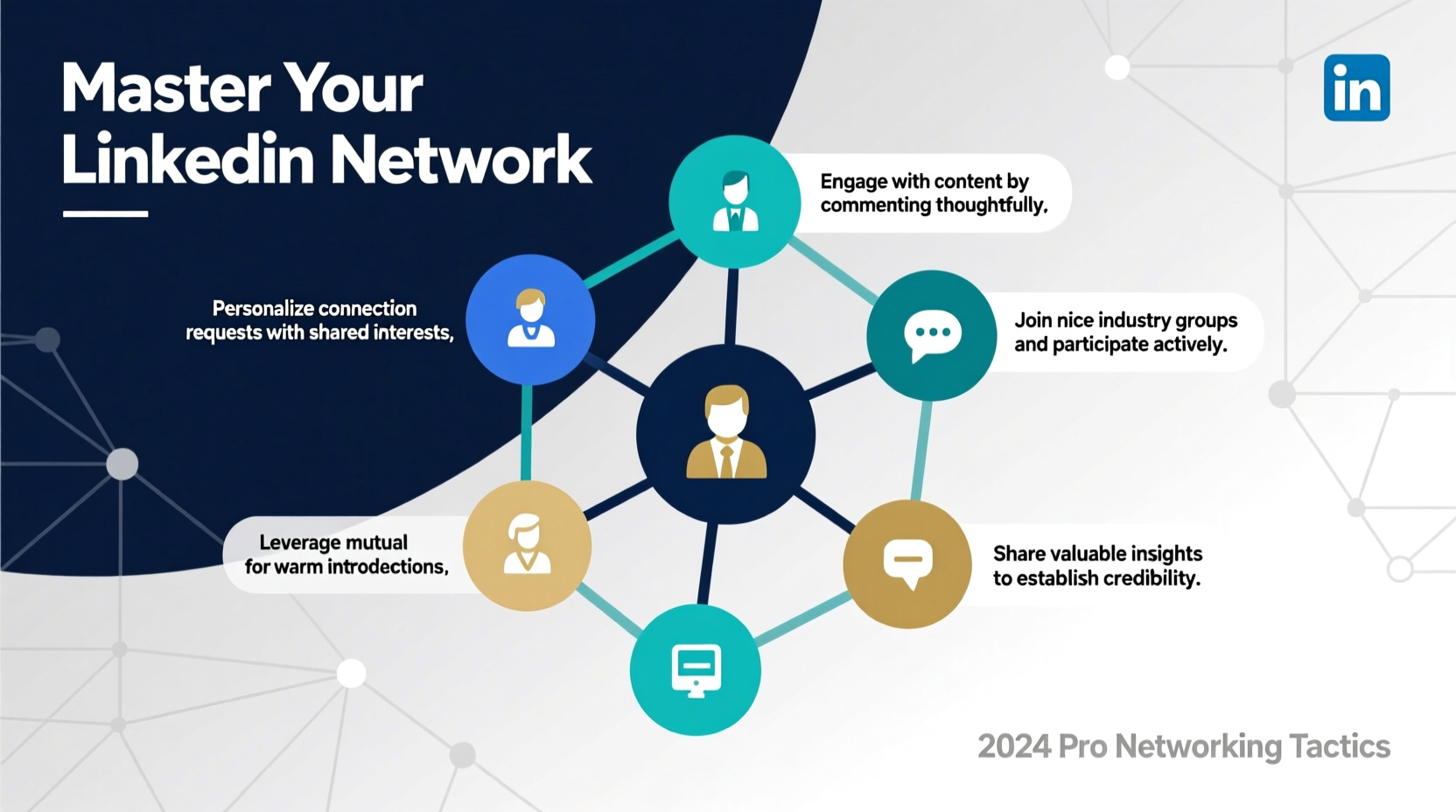
LinkedIn shows mutual connections on profile pages, but most users stop there. Instead of relying solely on direct outreach, use shared contacts as relationship bridges. A warm introduction from someone you both know dramatically increases response rates compared to cold invites.
When reviewing a target contact’s profile, identify mutual connections who are active and well-positioned. Reach out to them first with a personalized message:
“Hi [Name], I noticed we’re both connected to [Target Contact]. I’m currently exploring opportunities in [Industry/Field] and would value an introduction if appropriate. Would you be open to sharing a brief note when connecting me?”
This approach builds trust through association and positions your request as collaborative rather than transactional.
Use Boolean Search to Uncover Hidden Contacts
LinkedIn’s native search is limited unless you upgrade to Sales Navigator. However, even with the free version, you can use Boolean logic in Google to find precise profiles. This technique bypasses filters and surfaces results that standard searches miss.
Structure your query using site-specific operators and keywords. For example:
site:linkedin.com/in \"digital marketing manager\" \"New York\" -\"recruiter\" -\"agency\"
This search finds digital marketing managers in New York while excluding recruiters and agency staff—ideal for targeting in-house decision-makers.
Combine terms like job title, location, company, skills, or alma mater to narrow results. Use quotation marks for exact phrases, “-” to exclude irrelevant roles, and “OR” to broaden scope (e.g., “product manager OR product owner”).
| Search Goal | Boolean Query Example |
|---|---|
| Find UX designers at tech startups in Austin | site:linkedin.com/in \"UX designer\" \"Austin\" \"startup\" OR \"tech\" |
| Exclude sales roles when searching for engineers | site:linkedin.com/in engineer -sales -\"account executive\" |
| Locate alumni from Stanford in venture capital | site:linkedin.com/in \"Stanford University\" \"venture capital\" -student |
Engage Before You Connect
One of the biggest mistakes professionals make is sending a connection request with no prior interaction. Without context, your invite is easily ignored or dismissed as spam.
Instead, engage with a person’s content for 2–3 weeks before reaching out. Like, comment thoughtfully, or share their posts with added insight. This establishes visibility and familiarity.
A comment such as, “Your point about AI-driven customer service resonates—our team saw a 40% efficiency gain after implementing chatbots last quarter,” signals expertise and genuine interest.
Over time, this subtle engagement builds social proof. When you finally send a connection request, your name isn’t陌生—they recognize you as someone who adds value.
“People don’t connect with strangers. They connect with contributors.” — Laura Huang, Harvard Business School Professor and Networking Researcher
Step-by-Step: Building a Targeted Outreach Campaign
To systematically grow high-value connections, follow this five-step process:
- Define Your Objective: Are you looking for mentors, partners, clients, or job referrals? Clarity shapes your search.
- Identify Target Criteria: Industry, role, company size, location, or shared background (e.g., alumni).
- Use Boolean or Sales Navigator Search: Locate 50–100 relevant profiles. Save them to a list.
- Engage Publicly: Comment on recent posts or articles they’ve shared. Aim for three interactions per person.
- Send Personalized Invitations: Reference their content or mutual interests. Avoid templates.
Example message:
“Hi [First Name], I’ve been following your insights on sustainable supply chains—especially your post about circular logistics. As someone working in green operations at [Your Company], I’d appreciate connecting and exchanging ideas.”
Join and Participate in Niche LinkedIn Groups
While public groups have declined in popularity, private and industry-specific LinkedIn groups remain active hubs for professionals. These communities attract members with shared challenges and goals, making them ideal for discovering aligned contacts.
Search for groups using keywords like “B2B SaaS founders,” “Women in Engineering,” or “FinTech Innovators.” Once you join, avoid self-promotion. Instead, contribute by answering questions, sharing resources, or starting discussions.
Active participation increases your visibility and positions you as a knowledgeable peer. Over time, group members will begin connecting with you organically.
Mini Case Study: From Cold Outreach to Strategic Partnership
Sophie, a freelance UX researcher, wanted to break into the health tech space. Rather than mass-connecting with “health tech professionals,” she identified 30 key players using Boolean search and filtered by companies like Omada Health and Livongo.
She engaged with their posts for three weeks, commenting on topics like patient-centered design and HIPAA-compliant research. She also joined the “Digital Health Innovators” LinkedIn group and shared a case study on remote usability testing.
Within a month, four individuals messaged her directly to learn more about her work. One led to a paid consulting project; another introduced her to a startup CEO who later hired her full-time.
By focusing on visibility before connection, Sophie turned passive browsing into tangible career growth.
Do’s and Don’ts of LinkedIn Networking
| Do | Don't |
|---|---|
| Personalize every connection request | Use the default “I’d like to connect” message |
| Engage with content before reaching out | Send connection requests immediately after finding someone |
| Mention mutual interests or shared experiences | Lead with a sales pitch or job ask |
| Follow up once, politely, after connecting | Spam multiple messages if they don’t respond |
| Contribute value in groups and comments | Promote your services in every post |
FAQ
How many connection requests should I send per day?
LinkedIn recommends staying under 100 per week to avoid being flagged as spam. Focus on quality over quantity—sending 10–15 highly targeted, personalized invites daily is far more effective than blasting hundreds of generic ones.
Is it okay to reconnect with someone who declined my request?
No. If someone declines, respect their decision. Instead, continue engaging with their public content. If circumstances change or you develop a stronger reason to connect, they may accept a future request.
What’s the best time to send LinkedIn messages?
Tuesdays, Wednesdays, and Thursdays between 8–10 AM or 12–2 PM local time tend to yield the highest open and response rates. Avoid weekends unless you’re in a global industry with asynchronous communication norms.
Final Checklist: Advanced LinkedIn Connection Strategy
- ✅ Define your networking goal (clients, mentors, jobs, etc.)
- ✅ Use Boolean search or Sales Navigator to find precise contacts
- ✅ Identify and leverage mutual connections for warm intros
- ✅ Engage with target contacts’ content for 2–3 weeks
- ✅ Join and actively participate in 2–3 niche LinkedIn groups
- ✅ Send personalized invitations referencing shared interests
- ✅ Follow up once with a value-driven message after connecting
Take Action Today
Expanding your LinkedIn network isn’t about collecting contacts—it’s about cultivating relationships. The most impactful connections often come not from who you know, but how you show up. By combining smart search techniques, consistent engagement, and thoughtful outreach, you position yourself as a trusted professional worth knowing.
Start small: pick one strategy from this guide and apply it this week. Whether it’s crafting a Boolean search, joining a niche group, or re-engaging with past content, momentum begins with action. Build these habits into your routine, and watch your network—and opportunities—grow with purpose.




 浙公网安备
33010002000092号
浙公网安备
33010002000092号 浙B2-20120091-4
Comments
No comments yet. Why don't you start the discussion?