
Finding someone based on their address is a common need—whether you're reconnecting with an old friend, verifying a tenant's background, or locating a long-lost relative. While digital privacy laws limit access to personal data, public records, online tools, and investigative techniques can still yield results when used responsibly and legally. This guide outlines practical, ethical strategies to help you locate individuals using only an address, without violating privacy or breaking the law.
Understanding What’s Possible—and Legal
Before beginning any search, it's essential to understand the boundaries of legality and ethics. In most countries, including the United States, personal information such as phone numbers, email addresses, and family connections are protected under privacy regulations. However, certain data remains publicly accessible through government records, property databases, and licensed data brokers.
Using an address as a starting point allows access to several types of public records, including:
- Property ownership records
- Voter registration data
- Court filings (e.g., evictions, liens)
- Utility service history (limited availability)
- Tenant and landlord registries in some municipalities
These sources do not always provide direct contact details but can lead to identifying occupants or previous residents linked to an address.
“Public records are powerful tools for legitimate inquiries, but they must be used with respect for privacy and purpose.” — David Lin, Investigative Researcher & Privacy Advocate
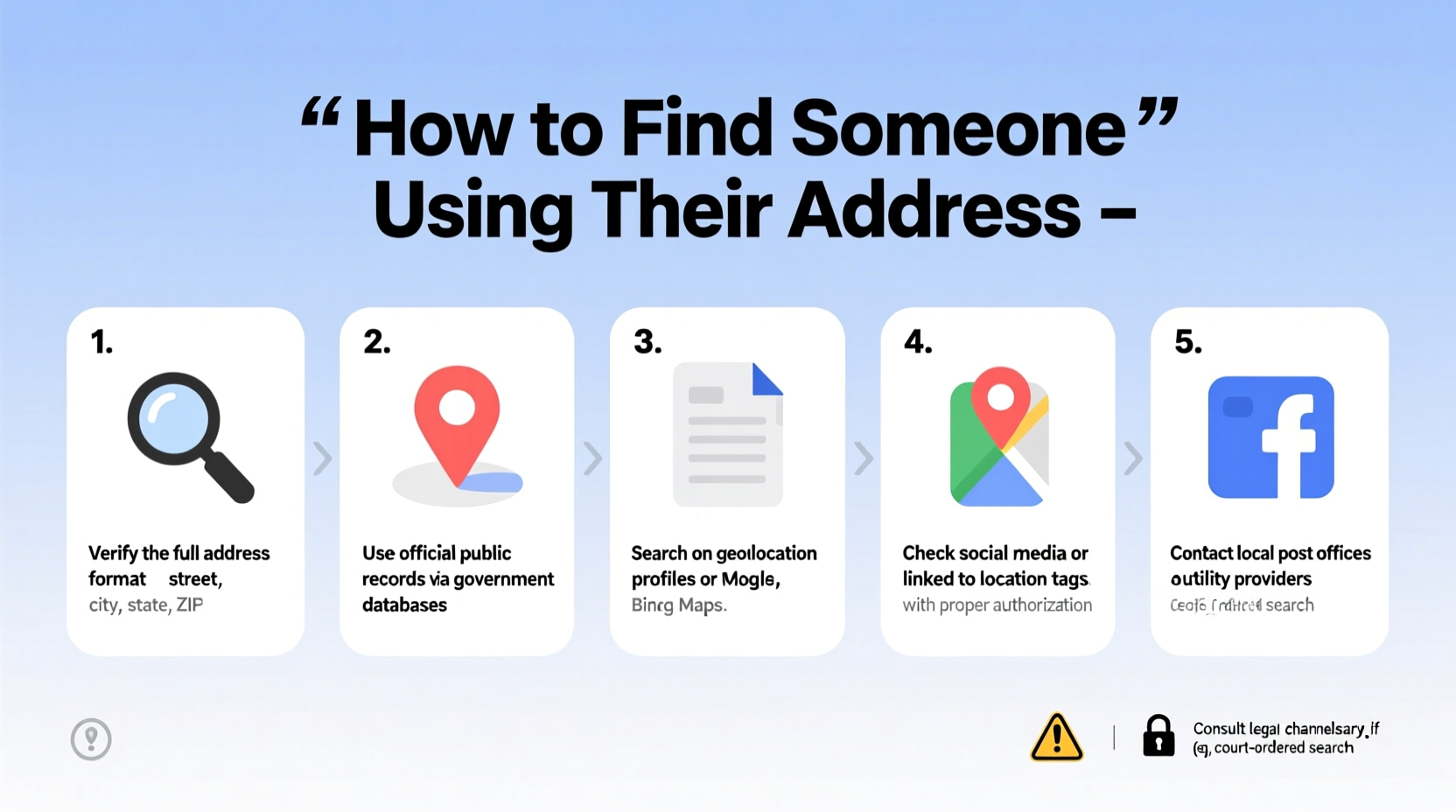
Step-by-Step Guide to Finding Someone Using Their Address
The process of identifying someone from an address involves systematic research across multiple platforms. Follow these steps to maximize your chances of success while staying within legal boundaries.
- Verify the Address Accuracy
Start by confirming the full, correct address. Even minor errors—like \"St.\" vs. \"Street\" or incorrect ZIP codes—can derail your search. Use Google Maps or USPS’s ZIP Code Lookup tool to validate formatting and existence. - Search Public Property Records
Visit your county’s assessor or recorder office website. These portals list property owners by address. Search for the property to find the registered owner’s name, parcel number, and sometimes mailing address. For example:- L.A. County Assessor:
assessor.lacounty.gov - Dallas County Clerk:
dallascounty.org
- L.A. County Assessor:
- Check Voter Registration Databases
In many states, voter rolls are public records. Access them via state election websites or third-party services like TruthFinder or PeopleFinders, which aggregate this data legally. Enter the address to see registered voters at that location. - Use Reverse Address Lookup Services
Paid platforms such as BeenVerified, Spokeo, or Intelius allow reverse address searches. They compile data from public records, social media, and business listings. Results may include:- Current and past residents
- Phone numbers
- Relatives and associates
- Age and possible employment
- Explore Social Media Geotags and Profiles
While rare, some users tag locations in posts or list addresses in bios. Search Facebook, Instagram, or LinkedIn using the address or nearby landmarks. You can also use advanced search operators:Tip: Try searching on Google with:\"123 Main St, Anytown\" site:facebook.comto find public mentions. - Review Obituaries, News Archives, and Legal Notices
Local newspapers often publish obituaries, marriage licenses, or court notices that mention addresses. Use sites like Legacy.com or NewsArchive.com to search by location. - Contact Neighbors Discreetly (If Appropriate)
If you have a legitimate reason—such as reuniting with family—you may consider visiting the neighborhood. Introduce yourself honestly, without deception. Avoid confrontational or suspicious behavior.
Do’s and Don’ts When Searching by Address
| Do’s | Don’ts |
|---|---|
| Use official government websites for public records | Never impersonate law enforcement or government officials |
| Document your search steps for clarity | Avoid harassment or repeated contact attempts |
| Respect privacy—use information only for lawful purposes | Don’t use data for stalking, fraud, or intimidation |
| Double-check all findings across multiple sources | Assume one result is definitive without verification |
Mini Case Study: Reconnecting After Decades
Sarah Thompson, a retired teacher from Ohio, wanted to find her childhood neighbor, James Reed, who had moved away in the 1980s. She only remembered his last known address: 457 Oakridge Drive, Toledo, OH.
Sarah began by searching Lucas County’s property records and discovered the current owner was not James. However, historical deed transfers showed the house was sold in 1991 by “James R. Reed” to a couple named Miller. She then used a reverse address lookup on BeenVerified, which listed James as a former resident and linked him to a relative in Indiana.
Through a Facebook search using the relative’s name and location, Sarah found a post mentioning James’s recent retirement party. She reached out respectfully through a mutual connection and successfully reconnected after 38 years.
This case highlights how combining public records, data aggregators, and social media—with patience and discretion—can lead to meaningful outcomes.
Essential Tools and Resources Checklist
To streamline your search, use this checklist of reliable tools and actions:
- ✅ Confirm the address using Google Maps or USPS Verify
- ✅ Visit the county assessor/recorder website for ownership records
- ✅ Search voter registration databases (state-specific)
- ✅ Run a reverse address search on BeenVerified or TruthFinder
- ✅ Check social media with geolocation keywords
- ✅ Review news archives and obituary sites
- ✅ Validate findings across at least two independent sources
- ✅ Document each step for future reference
Frequently Asked Questions
Can I find someone’s phone number just from their address?
Not directly through public records. Phone numbers are generally private. However, reverse address lookup services may associate landline numbers with addresses if the number is listed and tied to public directories.
Is it legal to search for someone using their address?
Yes, as long as you use publicly available data and do not intend to harass, defraud, or stalk. Using information for illegal purposes violates federal and state laws, including the FCRA (Fair Credit Reporting Act).
What if the person is not the property owner?
Rental units complicate ownership-based searches. In such cases, tenant screening services (for landlords), utility records (not public), or reverse lookups may reveal occupant names. Some cities maintain rental registries—check local housing authorities.
Conclusion: Responsible Searching Leads to Real Results
Finding someone using only their address requires persistence, attention to detail, and a commitment to ethical practices. By leveraging public records, trusted online tools, and logical deduction, you can uncover valuable leads without overstepping legal or moral boundaries.
Whether you’re seeking closure, reconnecting with family, or conducting due diligence, the key is to approach the process with respect and transparency. Every piece of data should serve a legitimate purpose—not invade someone’s right to privacy.




 浙公网安备
33010002000092号
浙公网安备
33010002000092号 浙B2-20120091-4
Comments
No comments yet. Why don't you start the discussion?