
Capital letters have their place—on road signs, in legal disclaimers, or for emphasis. But when it comes to everyday digital communication, excessive use of ALL CAPS can come across as shouting, reduce readability, and make messages feel impersonal. Whether you're editing an email, formatting a social media post, or cleaning up copied text, converting uppercase text to lowercase is a small change that significantly improves clarity and tone. The good news? You don’t need advanced technical skills. With the right tools and techniques, transforming all caps into readable, lowercase text is fast, simple, and often automatic.
Why Lowercase Text Enhances Communication
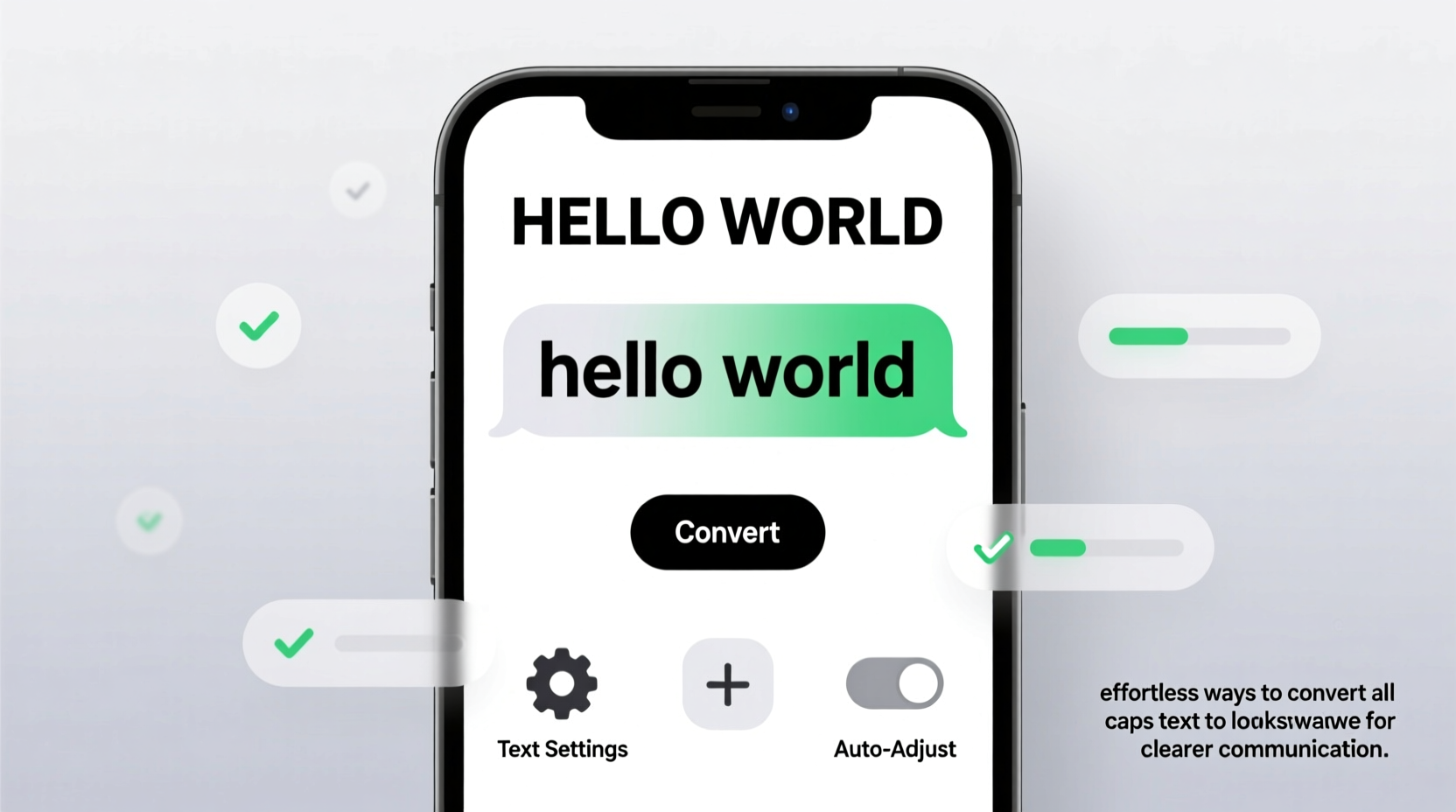
Typography influences how your message is received. Studies in cognitive psychology suggest that mixed-case text is easier to read than all-caps because our brains recognize word shapes quickly when case variation exists. Uppercase letters form uniform rectangles, slowing down visual processing. In professional settings, lowercase or proper sentence case also conveys calmness and approachability, while all caps can unintentionally signal urgency or aggression.
“Using all caps in digital writing is like speaking in a raised voice. It breaks conversational flow and distances the reader.” — Dr. Lena Peterson, Cognitive Linguist at Boston University
Clear communication isn’t just about what you say—it’s about how it’s perceived. Switching from all caps to lowercase softens tone, increases legibility, and aligns with modern digital etiquette.
5 Effortless Methods to Convert Text Case
You don’t need special software to fix capitalization. Here are five reliable, low-effort methods to convert uppercase text to lowercase—regardless of your device or platform.
1. Use Built-in Keyboard Shortcuts
Most operating systems include quick keyboard commands for changing text case. These work in word processors, emails, and even some web forms.
- Windows: Highlight the text, then press Shift + F3. Each press toggles between sentence case, uppercase, and lowercase.
- Mac: While macOS doesn’t have a native shortcut, many apps like Microsoft Word support Fn + Shift + F or custom shortcuts via system preferences.
- Google Docs: Select text > Format > Text > Change case > Choose “lowercase.”
2. Leverage Online Case Converters
Free online tools let you paste any block of text and instantly convert it to lowercase, uppercase, title case, or sentence case. They’re ideal for large chunks of copied content.
Popular options include:
- TextFixer.com
- LingoHub Case Converter
- ConvertCase.net
No installation required. Just paste, click “to lowercase,” and copy the result.
3. Use Find-and-Replace in Word Processors
In Microsoft Word or Google Docs, the find-and-replace function supports case-sensitive searches. This helps identify and correct accidental all-caps usage across long documents.
- Select “Replace” in your document editor (Ctrl+H).
- Type the capitalized phrase in the “Find” field.
- Enter the lowercase version in “Replace with.”
- Check “Match case” to avoid changing properly capitalized words.
- Click “Replace All.”
4. Automate with Text Expansion Tools
Tools like TextExpander, AutoHotkey (Windows), or Keyboard Maestro (Mac) allow you to create snippets that auto-convert text. For example, typing “/lc” could trigger a script that formats the last pasted text into lowercase.
This is especially useful for customer service agents, writers, or anyone who frequently handles copied text from external sources.
5. Use Browser Extensions for Web Forms
If you regularly fill out online forms or reply to comments written in all caps, browser extensions like “Case Converter” (available for Chrome and Firefox) add context-menu options to transform selected text directly in your browser.
Right-click any highlighted text and choose “Convert to lowercase”—no copying or pasting elsewhere needed.
Do’s and Don’ts of Text Case Management
| Do’s | Don’ts |
|---|---|
| Use lowercase for body text and casual messaging | Write entire emails or posts in all caps |
| Apply title case for headings and article titles | Mix case randomly (e.g., “ThIs Is UnReAdAbLe”) |
| Use automated tools for repetitive conversions | Rely solely on manual retyping |
| Preserve proper nouns and acronyms in correct case | Convert brand names like “iPhone” or “eBay” incorrectly |
| Proofread after conversion to ensure clarity | Assume auto-conversion always respects grammar rules |
A Real-World Example: Cleaning Up Client Communications
Sarah, a marketing coordinator at a mid-sized agency, received a client brief typed entirely in uppercase. While the content was detailed, the format made it difficult to scan during team meetings. Instead of retyping the 800-word document, she used a free online case converter to transform it into proper sentence case in under 10 seconds. She then adjusted headings to title case and shared the cleaned-up version with her team. Feedback was immediate: “It’s so much easier to read now.”
This small edit didn’t change the information—but it dramatically improved collaboration speed and professionalism.
Step-by-Step Guide: Converting All Caps in 60 Seconds
Follow this universal workflow to convert uppercase text efficiently, no matter where it appears:
- Copy the text: Highlight and copy (Ctrl+C / Cmd+C) the all-caps content.
- Paste into a converter: Open a trusted online tool like ConvertCase.net and paste the text.
- Select “Lowercase”: Click the button to transform all letters to lowercase.
- Edit for readability: Adjust capitalization for the first letter of sentences and proper nouns.
- Copy and reuse: Paste the clean version into your email, document, or platform.
- Save the tool: Bookmark the converter for future use.
This process takes less time than manually fixing each word and ensures consistency.
Essential Checklist for Better Text Formatting
Before sending any message, run through this checklist to ensure optimal readability and tone:
- ✅ Remove unnecessary all-caps phrases
- ✅ Convert body text to lowercase or sentence case
- ✅ Preserve correct capitalization for names and brands
- ✅ Use title case only for headings and titles
- ✅ Proofread after conversion for errors
- ✅ Use keyboard shortcuts or tools to save time
Frequently Asked Questions
Can I convert text case on my smartphone?
Yes. On iOS and Android, you can use third-party keyboard apps like Gboard, which offer quick case conversion options. Alternatively, paste text into a notes app that supports formatting (like Google Keep or Apple Notes), convert it, and copy it back.
Will converting to lowercase affect SEO or search rankings?
No. Search engines treat uppercase and lowercase versions of text as equivalent in most contexts. However, URL casing can matter—always use lowercase URLs for consistency and compatibility.
Is there a way to prevent all-caps input in forms or comments?
Website developers can use CSS (text-transform: lowercase;) or JavaScript to automatically format user input. For personal use, browser extensions can override display and input behavior to discourage all-caps typing.
Final Thoughts: Clarity Starts with Simple Choices
Switching from all caps to lowercase isn’t about strict grammar rules—it’s about respect for your reader’s experience. Clear, well-formatted text builds trust, improves comprehension, and reflects attention to detail. The tools to make this shift are already within reach: a keyboard shortcut, a bookmarked website, or a five-second copy-paste action.
Every piece of communication is an opportunity to be understood. By eliminating the visual noise of constant uppercase letters, you make room for your message to be heard—calmly, clearly, and effectively.




 浙公网安备
33010002000092号
浙公网安备
33010002000092号 浙B2-20120091-4
Comments
No comments yet. Why don't you start the discussion?