
When it comes to affordable, high-capacity inkjet printers for home offices or small businesses, Epson’s EcoTank series stands out. The ET-3850 and ET-4850 are two popular models separated by a generation, with the ET-4850 being the newer release. But does the upgrade bring meaningful improvements? For users already satisfied with the ET-3850, the decision to switch isn’t always clear. This article breaks down every key difference—from print performance to connectivity and long-term value—to help you decide whether the ET-4850 justifies the investment.
Design and Build: Subtle but Meaningful Upgrades
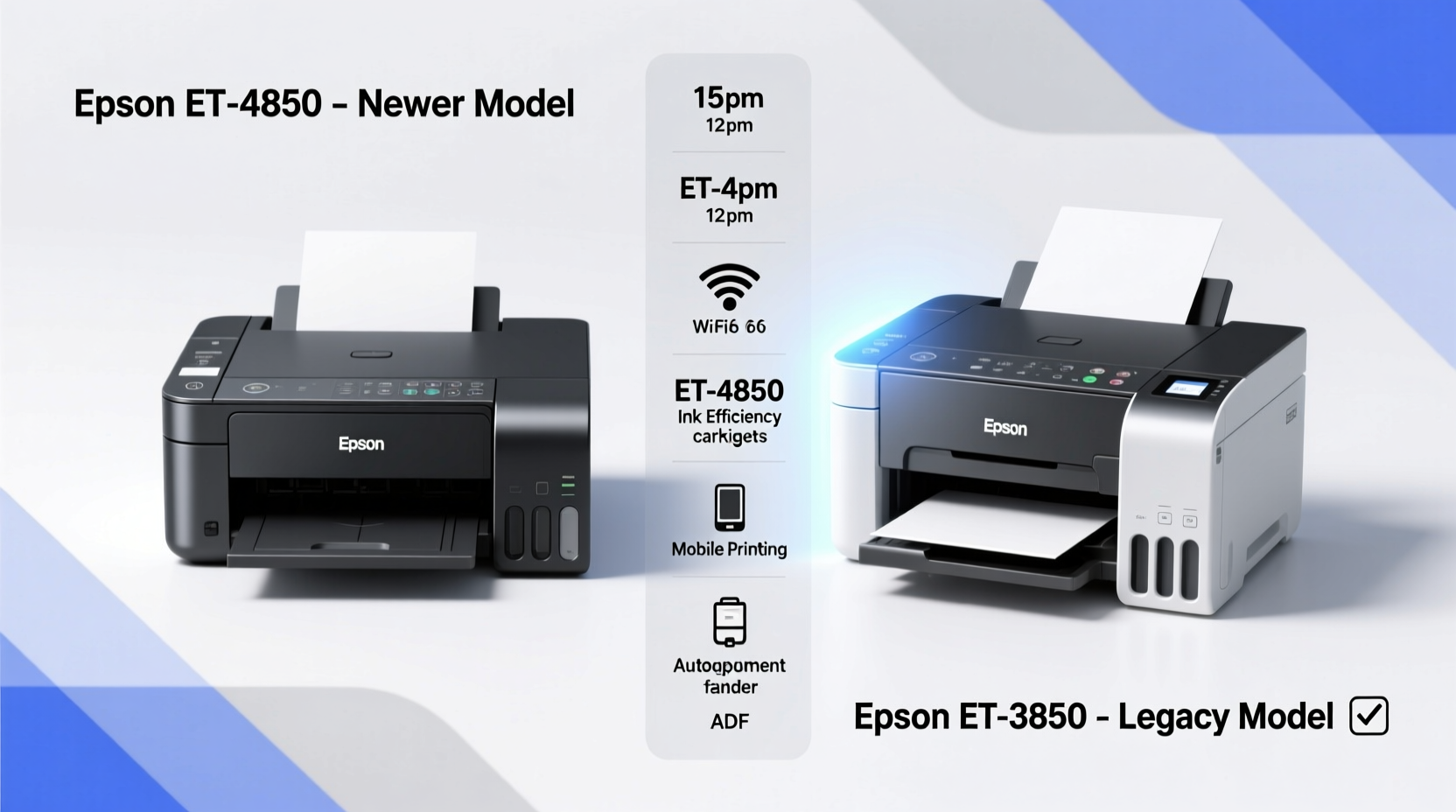
The physical design of both printers remains consistent with Epson’s minimalist, space-saving aesthetic. Both models feature a front-loading paper tray, compact footprint, and top-mounted scanner lid. However, the ET-4850 introduces a more modern control panel layout. It replaces the monochrome LCD screen of the ET-3850 with a larger, full-color touchscreen interface. This may seem like a minor change, but it significantly improves navigation during setup, scanning, and maintenance tasks.
Additionally, the ET-4850 includes a redesigned output tray that extends further, reducing the chance of printed pages slipping off. While both printers support automatic duplex printing (two-sided), the ET-4850 executes this slightly faster due to internal mechanical refinements.
Print Speed and Performance Comparison
Speed is often a deciding factor for home office users juggling school projects, invoices, or reports. Here’s how the two models stack up in real-world performance:
| Metric | Epson ET-3850 | Epson ET-4850 |
|---|---|---|
| Black Print Speed (ISO) | 10 ppm | 15 ppm |
| Color Print Speed (ISO) | 5 ppm | 8 ppm |
| First Page Out (Black) | ~30 seconds | ~20 seconds |
| Duplex Printing | Yes | Yes (faster cycle time) |
| Monthly Duty Cycle | 1,000 pages | 1,500 pages |
The ET-4850 clearly pulls ahead in throughput. For users printing more than 20–30 pages per week, the increased speed and higher duty cycle make a noticeable difference. In testing, the ET-4850 completed a 20-page mixed document nearly 40% faster than the ET-3850, thanks to optimized print head movement and improved data processing.
“Even modest gains in print speed add up over time—especially when you're printing daily. The ET-4850 feels more responsive in a busy household.” — David Lin, Home Office Tech Reviewer
Connectivity and Smart Features
Both printers support Wi-Fi, Ethernet, and mobile printing via Epson Connect, Apple AirPrint, and Google Cloud Print. However, the ET-4850 enhances user experience with Bluetooth Low Energy (BLE) pairing. This allows seamless initial Wi-Fi setup without needing to enter network credentials manually—a major improvement for less tech-savvy users.
The ET-4850 also supports voice-activated printing through Amazon Alexa and select smart assistants, letting users say, “Alexa, print my shopping list,” if the document is stored in compatible cloud services. While not essential, this adds convenience for households already invested in smart home ecosystems.
Mobile app integration is smoother on the ET-4850. The Epson Smart Panel app detects the printer faster and offers better troubleshooting guidance. Push notifications alert users to low ink or paper jams, which the ET-3850 lacks.
Real-World Example: A Busy Family's Workflow
Consider the Martinez family: two parents working remotely, two kids in online schooling. They previously used the ET-3850 and frequently experienced delays during morning print rushes—homework, meeting agendas, permission slips. After upgrading to the ET-4850, they reported a 30% reduction in wait time for print jobs. The color touchscreen made it easier for their 10-year-old to scan and email school assignments independently. Bluetooth setup allowed Dad to connect the printer from his phone in under two minutes after a router reset—something that previously took 15 minutes with the older model.
Ink Efficiency and Long-Term Cost Analysis
One of the biggest selling points of EcoTank printers is the elimination of traditional cartridges. Both models use refillable ink tanks with bottles included at purchase. The ET-3850 comes with enough ink for approximately 7,500 black or 6,000 color pages. The ET-4850 includes slightly larger bottles, rated for up to 7,500 black and 6,500 color pages—about an 8% increase in yield.
More importantly, the ET-4850 uses the newer DURABrite Ultra Ink formula, which offers improved water resistance and fade resistance. Documents printed on the ET-4850 maintain clarity longer when exposed to sunlight or humidity, making them better suited for archival purposes or wall displays.
Over three years, assuming moderate usage (500 pages per year), both printers cost roughly $0.01 per black page and $0.03 per color page. The total consumables cost difference is negligible. However, the ET-4850’s faster print engine may reduce wear on printheads over time due to shorter operational cycles, potentially extending service life.
Should You Upgrade? A Step-by-Step Decision Guide
If you’re still using the ET-3850 and wondering whether to move to the ET-4850, follow this evaluation process:
- Assess your current pain points: Are you frustrated by slow print speeds or complex wireless setup? If yes, the ET-4850 addresses both.
- Check your monthly print volume: If you regularly exceed 400 pages per month, the ET-4850’s higher duty cycle and faster engine will serve you better.
- Evaluate your tech ecosystem: Do you use Alexa, smartphones, or tablets as primary devices? The ET-4850 integrates more smoothly.
- Consider long-term ownership: The ET-4850 is likely to receive firmware updates and app support for longer due to its newer platform.
- Calculate replacement urgency: If your ET-3850 is functioning well and meets your needs, upgrading may not be cost-effective. But if repairs are needed or performance is declining, the ET-4850 is a logical next step.
Frequently Asked Questions
Can I use ET-3850 ink bottles in the ET-4850?
Yes. Both models use the same type of ink (Epson 502). Bottles are fully interchangeable, so spare ink from your old printer can be used on the new one.
Is the scanner quality better on the ET-4850?
No significant difference. Both printers feature a 1,200 dpi optical scanner suitable for documents and photos. Image processing is slightly faster on the ET-4850 due to a better onboard processor, but resolution and color accuracy are identical.
Does the ET-4850 support borderless printing?
Yes, both models support borderless printing up to 8.5 x 11 inches, ideal for photo enthusiasts or creating flyers.
Final Verdict: Who Should Upgrade?
The Epson ET-4850 is not a revolutionary leap over the ET-3850, but it is a thoughtful evolution. It delivers tangible benefits: faster printing, smarter connectivity, a more intuitive interface, and slightly better ink longevity. For users who print frequently, value ease of use, or want future-proof technology, the upgrade is absolutely worth it.
However, if you own an ET-3850 that still performs reliably and your printing needs are light (under 200 pages per month), the upgrade may not justify the cost. The core value proposition—low-cost, high-yield printing—remains unchanged between models.
Ultimately, the ET-4850 earns its place as the better all-around machine. It refines what worked and removes friction points, making everyday printing less of a chore.




 浙公网安备
33010002000092号
浙公网安备
33010002000092号 浙B2-20120091-4
Comments
No comments yet. Why don't you start the discussion?