
In today’s rapidly advancing tech landscape, the System on a Chip (SoC) has become the cornerstone of modern computing. From smartphones and tablets to high-performance laptops and AI-powered edge devices, the SoC integrates all critical components—CPU, GPU, memory, connectivity, and more—onto a single silicon die. This integration enables unprecedented efficiency, power savings, and performance in compact form factors. Choosing the right SoC is no longer just about raw speed; it’s about balancing performance, thermal design, energy efficiency, and specialized capabilities like AI acceleration and 5G support.
Understanding the Role of a Modern SoC
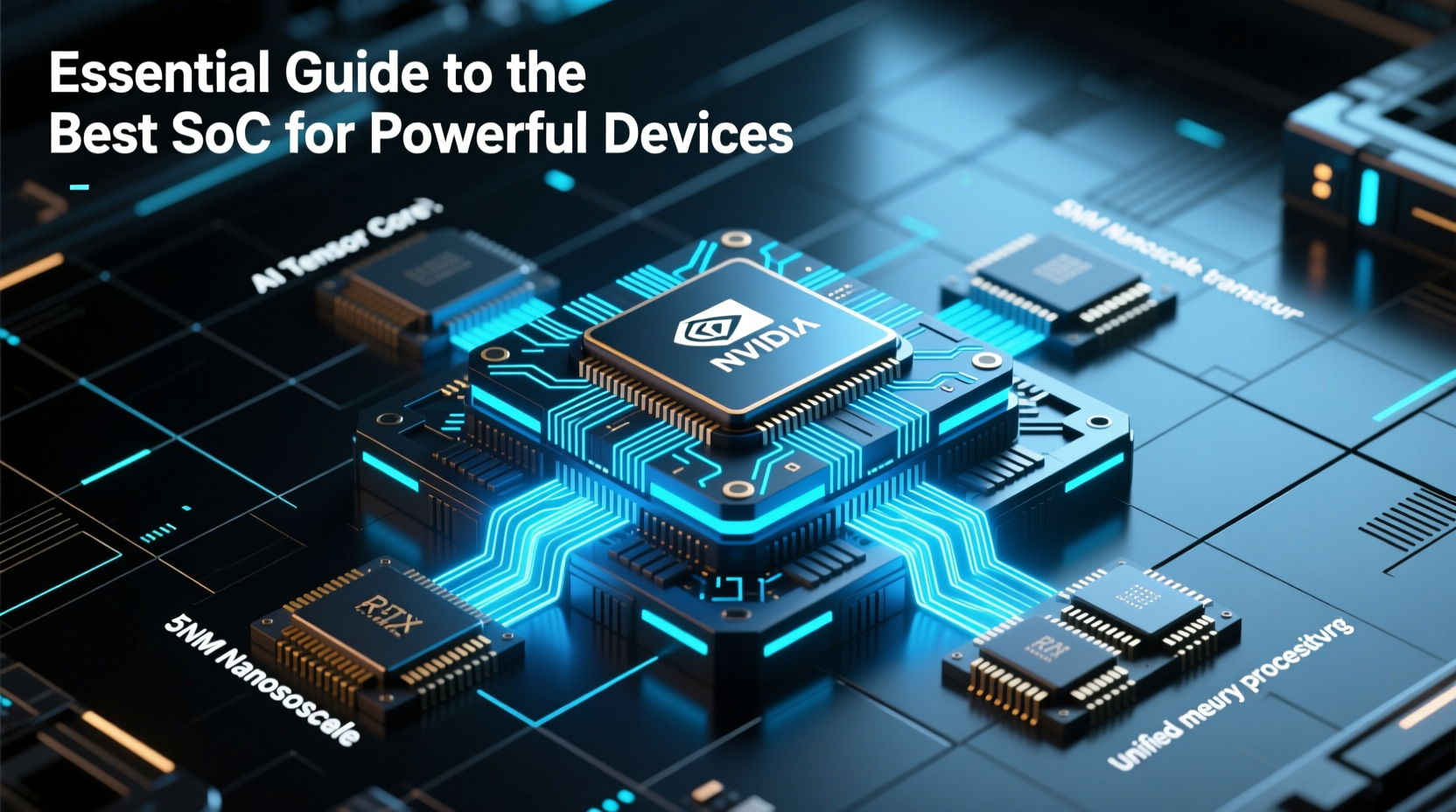
A System on a Chip consolidates multiple hardware functions into one unit, eliminating the need for separate chips across a motherboard. This consolidation reduces latency, improves data throughput, and minimizes power consumption. The core components typically included in an SoC are:
- CPU (Central Processing Unit): Handles general-purpose computing tasks.
- GPU (Graphics Processing Unit): Manages rendering, gaming, and graphical workloads.
- NPU (Neural Processing Unit): Accelerates machine learning and AI inference tasks.
- ISP (Image Signal Processor): Processes camera input for high-quality photography and video.
- Modem: Enables cellular connectivity, including 5G and LTE.
- Memory Controller: Manages RAM access and bandwidth efficiency.
The effectiveness of an SoC depends not only on individual component strength but also on how well they are optimized together. For example, Apple’s M-series chips demonstrate this holistic approach by tightly integrating CPU, GPU, and NPU with unified memory architecture, resulting in superior real-world performance despite modest clock speeds.
Top Contenders in High-Performance SoCs
Several manufacturers dominate the high-end SoC market, each offering unique advantages depending on use case and ecosystem. Below is a comparison of leading SoCs as of 2024:
| SoC Model | Manufacturer | Process Node | Peak Performance (TFLOPS) | AI Capability | Best For |
|---|---|---|---|---|---|
| Apple M3 Max | Apple | 3nm | 25+ | 18 TOPS (NPU) | Professional creative work, video editing, development |
| Qualcomm Snapdragon 8 Gen 3 | Qualcomm | 4nm | 6.6 | 45 TOPS (Hexagon NPU) | Flagship Android phones, AI apps, gaming |
| MediaTek Dimensity 9300+ | MediaTek | 4nm | 6.7 | 50 TOPS (APU 790) | High-end smartphones, cost-efficient power |
| AMD Ryzen Z1 Extreme | AMD | 4nm | 10.6 | XDNA AI Engine (16 TOPS) | Windows handhelds, portable gaming, light productivity |
| NVIDIA Grace CPU + Hopper GPU (Superchip) | NVIDIA | 4nm + 5nm | Exascale-level | Transformer engines | Data centers, AI training, scientific computing |
This table illustrates that while Apple leads in consumer device performance per watt, Qualcomm and MediaTek offer compelling AI throughput for mobile applications. AMD targets hybrid productivity-gaming devices, while NVIDIA pushes boundaries in enterprise-scale compute.
“Integration is the future. The most powerful systems aren’t built from discrete parts—they’re engineered as unified platforms.” — Dr. Linus Lee, Senior Architect at Semiconductor Research Group
How to Choose the Right SoC for Your Needs
Selecting the best SoC requires aligning technical specs with your actual usage patterns. Here’s a practical checklist to help you make an informed decision:
✅ SoC Selection Checklist
- Identify primary use: productivity, gaming, AI development, or multimedia creation?
- Evaluate battery life requirements vs. peak performance needs.
- Check software compatibility—especially for professional tools (e.g., Adobe Suite, Xcode).
- Consider thermal management: Can the device dissipate heat effectively under load?
- Assess AI workload demands: Does your app rely on on-device machine learning?
- Determine connectivity needs: Do you require integrated 5G or Wi-Fi 7 support?
- Review ecosystem lock-in: Are you tied to iOS, Android, or Windows workflows?
For instance, a mobile developer working primarily on iOS will benefit far more from an Apple Silicon Mac than a similarly specced Windows laptop with an Intel chip. Similarly, a field researcher deploying computer vision models on drones would prioritize MediaTek’s or Qualcomm’s NPUs due to their strong on-device AI inferencing capabilities.
Real-World Example: Engineering a Mobile Workstation
Consider Maria, a freelance video editor who travels frequently. She needed a lightweight yet powerful tablet capable of handling 4K timeline scrubbing and color grading. After testing several options, she chose a premium Android tablet powered by the Snapdragon 8 Gen 3. While its peak TFLOPS were lower than Apple’s M2 iPad Pro, the Snapdragon’s advanced ISP and dedicated AI engine allowed her to run real-time noise reduction and auto-color correction using on-device AI models. Additionally, the built-in 5G modem enabled seamless cloud backup without relying on Wi-Fi hotspots. In her workflow, the SoC’s balanced architecture outperformed raw benchmarks suggested.
This case underscores a crucial point: real-world performance often hinges on intelligent design rather than headline numbers.
Step-by-Step Guide to Evaluating SoC-Powered Devices
Follow these steps when purchasing a new device based on its SoC:
- Define your workload: List the apps and tasks you perform daily (e.g., video editing, coding, gaming).
- Research benchmark data: Use trusted sources like AnandTech, Geekbench, or SPECint scores—not just marketing claims.
- Analyze thermal behavior: Look for reviews measuring sustained performance under load (not just burst speed).
- Check OS and driver support: Ensure long-term updates and firmware stability, especially for Linux or niche platforms.
- Compare power efficiency: Review battery drain during active use and standby.
- Test peripheral compatibility: Verify support for external displays, storage, and accessories relevant to your work.
- Read user feedback: Forums and community reports often reveal issues missed in lab tests.
This methodical approach prevents overpaying for unnecessary features while ensuring reliability under real conditions.
Frequently Asked Questions
What makes one SoC better than another?
Beyond clock speed, key differentiators include process node efficiency, cache hierarchy, interconnect bandwidth, AI acceleration, and software optimization. A newer 4nm chip with efficient cores can outperform an older 7nm design even at lower GHz.
Do I need the latest SoC model?
Not always. If your tasks are moderate—web browsing, office apps, streaming media—a previous-generation SoC may offer excellent value. Reserve top-tier chips for demanding workloads like 3D rendering, AI training, or high-refresh gaming.
Can SoCs be upgraded?
No. Unlike desktop CPUs or GPUs, SoCs are permanently soldered onto the motherboard. Upgrading means replacing the entire device. Therefore, investing in a future-proof SoC is wise for long-term ownership.
Final Thoughts and Next Steps
The best System on a Chip for powerful devices isn’t defined by a single metric—it emerges from synergy between hardware design, software integration, and user intent. Whether you're building a smartphone, a portable workstation, or an embedded AI system, understanding SoC capabilities empowers smarter decisions. As Moore’s Law slows, innovation shifts toward architectural intelligence, making choices more nuanced than ever.




 浙公网安备
33010002000092号
浙公网安备
33010002000092号 浙B2-20120091-4
Comments
No comments yet. Why don't you start the discussion?