
Choosing the right method to scent your home goes beyond personal preference—it affects how long fragrance lingers in the air, how evenly it spreads, and even your indoor air quality. Two of the most popular options are essential oil diffusers and reed diffusers. While both use natural essential oils, they operate on entirely different principles. One relies on active dispersion through water and ultrasonic vibration; the other depends on passive capillary action through porous reeds. But when it comes to filling your room with scent—and keeping it there—only one truly outlasts the other.
This comparison dives deep into performance, longevity, maintenance, and real-world effectiveness so you can make an informed decision based on how much time, effort, and consistency matter in your daily routine.
How Each Diffuser Works: The Science Behind the Scent
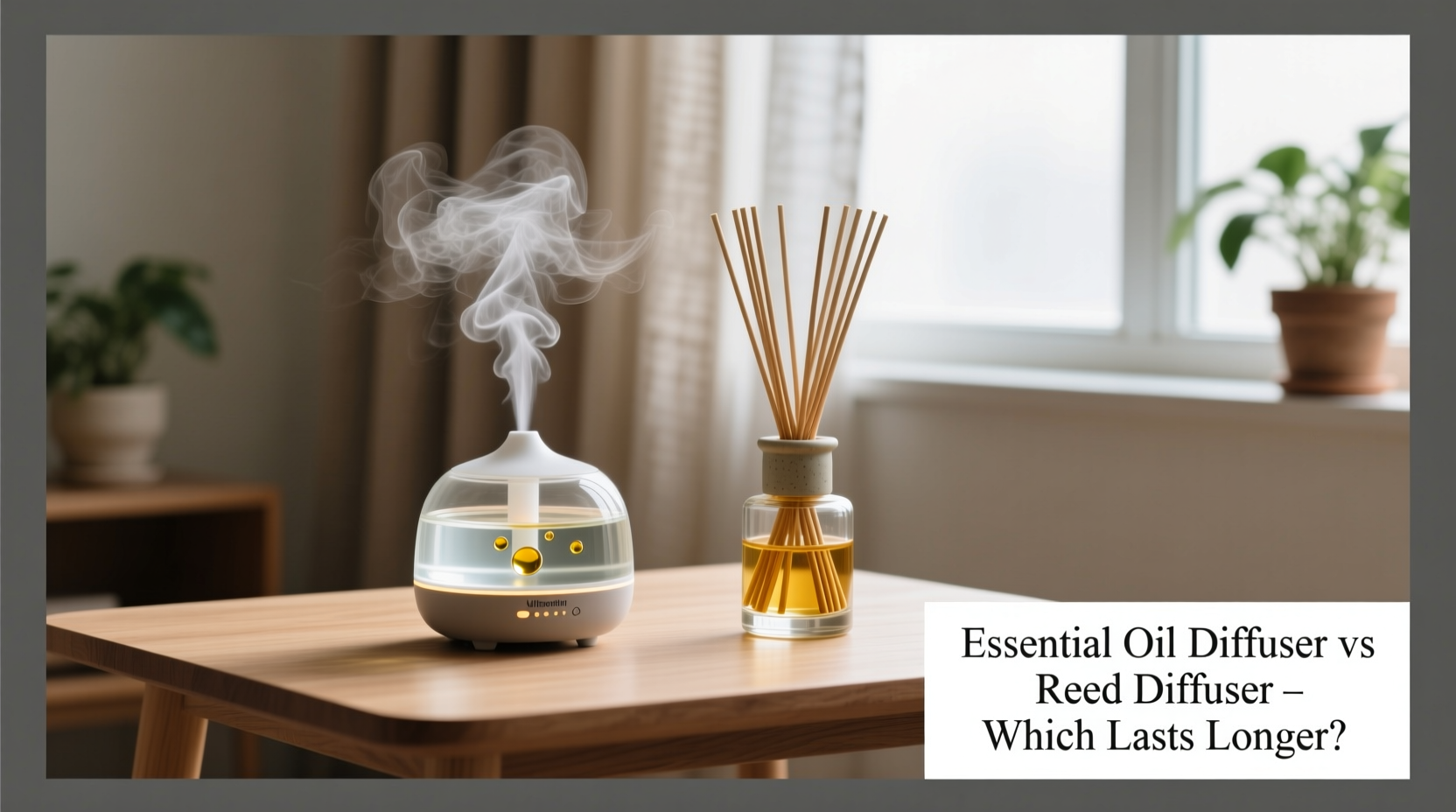
Understanding the mechanics behind each device is crucial to evaluating their performance. An essential oil diffuser uses electricity—typically via ultrasonic technology—to break down a mixture of water and essential oils into a fine mist. This mist is then released into the air, dispersing fragrance quickly and widely across a room. Because it's actively emitting particles, the scent impact is immediate and noticeable within minutes.
In contrast, a reed diffuser operates without power. It consists of a glass vessel filled with scented oil (often blended with a carrier), into which several thin reeds are inserted. These reeds absorb the liquid through capillary action and slowly release the aroma into the surrounding air as the oil evaporates from the surface of the reeds. The process is silent, steady, and subtle—but significantly slower than its electric counterpart.
“Passive diffusion systems like reed diffusers offer consistent low-level fragrance over extended periods, while ultrasonic models provide stronger bursts of scent but consume oils more rapidly.” — Dr. Lena Torres, Aromatherapy Researcher at the Holistic Wellness Institute
Scent Longevity: Which Lasts Longer?
When measuring how long a room stays scented, two factors dominate: total duration of use and intensity over time.
An essential oil diffuser delivers powerful, concentrated bursts of fragrance during operation. However, because it runs in cycles—typically 1–4 hours at a time—it depletes oil faster. Most users refill their diffusers every 1–3 weeks depending on frequency and room size. While the scent peaks quickly, it also fades fast once the machine stops running. Without continuous use, the aromatic presence diminishes within 1–2 hours after shutdown.
Reed diffusers, by contrast, work around the clock. Once set up, they emit fragrance continuously, 24/7, without needing refills or resets. A standard 100ml reed diffuser can last anywhere from 4 to 6 months before requiring replacement or refreshment. Though the scent intensity is lower at any given moment, the cumulative exposure is greater due to constant emission.
Performance Comparison: Coverage, Intensity, and Efficiency
To determine which system fills your space more effectively over time, consider three key metrics: coverage area, scent strength, and oil consumption rate.
| Feature | Essential Oil Diffuser | Reed Diffuser |
|---|---|---|
| Average Room Coverage | Up to 500 sq ft (depending on model) | Up to 200 sq ft (best in enclosed spaces) |
| Scent Intensity | High – strong initial burst | Low to moderate – gradual release |
| Oil Consumption Rate | Fast – lasts 1–3 weeks per fill | Slow – lasts 4–6 months per bottle |
| Runtime | Intermittent (manual or timed cycles) | Continuous (passive evaporation) |
| Maintenance Frequency | Daily water changes, weekly cleaning | Monthly reed flipping, occasional topping off |
| Best For | Quick refresh, therapeutic use, large rooms | Long-term ambiance, low-maintenance settings |
The data shows a clear trade-off: essential oil diffusers win in short-term potency and reach, while reed diffusers dominate in endurance and consistency. If your goal is to keep a background scent present all day, every day, with minimal upkeep, reed diffusers are superior. But if you want a strong, spa-like atmosphere for part of the day—especially for relaxation or respiratory benefits—an essential oil diffuser may be more effective.
Real-World Example: Living Room Scent Strategy
Consider Sarah, who lives in a 1,200-square-foot apartment in Portland. She loves coming home to a welcoming scent but works long hours and rarely has time to maintain devices. Initially, she used an essential oil diffuser in her living room, running it for two hours each evening. Within three weeks, she had gone through two bottles of lavender blend and found herself constantly refilling and cleaning the unit. Worse, the scent vanished soon after turning it off, leaving her space feeling neutral again.
Frustrated, she switched to a reed diffuser placed near the entryway. Using a sandalwood-vanilla blend in a 150ml bottle with eight rattan reeds, she noticed a soft, warm aroma greeting her upon arrival. There was no need to remember to turn it on. After five months, the scent had gently faded but was still perceptible. She flipped the reeds and added 10ml of fresh oil, revitalizing the fragrance without replacing the entire setup.
Sarah’s experience illustrates a common pattern: people often start with electric diffusers expecting convenience, only to discover that the maintenance undermines the benefit. Passive systems, though less dramatic, integrate seamlessly into daily life.
Step-by-Step Guide to Maximizing Scent Duration
Whether you choose an essential oil or reed diffuser, these steps will help you get the longest-lasting fragrance possible.
- Select high-quality oils: Pure essential oils last longer and diffuse more efficiently than synthetic fragrances or diluted blends.
- Optimize placement: Place your diffuser in a central location away from direct sunlight and drafts. Avoid corners or behind furniture where airflow is restricted.
- Control humidity levels: Essential oil diffusers perform best in dry environments (under 60% humidity). High moisture slows evaporation and reduces scent throw.
- Flip reeds regularly: Every 7–10 days, remove and reverse the reeds so the saturated ends are exposed to air. This refreshes the scent without adding more oil.
- Use the right number of reeds: More reeds = stronger scent but faster depletion. Start with 5–6 and add only if needed.
- Run diffusers strategically: Use intermittent modes instead of continuous output. For example, 30 seconds on, 30 seconds off extends oil life while maintaining presence.
- Clean routinely: Mineral buildup in ultrasonic diffusers reduces efficiency. Rinse the tank weekly with white vinegar and water.
Which Fills Your Room with Scent Longer? The Verdict
If “longer” means sustained presence over weeks and months, the reed diffuser wins decisively. Its ability to operate passively, without interruption, ensures that fragrance remains detectable throughout the day and night. Even when subtle, the cumulative effect creates a lasting olfactory impression.
However, if “longer” refers to peak scent duration during active use, the essential oil diffuser takes the lead. During operation, it floods the room with aromatic molecules, creating a dense, immersive environment that persists for several hours post-use—far longer than ambient evaporation alone.
Ultimately, the answer depends on your priorities:
- Choose a **reed diffuser** if you value low maintenance, continuous scent, and long-term cost efficiency.
- Choose an **essential oil diffuser** if you seek therapeutic effects, rapid fragrance delivery, and adjustable intensity.
For maximum coverage and longevity, many experts recommend combining both: use a reed diffuser as a baseline scent layer and supplement with an essential oil diffuser during evenings or after guests arrive.
FAQ
Do reed diffusers really last 6 months?
Yes, under optimal conditions—a sealed bottle, moderate temperature, and proper reed care—many high-quality reed diffusers last between 4 to 6 months. Smaller bottles (under 100ml) may deplete faster, especially in warm or drafty areas.
Can I reuse reeds when changing oils?
No. Reeds become saturated with specific fragrance compounds and cannot be fully cleaned. Attempting to reuse them will result in mixed scents and reduced performance. Always use new reeds when switching oils.
Why does my essential oil diffuser stop producing mist after a few weeks?
Mineral buildup from tap water clogs the ultrasonic plate. Always use distilled water and clean the reservoir weekly. Hard water drastically shortens the lifespan of internal components.
Checklist: Choosing the Right Diffuser for Long-Lasting Scent
- ✅ Define your primary goal: constant background scent or intense bursts?
- ✅ Measure your room size to ensure adequate coverage
- ✅ Decide how much maintenance you’re willing to do weekly/monthly
- ✅ Consider noise sensitivity—essential oil diffusers produce a faint hum
- ✅ Evaluate electrical access—reed diffusers don’t require outlets
- ✅ Budget for ongoing costs—oil refills, replacement reeds, electricity usage
- ✅ Test one of each type for 30 days before committing
Final Thoughts: Sustainability Meets Sensory Experience
The choice between an essential oil diffuser and a reed diffuser isn't just about scent strength—it reflects lifestyle, values, and expectations. Reed diffusers embody slow luxury: understated, enduring, and effortlessly elegant. They suit those who appreciate subtlety and consistency. Essential oil diffusers cater to intentionality—those who use scent as part of wellness rituals, meditation, or air purification.
From an environmental standpoint, reed diffusers generate less waste and consume no electricity, making them a greener option over time. Yet, ultrasonic diffusers offer unmatched versatility, allowing users to blend oils, adjust timing, and humidify dry indoor air—a valuable perk in winter months.
Neither option is universally better. But when measured purely by how long your room remains scented—with no intervention required—the reed diffuser stands unchallenged in endurance.




 浙公网安备
33010002000092号
浙公网安备
33010002000092号 浙B2-20120091-4
Comments
No comments yet. Why don't you start the discussion?