
When it comes to filling your home with natural fragrance, two popular options stand out: essential oil diffusers and reed diffusers. Both are widely used for their ability to disperse aromatic scents without synthetic chemicals. But if your primary concern is how long a scent lasts in a room, the answer isn’t always straightforward. The longevity of fragrance depends on several factors—device type, essential oil quality, room size, airflow, and usage habits. Understanding the differences between these two systems helps you make an informed choice based on performance, convenience, and lasting power.
How Each Diffuser Works
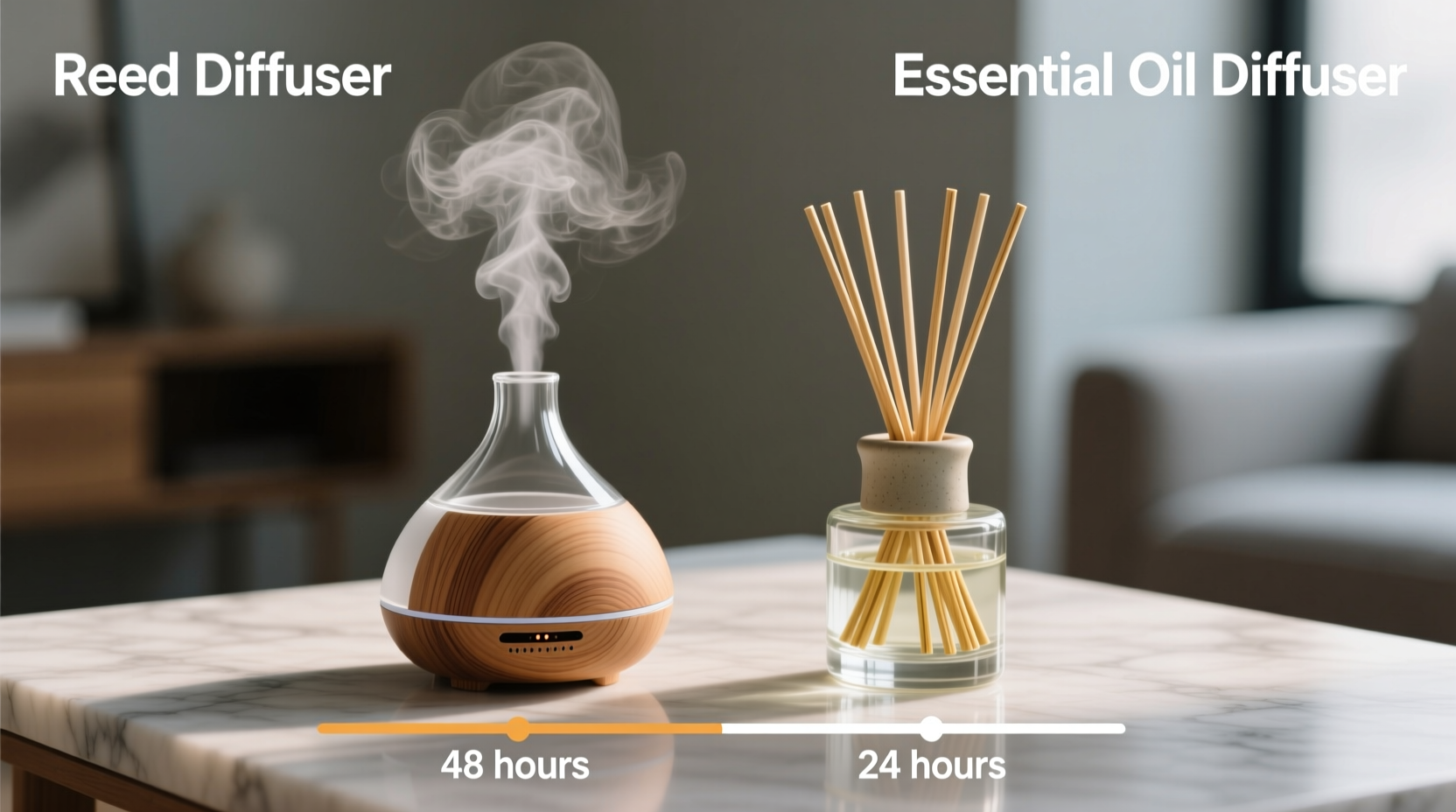
The fundamental difference between an essential oil diffuser and a reed diffuser lies in their mechanism of scent dispersion.
Essential Oil Diffusers (Ultrasonic or Nebulizing) use water and ultrasonic vibrations—or pure misting technology in nebulizers—to break essential oils into micro-particles and release them into the air as a fine mist. This method actively disperses fragrance, making it more immediate and potent. Because the oils are atomized, they spread quickly throughout a room, creating a noticeable aroma within minutes.
Reed Diffusers, on the other hand, rely on passive diffusion. A bundle of porous reeds is placed in a bottle containing essential oils mixed with a carrier liquid. Over time, the oil travels up the reeds through capillary action and evaporates into the air. This process is slow, steady, and requires no electricity. While the scent is subtle, it can linger continuously for weeks.
“Passive systems like reed diffusers offer consistent background fragrance, while active diffusers provide stronger but shorter bursts of scent.” — Dr. Lena Patel, Aromatherapy Researcher at Holistic Wellness Institute
Comparing Scent Longevity: Active vs Passive Release
One of the most common misconceptions is that because essential oil diffusers produce a stronger initial scent, they last longer. In reality, the opposite is often true when measuring total scent duration per refill.
An ultrasonic diffuser typically runs in cycles—30 minutes on, 30 minutes off—and may consume 3–5 mL of water and oil mixture per hour. Depending on usage, a full tank might last 4–8 hours per session. Even with intermittent use, a standard 100 mL diffuser may deplete its oil supply in 10–15 uses. That means concentrated bursts of fragrance, but limited cumulative runtime.
In contrast, a high-quality reed diffuser using 100 mL of scented oil blend can last anywhere from **4 to 12 weeks**, depending on environmental conditions. Since evaporation is gradual, the same volume of oil lasts significantly longer than in an active diffuser. However, the intensity diminishes over time rather than delivering sharp peaks.
Detailed Comparison Table: Key Performance Factors
| Feature | Essential Oil Diffuser | Reed Diffuser |
|---|---|---|
| Scent Intensity | High – immediate and strong | Low to moderate – subtle and ambient |
| Scent Duration per Refill | 10–20 hours of actual runtime | 4–12 weeks of continuous release |
| Coverage Area | Up to 300 sq ft (depending on model) | Up to 150 sq ft (best in enclosed spaces) |
| Maintenance Frequency | Daily water refills, weekly cleaning | Flip reeds every 7–10 days; replace oil every 1–3 months |
| Noise Level | Slight hum from motor | Completely silent |
| Energy Use | Requires electricity (USB or outlet) | None – passive operation |
| Best For | Quick refreshment, aromatherapy benefits, large rooms | Continuous low-level scent, bedrooms, offices, bathrooms |
Factors That Influence Scent Longevity
It’s not just the device type that determines how long a room stays scented—it’s also how you use it and where you place it.
- Airflow and Ventilation: Rooms with open windows, fans, or HVAC systems will dissipate scent faster. Reed diffusers lose potency quicker in drafty areas, while diffusers may struggle to maintain concentration in well-ventilated spaces.
- Bottle Size and Oil Concentration: Larger reed diffuser bottles (150–200 mL) naturally last longer. Similarly, diffusers with bigger reservoirs extend runtime. Higher concentrations of essential oils increase both strength and longevity.
- Number of Reeds: More reeds mean faster evaporation. Using 5–7 reeds creates a stronger scent but shortens lifespan by up to 30% compared to using 3–4.
- Room Temperature: Warm environments accelerate evaporation. A reed diffuser in a sunlit bathroom may last half as long as one in a cool hallway.
- Type of Essential Oil: Light citrus oils (like lemon or grapefruit) evaporate faster than base notes like sandalwood, patchouli, or vanilla. Blends with heavier molecules tend to linger longer in both systems.
Real-World Example: Office vs Bedroom Use
Consider Sarah, a remote worker who uses both types of diffusers in different parts of her home. In her office—a medium-sized, frequently ventilated space—she uses an ultrasonic diffuser during work hours. She fills it each morning and runs it on intermittent mode for 6 hours. The lavender-peppermint blend clears mental fog and boosts focus. However, she notices the scent fades within a few hours after turning it off, and she must refill daily.
In her bedroom, she prefers a reed diffuser with a warm vanilla-amber blend. Placed on a nightstand away from direct sunlight, it has maintained a soft, comforting presence for nearly nine weeks. Though less intense, the scent greets her each evening and subtly lingers overnight. Despite using fewer drops of oil overall, this system provides far greater total scent exposure.
This case illustrates a key insight: longevity isn't about peak strength, but sustained release. For all-day ambiance, reed diffusers win on endurance. For targeted therapeutic effects, active diffusers deliver immediacy.
Step-by-Step Guide to Maximizing Scent Duration
Whether you prefer reed or essential oil diffusers, these steps help stretch the life of your fragrance:
- Choose High-Quality Oils: Pure essential oils without alcohol dilution last longer and diffuse more efficiently.
- Optimize Placement: Place diffusers centrally, away from vents, windows, and direct heat sources.
- Control Usage Time: For electric diffusers, limit sessions to 30–60 minutes at a time, especially in small rooms.
- Maintain Cleanliness: Clean ultrasonic diffusers weekly to prevent clogging and oil buildup, which reduces efficiency.
- Flip Reeds Strategically: Rotate reeds every 7–10 days to renew scent, but avoid doing so daily, which speeds evaporation.
- Seal Unused Oil: Store extra essential oils in dark glass bottles, tightly capped, in a cool cupboard to preserve potency.
- Use Proper Ratios: In DIY reed diffusers, a mix of 80% carrier oil (like safflower) and 20% essential oil balances longevity and scent throw.
Checklist: Choosing the Right Diffuser for Your Needs
- ☐ Do I want a strong, immediate scent? → Choose an essential oil diffuser.
- ☐ Am I looking for low-maintenance, continuous fragrance? → Go for a reed diffuser.
- ☐ Will the device be left unattended? → Reed diffusers are safer (no electricity or water).
- ☐ Do I need aromatherapy benefits (e.g., relaxation, focus)? → Ultrasonic diffusers disperse particles that can affect mood and respiration.
- ☐ Is noise a concern? → Reed diffusers operate silently.
- ☐ How often am I willing to refill or maintain the unit? → Reed diffusers require less frequent attention.
- ☐ What’s my budget for ongoing supplies? → Essential oil consumption is higher with active diffusers, increasing long-term cost.
Frequently Asked Questions
Can I use the same essential oils in both diffusers?
Yes, but with caveats. Essential oils used in reed diffusers should be diluted with a carrier oil (such as dipropylene glycol or fractionated coconut oil), whereas ultrasonic diffusers typically mix oils with water. Never put undiluted essential oils directly into a water-based diffuser, as this can damage the unit.
Why does my reed diffuser stop smelling after a few weeks?
This is normal. As oils evaporate, the concentration decreases. Additionally, reeds can become clogged with residue. Try flipping them first. If that doesn’t help, replace the reeds and refresh the oil. Avoid placing the diffuser in high-dust areas, which accelerates clogging.
Which diffuser is better for large rooms?
For large or open-concept spaces, an essential oil diffuser is generally more effective due to active mist dispersion. Reed diffusers work best in enclosed, smaller areas like bedrooms, bathrooms, or entryways.
Expert Insight: Balancing Aesthetics and Function
Interior designers increasingly favor reed diffusers not only for their longevity but also for their decorative appeal. Unlike electronic units, which can look utilitarian, reed diffusers come in elegant bottles that complement home décor.
“In wellness-focused design, we prioritize solutions that are both functional and beautiful. Reed diffusers offer invisible luxury—a constant, gentle scent without clutter or noise.” — Marcus Tran, Sustainable Interior Designer
Yet, for clients seeking dynamic sensory experiences—such as shifting scents throughout the day or pairing fragrance with humidity control—he recommends keeping an ultrasonic diffuser as a secondary tool.
Final Verdict: Which One Scents a Room Longer?
If the sole metric is how long a single application of oil keeps a room perceptibly scented, the reed diffuser is the clear winner. It provides continuous, low-level fragrance for weeks without intervention. An essential oil diffuser, while powerful, operates in short bursts and consumes oil rapidly, resulting in fewer total hours of scent delivery per milliliter.
However, “longer” doesn’t always mean “better.” If you value intensity, therapeutic effects, or rapid room refreshment, an essential oil diffuser serves those needs more effectively. The ideal solution may be using both: a reed diffuser for baseline ambiance and an ultrasonic model for targeted sessions.




 浙公网安备
33010002000092号
浙公网安备
33010002000092号 浙B2-20120091-4
Comments
No comments yet. Why don't you start the discussion?