
Losing your Social Security card—or simply not being able to recall your number—can be stressful, especially when it’s needed for employment, banking, or government services. While the Social Security Administration (SSA) doesn’t recommend carrying your card daily, there are legitimate situations where you must provide your SSN. The key is to retrieve it safely without exposing yourself to identity theft. This guide outlines secure, practical methods to locate your number and protect your personal information throughout the process.
Why You Should Never Guess or Improvise
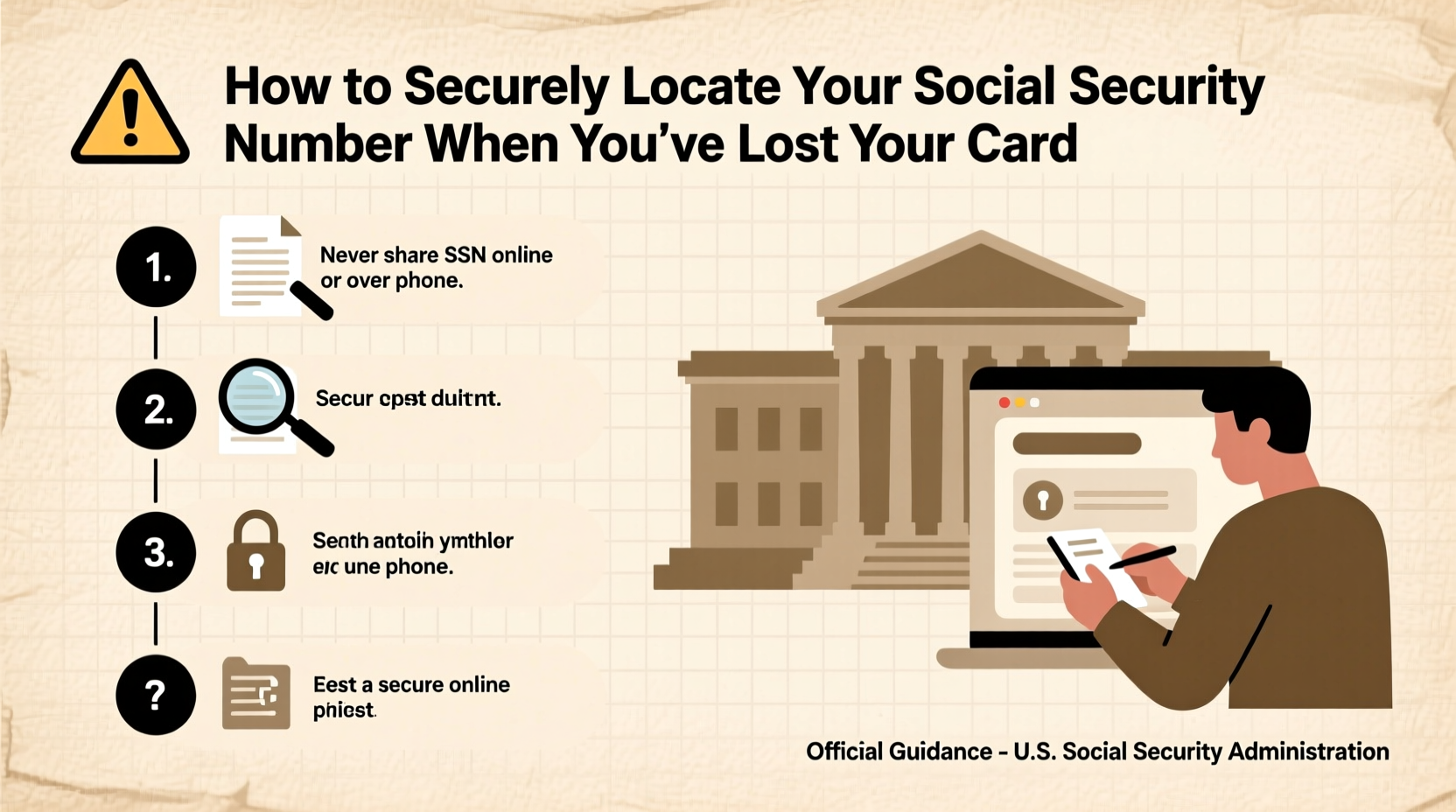
Your Social Security number is a nine-digit identifier used across financial, medical, and legal systems in the United States. It's tied directly to your identity, credit history, and government benefits. Guessing digits or using outdated numbers can lead to application denials, tax issues, or even trigger fraud alerts on your credit file.
Attempting to reconstruct your SSN based on memory or patterns increases the risk of errors and potential misuse. Instead, follow verified procedures that prioritize both accuracy and security.
Step-by-Step Guide to Securely Retrieve Your SSN
Finding your Social Security number when your card is missing requires methodical action. Follow these steps in order to minimize risk and maximize success.
- Gather past documents – Review tax returns, W-2s, bank statements, loan agreements, or prior job applications. These often list your full SSN.
- Check official records – If you’ve applied for government benefits (Medicare, disability, etc.), correspondence from federal agencies may include your number.
- Contact your employer or HR department – Current or former employers keep W-2 forms on file for at least four years. Request a copy securely through official channels.
- Access your mySocialSecurity account – If you’ve created an online profile, log in at ssa.gov/myaccount to view your number digitally.
- Request a replacement card – If all else fails, apply in person at a local SSA office with required identification.
Important Notes During Retrieval
- Always verify the legitimacy of any website or service asking for personal details.
- Avoid sharing your SSN over email, phone, or unsecured platforms—even if someone claims to be from the SSA.
- Never pay a third party to “find” your number. The SSA provides this service free of charge.
Where to Look: Common Places Your SSN Appears
You likely have your SSN recorded in multiple places without realizing it. Below is a checklist of documents and accounts where your number may be stored.
| Document Type | Likely Contains SSN? | Retention Period |
|---|---|---|
| Tax Returns (Form 1040) | Yes | 7+ years recommended |
| W-2 or 1099 Forms | Yes | 4+ years by law |
| Pay Stubs | Sometimes (partial only) | 1–2 years |
| Bank Loan Agreements | Yes | Until loan closure + 7 years |
| Life Insurance Policies | Often | Lifetime of policy + 5 years |
| College Financial Aid Records (FAFSA) | Yes | While enrolled + 3 years |
When You Must Replace the Card: What You’ll Need
If you cannot locate your number through existing records, requesting a replacement card is the safest next step. The SSA allows up to three replacements per year and ten in a lifetime for good reason—to prevent misuse.
To apply, visit ssa.gov/ssnumber and follow the instructions for replacing a lost card. You'll need:
- Proof of identity (e.g., driver’s license, U.S. passport)
- Proof of citizenship (e.g., birth certificate, naturalization papers)
- Completed Form SS-5 (available online)
In-person visits are required if you’re changing your name or lack sufficient documentation. Appointments are encouraged to reduce wait times.
“Your Social Security number is one of the most valuable pieces of personal data you own. Treat it with the same care as your bank PIN or passport.” — Federal Trade Commission, Identity Theft Prevention Guidelines
Mini Case Study: Recovering After a Move
After relocating across state lines, Maria misplaced her wallet during the move—including her Social Security card. When applying for a new job, she was asked to provide her SSN immediately. Panicked, she considered guessing but instead paused and reviewed her options.
Maria accessed her last two tax returns through her online IRS account, found her full SSN on the 1040 form, and verified it against a scanned W-2 stored in her cloud drive. She then reported the loss via her mySocialSecurity portal and scheduled an appointment to request a replacement card. By relying on trusted documents and avoiding shortcuts, she avoided potential errors and protected her identity.
Do’s and Don’ts of Handling Your SSN
| Do | Don’t |
|---|---|
| Store SSN-containing documents in a locked drawer or safe | Carry your Social Security card in your wallet |
| Use multi-factor authentication on accounts linked to your SSN | Share your number over the phone unless you initiated the call |
| Monitor your credit reports annually at AnnualCreditReport.com | Respond to unsolicited texts or emails requesting personal info |
| Shred old documents containing your SSN before disposal | Write your SSN on checks, envelopes, or public forms unnecessarily |
Frequently Asked Questions
Can I find my SSN online without logging into an account?
No legitimate government website will display your full Social Security number without secure login credentials. Be cautious of third-party sites claiming otherwise—they may be phishing attempts.
Is it safe to call the SSA to verify my number?
Yes, calling the official SSA hotline at 1-800-772-1213 is safe if you initiate the call. Do not provide personal information if someone calls you claiming to be from the SSA—this is a common scam tactic.
What should I do if I suspect my SSN has been stolen?
Immediately place a fraud alert on your credit files by contacting one of the three major bureaus (Equifax, Experian, or TransUnion). Consider setting up a credit freeze and report the incident to identitytheft.gov.
Protecting Your Number Long-Term
Once you’ve recovered your SSN, take proactive steps to prevent future issues. Digitally scan and store critical documents (like W-2s and tax returns) in an encrypted folder or password manager. Avoid using your SSN as a default identifier—for example, many medical offices allow alternate IDs.
Regularly review your Social Security statement at mySocialSecurity to ensure no unauthorized earnings are reported under your number. Discrepancies could indicate identity misuse.
Conclusion: Act Wisely, Not Quickly
Finding your Social Security number without your card doesn’t require risky shortcuts. By leveraging official documents, secure online accounts, and direct support from the SSA, you can retrieve your number safely and accurately. The goal isn’t just to recover a number—it’s to protect your identity now and in the future.




 浙公网安备
33010002000092号
浙公网安备
33010002000092号 浙B2-20120091-4
Comments
No comments yet. Why don't you start the discussion?