
Maintaining strong personal or professional connections across the Atlantic requires reliable communication. Whether you're contacting family in London, coordinating with colleagues in Manchester, or confirming travel plans in Edinburgh, knowing how to call the UK from a US phone efficiently can save time, money, and frustration. While international calling is more accessible than ever, many callers still make preventable errors that result in dropped calls, unexpected charges, or failed connections. This guide breaks down the correct dialing procedure, compares cost-effective options, highlights frequent pitfalls, and offers expert-backed advice to ensure your calls go smoothly every time.
Step-by-Step Guide to Dialing the UK from the US
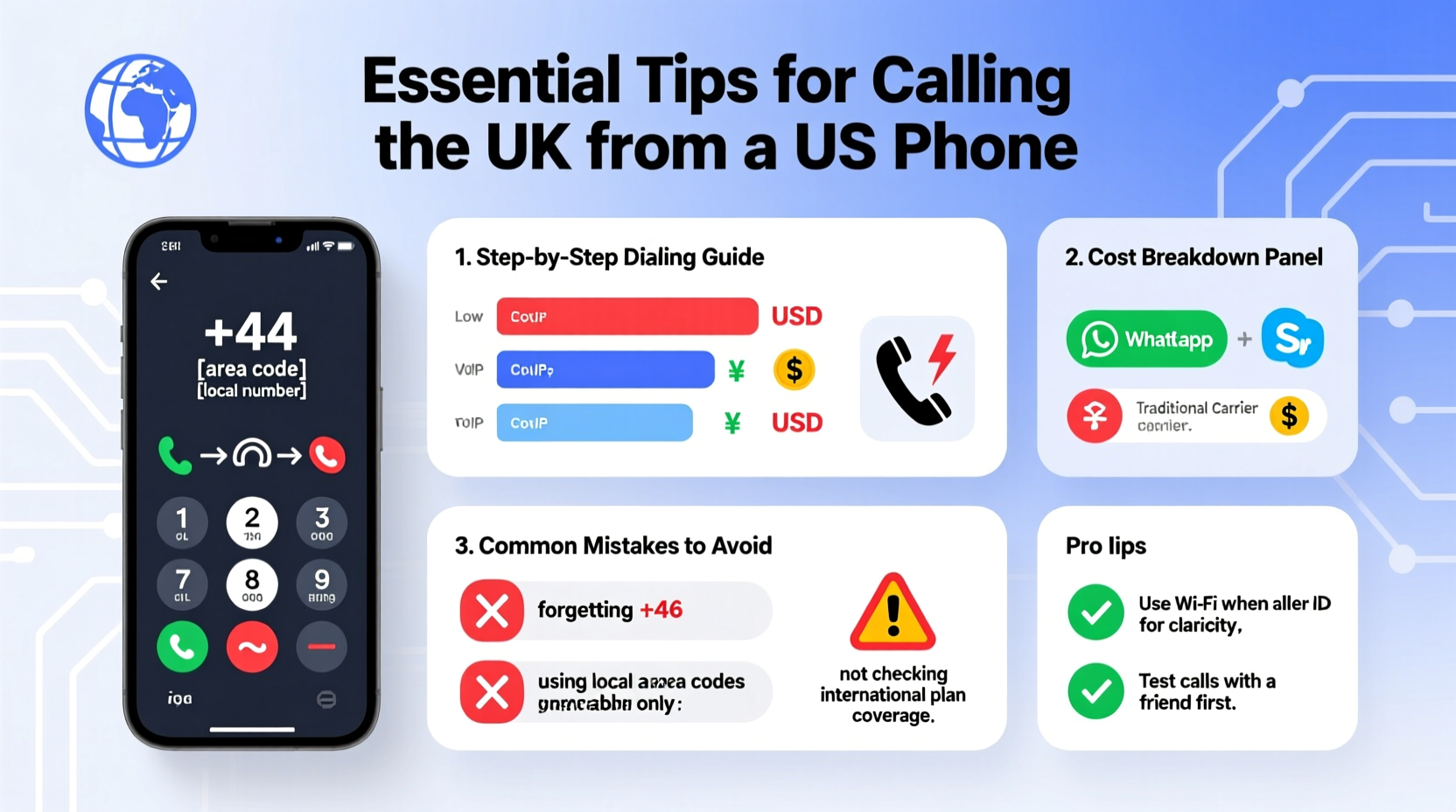
Calling the United Kingdom from the United States follows a standardized international dialing format. Getting each step right ensures your call connects without delay or error.
- Start with the US exit code: Dial 011. This signals your phone network that you’re placing an international call.
- Enter the UK country code: After 011, dial 44, which is the country code for the United Kingdom.
- Dial the local area code (without the leading zero): UK area codes often begin with a zero when dialed domestically. When calling internationally, omit this zero. For example, London’s 020 becomes 20.
- Enter the local phone number: Finish by entering the full local number, typically 7 to 8 digits long.
For example, to call a London number listed as 020 7946 0958 from the US:
- Dial: 011 - 44 - 20 - 7946 0958
Understanding Call Costs and Budget-Friendly Alternatives
Traditional voice calls via mobile carriers can be expensive, especially for regular contact. Rates vary widely depending on your provider and plan, but average costs range from $0.10 to over $2.00 per minute. VoIP (Voice over Internet Protocol) services and messaging apps offer significantly cheaper—often free—alternatives.
| Method | Avg. Cost per Minute | Internet Required? | Best For |
|---|---|---|---|
| Traditional Mobile Carrier | $0.25 – $2.00 | No | Emergency or one-time calls |
| Google Voice | $0.01 – $0.03 | Yes | Regular personal or business calls |
| Skype Out | $0.02 – $0.10 | Yes | Long conversations with pay-as-you-go credit |
| WhatsApp / FaceTime Audio | Free | Yes | Friends and family with app access |
| International Calling Card | $0.05 – $0.15 | No | Travelers or those without smartphone access |
Switching to internet-based calling not only reduces costs but often improves audio quality. Services like Google Voice allow you to purchase a US number and use it to call UK landlines at minimal rates, while WhatsApp and FaceTime offer end-to-end encryption and HD voice when both parties are connected.
Common Mistakes to Avoid When Calling the UK
Even experienced callers sometimes make simple errors that disrupt communication. Being aware of these common missteps can help you avoid unnecessary charges and failed attempts.
- Forgetting to remove the leading zero from UK area codes: Domestic UK numbers start with 0 (e.g., 0161 for Manchester), but this must be dropped when dialing from abroad.
- Dialing too quickly: Some older systems require pauses between segments. If your call fails repeatedly, try adding short pauses after each part (011...44...20...).
- Using outdated carrier plans: Many legacy mobile plans charge premium rates for international calls. Check your provider’s current rates or consider switching to an unlimited-international add-on.
- Ignoring time zone differences: The UK is typically 5 hours ahead of New York and 8 hours ahead of Los Angeles. Calling at 8 PM your time may wake someone at 1 AM their time.
- Assuming all UK numbers are reachable: Some UK mobile providers block international incoming calls unless configured otherwise.
Real-World Example: Avoiding a Costly Oversight
Sarah, a freelance project manager based in Austin, regularly coordinated with a client team in Bristol. She used her standard mobile line for weekly check-ins, unaware her carrier charged $1.75 per minute for UK calls. After three months, she noticed a $180 spike in her phone bill. Upon reviewing her usage, she realized she’d spent nearly 100 minutes on international calls monthly.
She switched to Google Voice, set up a low-cost calling plan ($0.02/min to UK landlines), and saved over $150 annually. Additionally, she began scheduling meetings during overlapping business hours to respect time zones, improving team responsiveness.
Sarah’s experience underscores how small oversights—like not verifying calling rates—can lead to significant expenses. A five-minute audit of calling habits and tools could have prevented the issue entirely.
Expert Insight: What Telecommunications Specialists Recommend
Industry professionals emphasize planning and technology awareness when managing international communication.
“Most people don’t realize their smartphone settings can automatically route calls through Wi-Fi using low-cost VoIP services. Enabling Wi-Fi calling and using apps like WhatsApp or Google Voice isn’t just cheaper—it’s often clearer and more reliable than traditional networks.” — Dr. Alan Reeves, Senior Telecom Analyst at Global Connect Insights
Experts also advise verifying number formats before saving them. Incorrect formatting leads to failed calls and wasted time, especially when dealing with UK mobile numbers (which start with 7 after removing the 0).
Quick Checklist for Successful UK Calls
Before making your next call to the UK, run through this checklist to ensure everything goes smoothly:
- ✅ Confirm the correct UK number format (remove leading 0)
- ✅ Verify current time in the UK (avoid early morning or late night)
- ✅ Choose the most cost-effective method (VoIP vs. carrier)
- ✅ Test your internet connection if using VoIP
- ✅ Save the number in +44 format for future use
- ✅ Check if your plan includes international minutes
- ✅ Inform the recipient if using an unfamiliar number
Frequently Asked Questions
Can I use my US cell phone to call the UK without extra charges?
It depends on your carrier and plan. Some unlimited US plans include limited international calling. However, most standard plans charge per minute. To avoid fees, use Wi-Fi calling or VoIP apps like WhatsApp, FaceTime, or Google Voice, which are often free when both parties have the app.
Why does my call to the UK keep failing?
Common reasons include incorrect dialing format (such as keeping the leading zero in the area code), poor signal strength, blocked international calling on either end, or network restrictions. Double-check the number format and try using a different method, such as a VoIP service over Wi-Fi.
Are mobile-to-mobile calls to the UK more expensive than landline calls?
Historically, yes. Many carriers charge higher rates for UK mobile numbers compared to landlines. However, with VoIP services, there’s usually no difference in cost. Always verify rates with your provider or app service before calling.
Final Thoughts and Next Steps
Calling the UK from the US doesn’t have to be complicated or expensive. By understanding the correct dialing sequence, leveraging affordable digital tools, and avoiding common errors, you can maintain seamless communication across the pond. Whether you're reconnecting with loved ones or managing international business, taking a few moments to optimize your calling strategy pays dividends in clarity, cost savings, and reliability.




 浙公网安备
33010002000092号
浙公网安备
33010002000092号 浙B2-20120091-4
Comments
No comments yet. Why don't you start the discussion?