
Finding the right pair of plus size sandals can be a challenge—not because stylish options are scarce, but because many women skip a crucial first step: accurate foot measurement. For those with wider feet or higher volume needs, standard sizing charts often fall short. Without precise measurements, even high-quality sandals can lead to discomfort, blisters, or long-term foot issues. This guide walks through the exact process of measuring your foot at home, explains why standard shoe sizes aren’t enough, and offers expert-backed strategies to ensure your next sandal purchase fits flawlessly.
Why Standard Shoe Sizes Aren't Enough for Plus Size Feet
Most women rely on standard shoe size labels—like 9W or 10XW—without realizing these designations vary widely between brands. A “wide” in one company might be equivalent to a “regular” in another. Plus size feet often require attention to more than just length and width; arch height, ball girth, heel width, and instep volume all play critical roles in fit.
According to Dr. Lena Patel, a podiatrist specializing in footwear biomechanics:
“Plus size feet aren’t just longer or wider—they often have unique proportions that off-the-shelf sizing doesn’t account for. Measuring both dimensions and volume gives you control over fit, not guesswork.” — Dr. Lena Patel, DPM
Without proper measurement, women may end up squeezing into narrow toe boxes or dealing with slippage due to inadequate heel hold—all avoidable with a few minutes of careful assessment.
Step-by-Step Guide: How to Measure Your Foot Accurately at Home
You don’t need special tools to get reliable measurements. Follow this timeline-tested method to capture the key dimensions needed for selecting plus size sandals.
- Time it right: Measure your feet in the afternoon or evening when they’re naturally slightly swollen from daily activity—this mimics real-world wear conditions.
- Gather supplies: You’ll need a ruler or tape measure, a blank sheet of paper larger than your foot, a pencil, and a flat surface with minimal carpeting.
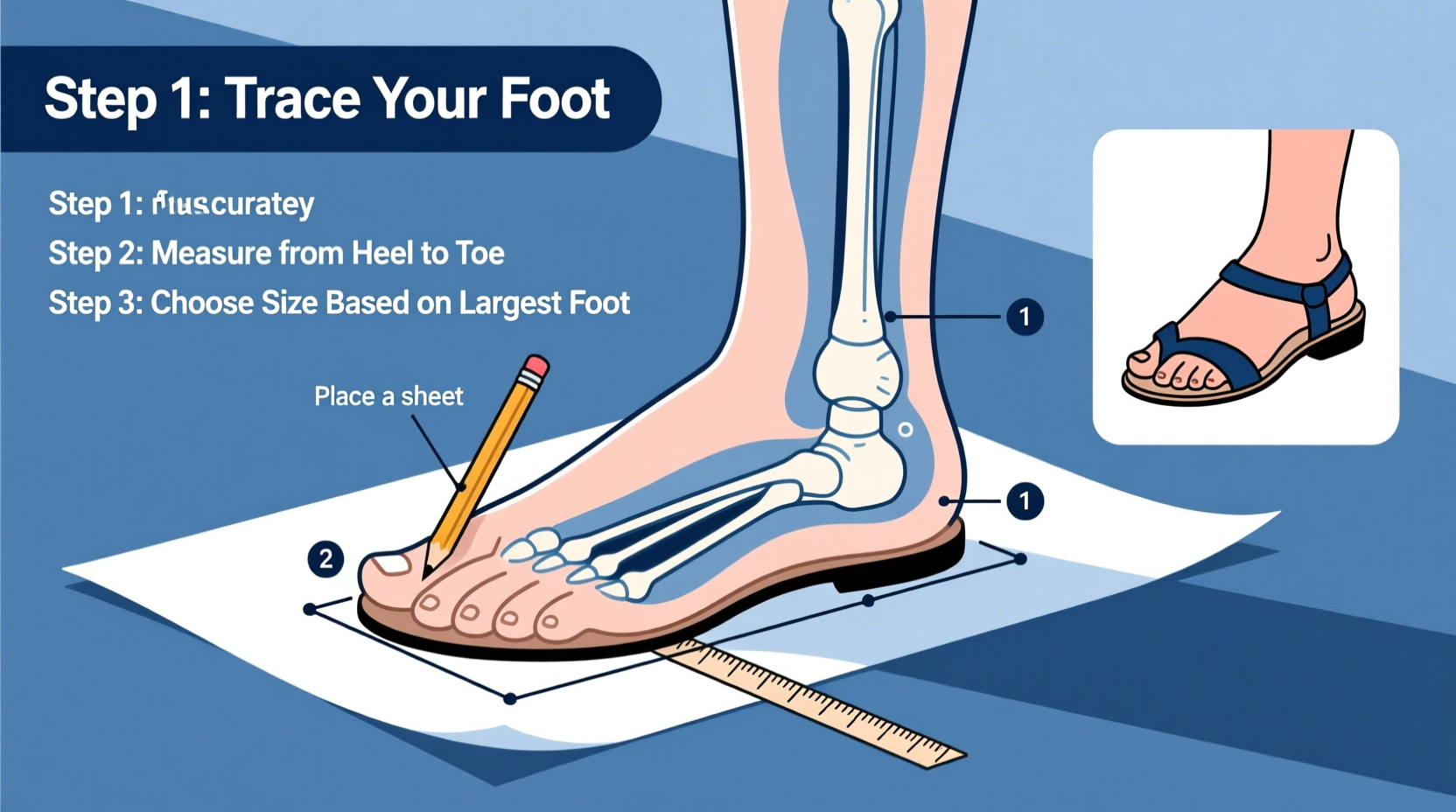
- Position your foot: Stand barefoot on the paper with your full weight evenly distributed. Have someone assist if possible to keep the pencil vertical while tracing.
- Trace your foot: Hold the pencil perpendicular to the paper and outline the entire perimeter of your foot. Don’t tilt the pencil inward or outward.
- Measure foot length: Use the ruler to find the distance from the heel to the longest toe (often the second toe). Record this in inches or centimeters.
- Measure foot width: Identify the widest part of the foot—usually across the ball area—and measure side-to-side at that point.
- Check ball girth: Wrap the tape measure around the foot just behind the toes, where the metatarsal heads are most prominent. This helps determine if sandals with wide forefoot zones are necessary.
- Assess instep height: Place the tape over the top of the foot, from the outside edge near the ankle across to the other side, passing over the highest point of the arch. Higher insteps need adjustable straps or stretchable uppers.
- Repeat for the other foot: Most people have one foot slightly larger than the other. Always size to the bigger foot.
Essential Fit Metrics for Plus Size Sandals: What to Track
Once you’ve taken your measurements, compare them against brand-specific sizing charts—not generic conversion tables. Below is a reference table showing common measurement benchmarks for women’s plus size sandals.
| US Size | Foot Length (in) | Foot Width (in) | Ball Girth (in) | Typical Width Label |
|---|---|---|---|---|
| 9 | 9.6 | 3.9 | 9.5 | B (Medium) |
| 9 | 9.6 | 4.2 | 10.1 | 2E (Wide) |
| 10 | 10.0 | 4.4 | 10.7 | 4E (Extra Wide) |
| 11 | 10.4 | 4.6 | 11.2 | 6E (Double Extra Wide) |
Note that some premium sandal brands like Birkenstock, Propet, and Wolky provide full metric specs including depth and strap adjustability—details worth checking before ordering online.
Real-World Example: Sarah’s Search for Summer Sandals
Sarah, a 42-year-old teacher from Portland, struggled for years with sandals that pinched her toes or slipped off her heels. She wore a “size 10 wide,” but found inconsistent fits across retailers. After measuring her feet using the method above, she discovered her left foot was 10.1 inches long and 4.3 inches wide at the ball, with a ball girth of 10.3 inches—falling into a 2E category.
She used this data to filter online stores by “minimum width” and “adjustable straps.” Her final choice? A pair of Ecco Yucatan sandals with dual ratchet closures and a contoured footbed. “For the first time,” she said, “I walked eight miles at an outdoor festival without a single blister.”
Checklist: Pre-Purchase Foot & Fit Verification
- ✅ Measured both feet today (not guessed based on past size)
- ✅ Recorded length, width, ball girth, and noted instep height
- ✅ Identified the larger foot and will size accordingly
- ✅ Researched brand-specific sizing charts (not relied on Amazon defaults)
- ✅ Confirmed sandal has adjustable straps or stretch panels
- ✅ Verified return policy in case fit isn’t perfect
- ✅ Checked customer reviews mentioning “wide foot fit” or “high instep”
Common Mistakes to Avoid When Buying Plus Size Sandals
Even with good intentions, many shoppers make errors that compromise fit and comfort:
- Mistake: Using men’s sizes as a shortcut.
Reality: Men’s and women’s lasts differ in proportions—especially in heel-to-ball ratio. - Mistake: Assuming “wide” means the same thing everywhere.
Reality: One brand’s wide may only add 1/8 inch, while another adds nearly 1/2 inch. - Mistake: Ignoring strap placement.
Reality: A sandal may be wide overall but still press on bunions if the strap crosses too close to the joint. - Mistake: Skipping the standing test.
Reality: Feet expand under weight. Sitting during try-ons gives false confidence.
Frequently Asked Questions
Can I use my shoe size from five years ago?
No. Feet change over time due to aging, weight fluctuations, and hormonal shifts. Always remeasure before making a significant footwear purchase, especially for supportive styles like orthopedic or travel sandals.
Do all wide sandals accommodate high insteps?
Not necessarily. Width and instep clearance are separate considerations. Look for models with top-strap adjustability or elasticized sections that won’t constrict the top of the foot.
Are printable foot sizers online reliable?
Only if calibrated correctly. Many free PDF templates assume standard printer scaling, which often fails. For accuracy, use physical rulers and manual tracing instead of relying solely on digital tools.
Final Thoughts: Take Control of Your Fit
Accurate foot measurement isn’t just a preliminary step—it’s an act of self-care. For women with plus size feet, it’s the foundation of lasting comfort, mobility, and confidence. Armed with precise numbers and a clear understanding of what to look for, you’re no longer limited by vague labels or inconsistent sizing. You now have the power to choose sandals that truly fit—because you know exactly what your feet need.




 浙公网安备
33010002000092号
浙公网安备
33010002000092号 浙B2-20120091-4
Comments
No comments yet. Why don't you start the discussion?