
A well-fitted watch should feel secure, balanced, and comfortable on the wrist. Yet, many people overlook one of the most important aspects of wearing a timepiece: strap fit. Metal watch bands, while durable and elegant, often require fine-tuning to match your wrist size. Rather than visiting a jeweler every time the links feel too loose or too tight, you can adjust them yourself with confidence—right from your home.
With the right tools, attention to detail, and a bit of patience, adjusting a metal watch strap becomes a simple, repeatable task. This guide delivers expert-backed techniques that ensure precision and protect your investment. Whether you're downsizing after weight loss or fitting a new vintage find, these methods apply across most popular brands and styles.
Understanding Metal Watch Strap Construction
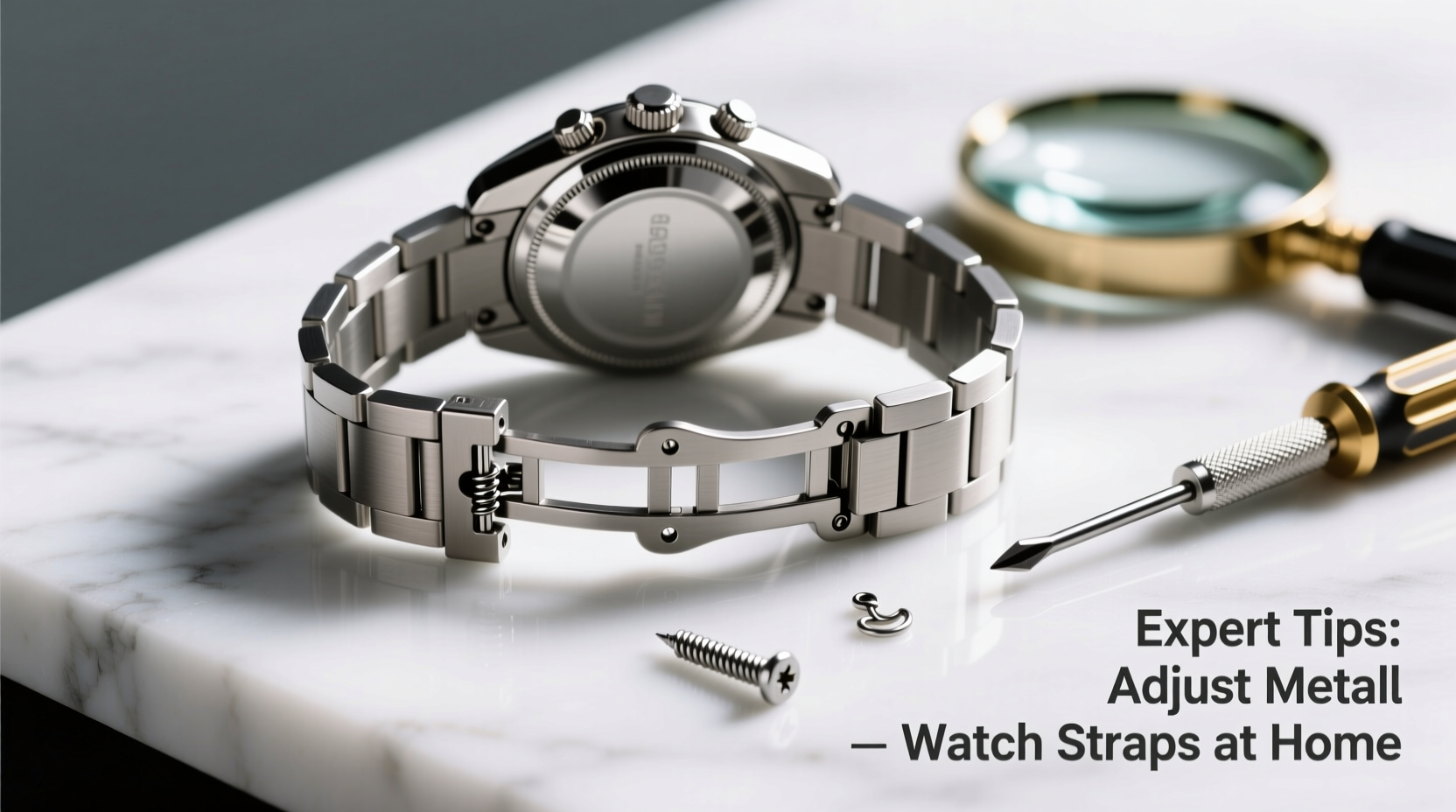
Metal watch bands are typically made of individual links connected by small pins or screws. These links allow the band to expand or contract in length. Most common designs use either solid end links (SELs) or hollow pins, each requiring slightly different handling during adjustment.
The key components include:
- Links: Individual metal segments that form the band.
- Pins: Small metal rods holding adjacent links together; may be push-in or screw-in types.
- Springs bars (in some cases): Used in micro-adjust clasp systems rather than full link removal.
- Clasp mechanism: Folding or deployment clasps may have secondary adjustments built-in.
Before making any changes, identify whether your watch uses removable links or an integrated sizing system. Many modern watches, especially from brands like Seiko, Citizen, and Tissot, feature user-serviceable link systems designed for at-home adjustments.
Essential Tools You’ll Need
You don’t need a full watchmaker’s toolkit to adjust a metal strap. A few affordable, widely available tools will do the job safely and efficiently.
| Tool | Purpose | Alternative / Workaround |
|---|---|---|
| Jeweler’s Screwdriver Set | For removing screw-type pins or securing clasp screws | Precision phone repair kit |
| Pin Pusher Tool (or Adjusting Tool) | Precisely pushes out spring pins without damaging links | Nail file or small awl (with caution) |
| Hammer & Bench Block (optional) | Secures the tool when driving pins | Wooden cutting board + tape |
| Magnifying Glass or Loupe | Helps spot pin direction and alignment | Smartphone zoom function |
| Tweezers | Handles tiny pins and springs safely | Clean needle-nose pliers |
“Most people fear breaking their watch during strap adjustment, but using the correct tool eliminates 90% of risks.” — Daniel Reyes, Master Watch Technician, Geneva Timeworks
Step-by-Step Guide to Removing Links
Follow this sequence to shorten your metal watch band accurately and safely.
- Determine how many links to remove: Fasten the watch loosely and count how many excess links sit beyond the clasp. Typically, removing two to four links achieves optimal fit.
- Inspect the band for directional arrows: On the inner side of the links, look for tiny engraved arrows indicating which way the pins should be pushed. Never force pins against the arrow direction.
- Secure the watch: Place it on a non-slip surface or use a padded vise. Hold firmly but avoid pressure on the crystal or case.
- Insert the pin pusher: Align the tool tip into the exposed end of the pin. Apply slow, steady pressure until the pin begins to slide out. Stop once enough of the pin protrudes to grip with tweezers.
- Remove the pin completely: Use tweezers to pull it the rest of the way. Store it in a labeled container.
- Detach the link: Once both pins are partially extracted, gently separate the link from the band. Repeat for additional links as needed.
- Reconnect the remaining links: Align the open ends and reinsert the pins. Tap lightly with a hammer if necessary, ensuring the pin seats flush with the link.
- Test the fit: Wear the watch and check comfort, movement, and clasp security. The band should rest flat against the wrist without sagging.
Real Example: Adjusting a Stainless Steel Citizen Eco-Drive
Sarah purchased a Citizen BM8180 online, excited about its solar-powered elegance. Upon arrival, she found the band was too large, slipping with every gesture. Instead of returning it, she decided to resize it herself.
Using a $15 pin removal tool from an online retailer, Sarah examined the underside of the links and spotted small arrows pointing outward. She carefully removed two outer links—one from each side—to maintain symmetry. After reassembling the band with the original pins, the watch sat perfectly flush on her 6.5-inch wrist. The entire process took under 20 minutes, saving her a trip to the local jewelry store and preserving the warranty.
This is a common scenario. Many mid-tier and premium watches are designed with DIY-friendly construction, assuming users may want to personalize fit without professional help.
Do’s and Don’ts of Home Adjustment
| Do’s | Don’ts |
|---|---|
| Always check for directional arrows before pushing pins | Never use excessive force—precision matters more than strength |
| Work on a clean, well-lit surface with organized tools | Don’t disassemble multiple links at once—keep track of order |
| Keep removed pins in a magnetic tray or pillbox | Don’t assume all pins are identical—some are longer or threaded |
| Use magnification to verify proper pin seating | Don’t wear the watch immediately if pins feel loose—double-check |
Frequently Asked Questions
Can I damage my watch by adjusting the strap myself?
Yes—if done incorrectly. However, using proper tools and following manufacturer guidelines minimizes risk significantly. Most modern metal bands are built for occasional user adjustment. Avoid using pliers or screwdrivers that are too large, as they can scratch the finish or deform pins.
How do I know how many links to remove?
Fasten the watch on your wrist normally. Any links extending past the clasp that cause wobbling or rotation are candidates for removal. As a rule of thumb, aim for the clasp to meet near the center of the back of your wrist. When in doubt, remove fewer links first—you can always take more out later.
What if my watch has screwed links instead of pins?
Screwed links, found on higher-end models like certain Omega or Rolex bracelets, use tiny Allen-style screws instead of friction pins. These require a precision hex key (usually 1.2mm or 1.5mm). Unscrew slowly to prevent stripping. Reapply a drop of thread locker (like Loctite 222) upon reassembly to prevent loosening over time.
Final Checklist Before You Begin
- ✔️ Identify your band type (pin vs. screw)
- ✔️ Locate directional arrows on inner links
- ✔️ Gather necessary tools (pin pusher, tweezers, magnifier)
- ✔️ Count and mark target links for removal
- ✔️ Work slowly and methodically—rushing causes mistakes
- ✔️ Test fit before finalizing reassembly
Conclusion: Confidence Starts With a Perfect Fit
A watch that fits well doesn’t just look better—it performs better. It stays stable during activity, avoids skin irritation, and enhances the overall wearing experience. By mastering the art of at-home strap adjustment, you gain independence, save money, and deepen your appreciation for horological craftsmanship.
These techniques aren’t reserved for professionals. With careful observation and the right approach, anyone can achieve a custom fit that rivals a boutique service. Your watch was made to last; now, make it fit to live with you—every day, in comfort and style.




 浙公网安备
33010002000092号
浙公网安备
33010002000092号 浙B2-20120091-4
Comments
No comments yet. Why don't you start the discussion?