
Selecting the right earrings goes beyond personal taste or current trends. The most flattering pair doesn’t just catch the eye—it enhances your natural features, balances your proportions, and draws attention to your best qualities. One of the most overlooked yet powerful factors in this equation? Earring size in relation to your face shape. A mismatch can make even the most expensive studs look awkward, while the right choice elevates your entire appearance.
From delicate huggies to dramatic chandeliers, understanding how length, width, and volume interact with your facial structure is key. Whether you're dressing for a special occasion or refining your everyday style, these expert-backed guidelines will help you choose earrings that harmonize with your face shape—not compete against it.
Understanding Face Shapes and Proportion Principles
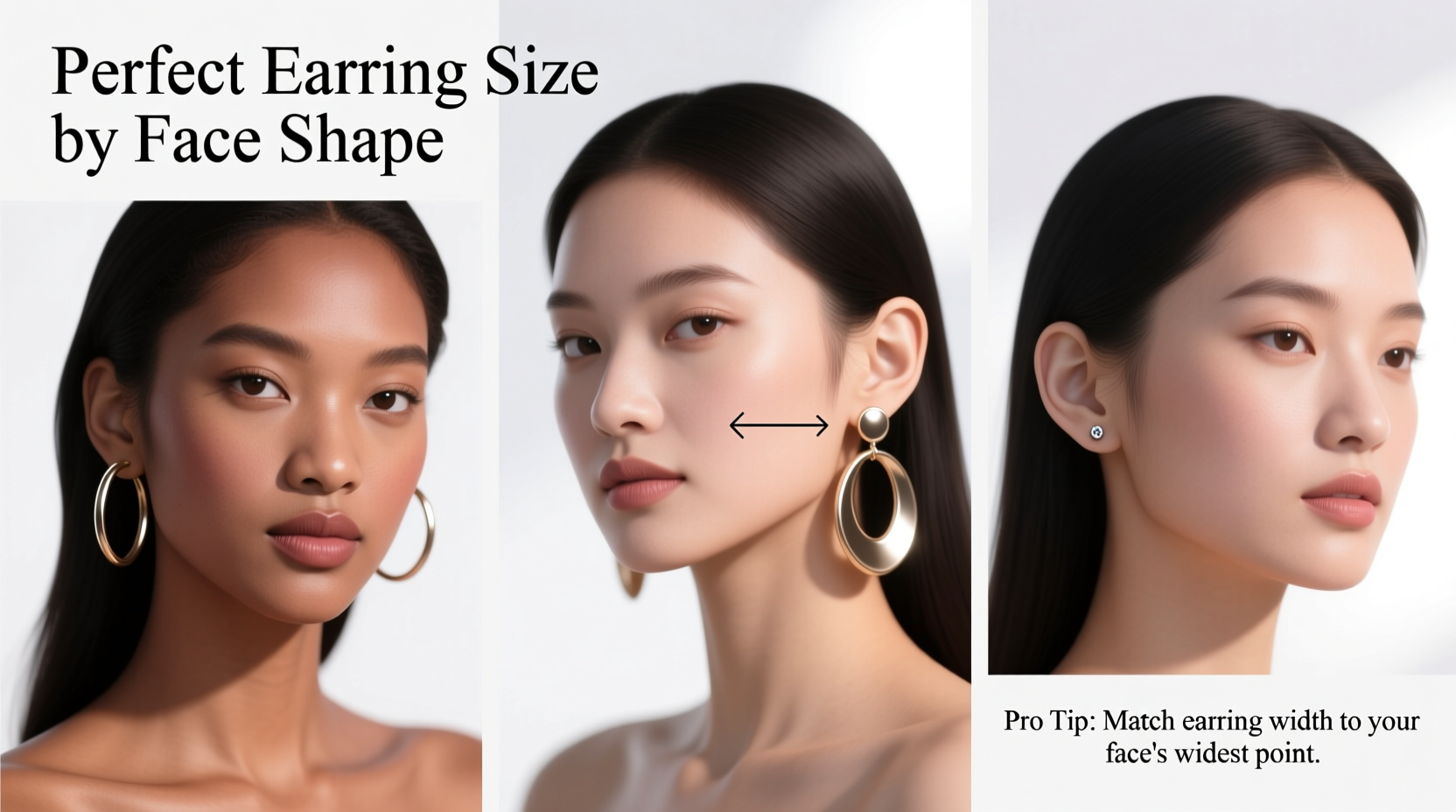
Your face shape determines how earrings visually interact with your features. Jewelry acts as a frame, either softening angles, elongating roundness, or adding symmetry. The goal is balance: use earrings to counteract dominant traits and highlight your strengths.
The five primary face shapes—oval, round, square, heart, and long—are defined by their proportions. While many people fall into hybrids, identifying your dominant shape helps narrow ideal earring choices.
Once identified, apply the principle of visual counterbalance. For example, long faces benefit from horizontal width to create fullness across the cheeks, while round faces gain definition from vertical length that elongates the jawline.
Earring Size Guidelines by Face Shape
| Face Shape | Best Earring Size & Style | Avoid |
|---|---|---|
| Oval | Medium to large studs, teardrop dangles, hoops (1–2 inches) | Overly long or oversized pieces that overwhelm symmetry |
| Round | Long drops, linear designs, angular geometrics (1.5–3 inches) | Small hoops or circular studs that emphasize roundness |
| Square | Round hoops, oval drops, curved silhouettes (1.5–2.5 inches) | Rigid, boxy shapes that accentuate jaw angles |
| Heart | Bottom-heavy drops, fan shapes, modest studs (1–2 inches) | Top-heavy designs or large upper elements that widen forehead |
| Long / Oblong | Wide hoops, clustered studs, horizontal bars (1–2 inches wide) | Excessively long dangles that stretch the face further |
This table serves as a starting point. Remember, confidence plays a role—rules are meant to guide, not restrict. But when in doubt, proportionality wins every time.
Step-by-Step Guide to Choosing Your Ideal Earring Size
- Determine your face shape: Use a mirror and observe the widest part of your face, jawline angle, and chin shape. Is your forehead wider than your jaw? Are your cheekbones prominent?
- Measure your face dimensions: Note the length from hairline to chin and width across the cheekbones. A ratio close to 1.5:1 suggests an oval or long face; near-equal ratios often indicate round or square.
- Assess your neckline and hairstyle: Updos expose more ear and neck, making longer earrings viable. High collars or turtlenecks may clash with long drops.
- Test proportions with temporary stand-ins: Use chopsticks or straws clipped to your ears to simulate different lengths. Step back and observe the visual effect.
- Start conservative, then scale up: Begin with medium-sized options that align with your face shape’s recommendations. Gradually experiment with bolder sizes once you understand what works.
Real-Life Example: Transforming Style Through Smart Sizing
Maria, a communications manager with a square face and strong jawline, always avoided statement earrings. “I thought big jewelry made me look harsh,” she said. After a consultation, she switched from angular geometric studs to soft, 2-inch round gold hoops. The change was immediate: her features appeared softer, and colleagues commented on her “new glow.”
“I didn’t realize how much the wrong shape was working against me,” Maria shared. “Now I reach for those hoops before every client meeting.”
Her experience underscores a universal truth: the right earring size doesn’t just accessorize—it transforms perception.
Expert Insight: What Designers Know About Balance
“Earrings are one of the few accessories that directly frame the face. A well-chosen size creates harmony between bone structure and adornment. It’s not about following trends—it’s about optical alignment.” — Lena Park, Fine Jewelry Designer and Facial Proportions Consultant
Park emphasizes that many clients overlook lobe weight and earring drop point. “The earring should ideally end at or just below the jawline for maximum balance. Too short, and it cuts off the face; too long, and it competes with your expression.”
Checklist: Picking Earrings That Flatter Your Face
- ✅ Identify your dominant face shape using mirror analysis
- ✅ Choose earring length that complements, not exaggerates, your proportions
- ✅ Prioritize movement and dimension over sheer size (e.g., textured surfaces add interest without bulk)
- ✅ Match metal tone to your skin undertone (warm, cool, or neutral) for added cohesion
- ✅ Consider daily wear practicality—large earrings may snag or cause fatigue
- ✅ Test new pairs during daylight hours to see true color and proportion impact
Frequently Asked Questions
Can I wear large earrings if I have a small face?
Yes—but with caution. Very large earrings can overpower petite features. Opt for lightweight, open designs like filigree hoops or airy drops that create presence without overwhelming. Avoid heavy, dense materials unless worn for brief events.
Do face shape rules apply to men and non-binary individuals too?
Absolutely. Facial proportions affect visual balance regardless of gender. Men with square jaws, for instance, also benefit from rounded or vertically oriented designs. The principles are anatomical, not gendered.
What if my face is a mix of two shapes?
Most faces are hybrids. Focus on the most dominant trait—such as a wide forehead (heart-shaped tendency) or a long jaw (oblong influence)—and choose earrings that address that feature first. You can then fine-tune based on experimentation.
Final Thoughts: Confidence Begins With Harmony
The perfect earring size isn’t about fashion dictates—it’s about synergy. When your jewelry aligns with your face shape, it doesn’t shout for attention. Instead, it quietly elevates your presence, drawing eyes to your smile, your gaze, your confidence.
Take inventory of your current collection. How many pairs truly complement your structure? Start by replacing one or two mismatched items with purposefully chosen alternatives. Notice how they change not just your look, but how you feel when you wear them.




 浙公网安备
33010002000092号
浙公网安备
33010002000092号 浙B2-20120091-4
Comments
No comments yet. Why don't you start the discussion?