
Opals captivate with their iridescent play-of-color—shifting hues of green, blue, red, and purple that seem to dance beneath the surface. This unique beauty makes them highly sought after, but also a prime target for imitations. From synthetic doubles to plastic fakes, the market is flooded with convincing replicas. Knowing how to distinguish a genuine opal from an imitation isn’t just valuable for collectors and buyers—it’s essential to avoid costly mistakes.
With decades of gemological research and field experience, experts have developed reliable techniques to verify authenticity. Whether you're evaluating a vintage piece or considering a new purchase, understanding these methods empowers you to make informed decisions with confidence.
Understanding Opal: Nature’s Rainbow in Stone
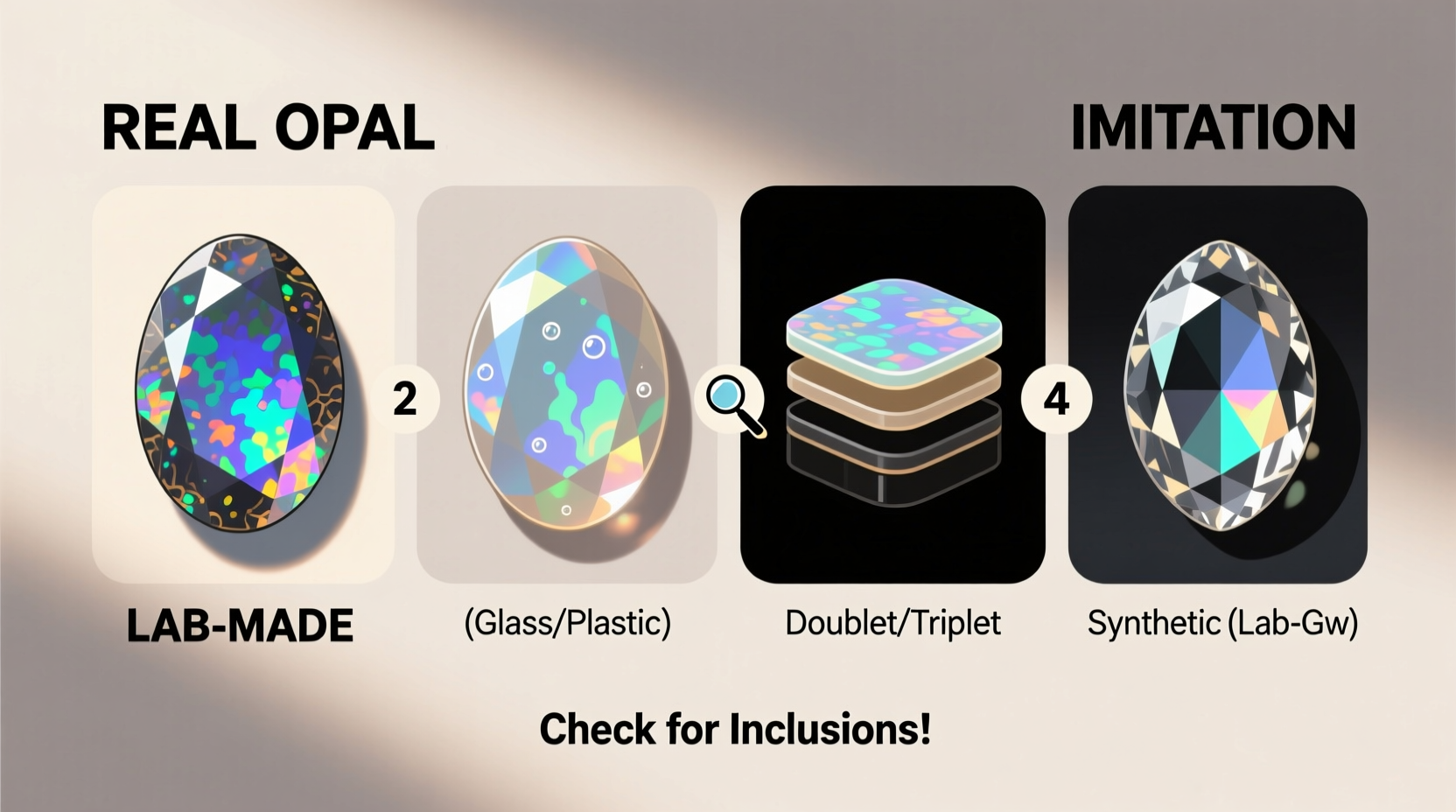
Natural opal forms over millions of years when silica-rich water seeps into cracks in sedimentary rock. As the water evaporates, it leaves behind microscopic silica spheres that diffract light, creating the signature “play-of-color.” This phenomenon is entirely natural and varies from stone to stone—no two opals are exactly alike.
There are several types of natural opal:
- White opal – milky base with floating color patches
- Black opal – dark body tone that enhances color contrast (most valuable)
- Boulder opal – formed within ironstone matrix, often with rugged texture
- Crystal opal – transparent to semi-transparent with vivid internal fire
In contrast, imitation opals—such as glass, plastic, or lab-created doublets—are engineered to mimic this effect. While some imitations can be beautiful in their own right, they lack the rarity and value of natural stones.
Key Visual Clues to Spot Fakes
The first line of defense is visual inspection. With good lighting and a 10x loupe (a standard jeweler’s magnifier), you can detect telltale signs of imitation.
Color Pattern & Movement
Natural opals display irregular, mosaic-like color patches that change subtly with viewing angle. Imitations, especially synthetic opals like those made by Gilson, often feature perfectly hexagonal or grid-like color patterns—a sign of artificial structure.
Surface Texture & Luster
Real opal has a vitreous (glassy) to waxy luster. Plastic imitations appear too glossy or unnaturally smooth. Glass opals may show mold marks, bubbles, or flow lines under magnification—none of which occur in natural opal.
Layering in Doublets and Triplets
Many lower-cost \"opal\" jewelry pieces use doublets or triplets—thin slices of real opal glued to a backing (often black potch or ironstone) and topped with a clear quartz dome. These are partially real but not solid opal.
- Doublet: Real opal layer + dark backing
- Triplet: Real opal layer + backing + protective crystal cap
Look for visible glue lines at the side profile or abrupt color changes near the base. The play-of-color should originate from within the stone, not just on the surface.
“Natural opal breathes light from within. If the color looks painted on or stuck to the top, it’s likely a composite.” — Dr. Lena Torres, GIA Gemologist
Simple At-Home Tests You Can Trust
While professional lab analysis is the gold standard, several practical tests can help narrow down authenticity.
Temperature Test
Hold the stone in your hand. Natural opal feels cool initially and warms slowly. Plastic imitations warm up almost immediately due to low thermal conductivity.
Scratch Resistance
Opal ranks around 5.5–6.5 on the Mohs hardness scale. Try gently scratching an inconspicuous area with a steel needle (not a diamond). If it scratches easily, it could be plastic. However, avoid aggressive testing on valuable pieces.
UV Light Reaction
Some natural opals fluoresce under UV light—typically showing soft blue, green, or white glows. Many imitations do not react, though this test isn't definitive alone.
The Scratch-and-Smell Test (Use with Caution)
A last-resort method: lightly scratch the back of the stone and smell it. Some plastic imitations emit a faint chemical or burnt plastic odor when abraded. Never perform this on mounted or valuable stones.
| Feature | Natural Opal | Imitation (Plastic/Glass) | Synthetic Opal |
|---|---|---|---|
| Color Pattern | Irregular, organic patches | Uniform, repeating grids | Perfectly aligned hexagons |
| Hardness | 5.5–6.5 | 2–5 (plastic), ~5.5 (glass) | 5.5–6.0 |
| Thermal Feel | Cool, slow-warming | Warm quickly | Cool, similar to real |
| Transparency | Varies (milky to clear) | Often too clear or cloudy | Highly consistent |
| Price Indicator | $50–$10,000+ | Under $30 | $50–$200 |
When in Doubt: Seek Professional Verification
For high-value purchases or estate jewelry, professional gemological evaluation is non-negotiable. Reputable labs like the Gemological Institute of America (GIA) or International Gemological Institute (IGI) provide certification reports that analyze:
- Internal structure via magnification
- Refractive index and specific gravity
- Spectroscopic signatures
- Evidence of treatment or assembly
A certified report will specify whether the stone is natural, synthetic, or imitation—and if it's a doublet/triplet, it will be clearly disclosed.
Red Flags from Sellers
- “Guaranteed real” without documentation
- Unrealistically low prices for large black opals
- Vague descriptions like “opal-like” or “rainbow stone”
- No return policy or refusal to allow independent appraisal
Real-World Example: The Tourist Market Trap
Sophia was vacationing in Bali when she found a stunning black opal pendant for $80—a price that would barely cover a small natural stone in Australia. Excited, she bought it on the spot. Back home, her local jeweler examined it under a loupe and revealed it was a triplet with a thin slice of Ethiopian opal glued to a black backing and capped with glass. Worse, the setting was plated silver, not solid.
While not worthless, the piece was worth closer to $40. Sophia learned a hard lesson: emotional appeal and bargain pricing can cloud judgment. Had she used a loupe to inspect the side profile or asked for certification, she might have avoided the disappointment.
Frequently Asked Questions
Can synthetic opal be considered “real”?
No. Synthetic opal is lab-grown with the same chemical composition as natural opal, but it lacks geological formation history. It’s not “fake,” but it’s not naturally occurring. Full disclosure is required by ethical sellers.
Are all doublets and triplets imitations?
No—but they aren’t solid natural opals either. They contain real opal but are assembled for durability and affordability. They should be clearly labeled as such. A well-made doublet can still be a beautiful, long-lasting piece.
Is Australian opal always better than other types?
Australian opal, especially from Lightning Ridge (black opal), is historically the most prized due to its depth of color and rarity. However, high-quality Ethiopian and Mexican opals now rival them in beauty. Origin matters less than quality and authenticity.
Final Checklist: How to Verify an Opal Before Buying
- Examine the stone under natural light and tilt it to observe color movement.
- Use a 10x loupe to check for uniform patterns, glue lines, or surface coatings.
- Feel the temperature and weight—plastic feels lightweight and warm.
- Ask if it’s solid, a doublet, triplet, or synthetic.
- Demand written confirmation and, for high-value items, third-party certification.
- Buy from reputable dealers with return policies and gemological training.
Conclusion: Confidence Comes from Knowledge
Identifying real opal versus imitation isn’t about memorizing technical data—it’s about cultivating observation skills and knowing what questions to ask. The most convincing fakes prey on impulse and ignorance. But armed with the right knowledge, you can appreciate opal’s true magic without falling for illusions.
Whether you’re building a collection, investing in heirloom jewelry, or simply buying a meaningful gift, take the time to verify authenticity. Your discernment protects not only your wallet but also the legacy of one of nature’s most mesmerizing creations.




 浙公网安备
33010002000092号
浙公网安备
33010002000092号 浙B2-20120091-4
Comments
No comments yet. Why don't you start the discussion?