
A flower brooch is more than just an accessory—it’s a statement of elegance, personality, and often, legacy. Whether you're building a vintage collection, investing in fine jewelry, or simply selecting the perfect accent for your outfit, knowing how to distinguish a high-quality piece from a mass-produced imitation is essential. The difference lies not in price alone, but in materials, construction, and attention to detail. With the right knowledge, anyone can spot a superior flower brooch at a glance.
1. Examine the Materials with Precision
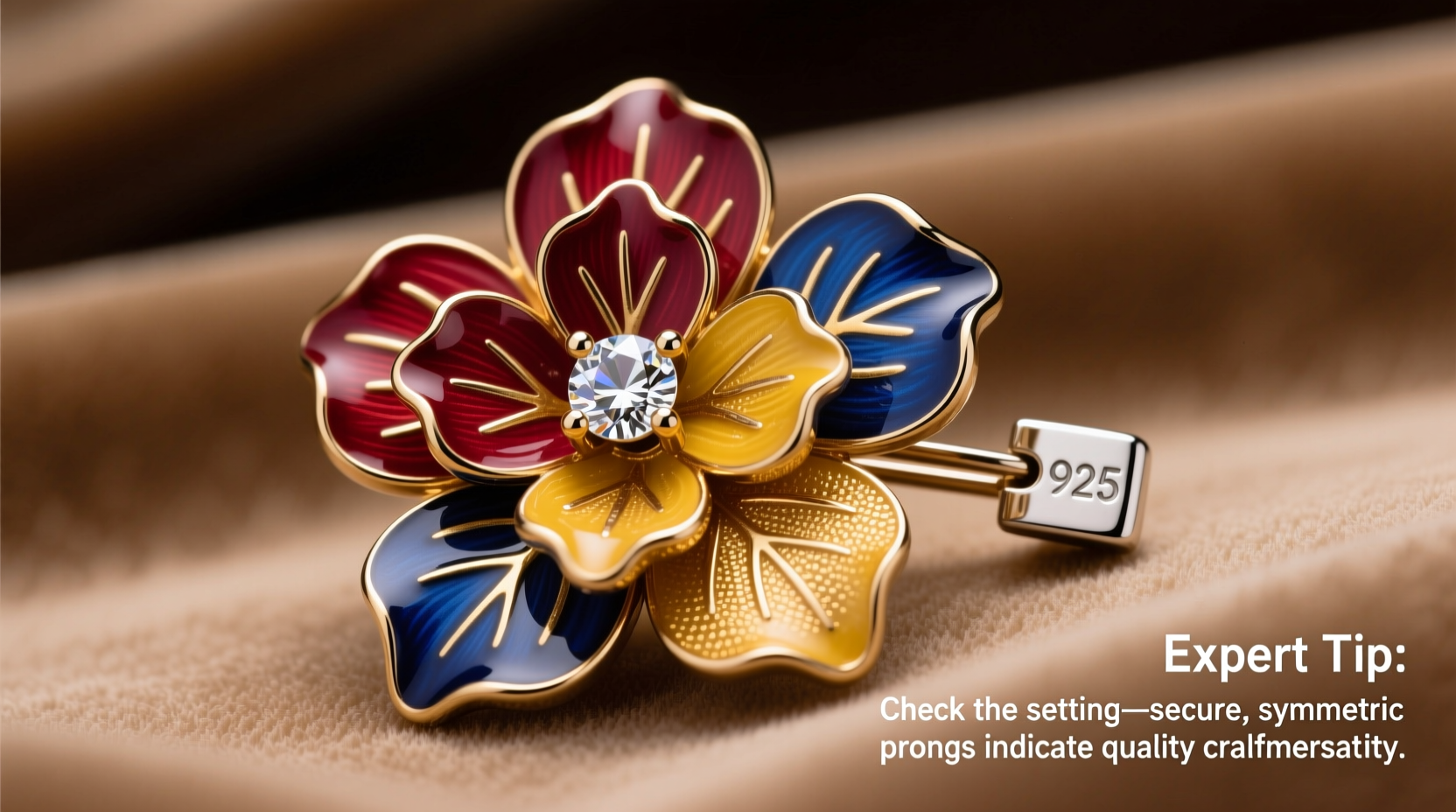
The foundation of any quality brooch is its materials. High-end pieces use premium components that reflect both durability and aesthetic value. Look beyond surface shine—what matters most is composition.
Precious metals like sterling silver, 14k or 18k gold, and platinum are hallmarks of fine craftsmanship. These metals resist tarnishing, maintain luster, and carry intrinsic value. Avoid brooches labeled “gold-plated” unless the base metal is clearly specified; many low-cost options use brass or copper cores that degrade over time.
For gemstones or embellishments, natural stones such as pearls, cubic zirconia, or genuine rhinestones (like Swarovski) indicate higher quality. Glass or plastic stones may mimic sparkle initially but lack depth and longevity.
Common Brooch Materials Compared
| Material | Quality Indicator | Durability | Red Flags |
|---|---|---|---|
| Sterling Silver | Marked \"925\" | High (tarnishes slowly) | No stamp, darkens quickly |
| 14k Gold | Stamped \"14K\" or \"585\" | Very High | Fades color, no hallmark |
| Brass with Plating | May say \"GP\" or \"GEP\" | Low to Moderate | Peeling finish, green residue on skin |
| Swarovski Crystals | Clean facets, consistent sparkle | High | Dull reflection, uneven cuts |
| Plastic Stones | Lightweight, cloudy appearance | Low | Easily scratched, loses shine |
2. Assess the Craftsmanship and Construction
A well-made flower brooch should feel substantial—not heavy, but solid. Lightweight pieces often signal thin metal stamping or hollow components, common in costume jewelry meant for short-term wear.
Inspect the back of the brooch. High-quality pieces feature clean soldering, smooth pin mechanisms, and reinforced clasps. The safety catch should snap securely into place without wobbling. If the clasp feels flimsy or opens too easily, it’s a sign of poor engineering.
Look closely at how petals and leaves are formed. Are they hand-shaped or machine-stamped? Hand-formed elements show subtle variations in curvature and texture—evidence of artisan work. Machine-made petals are uniform, flat, and lack dimensionality.
“True artistry in a flower brooch lies in the subtlety of form—the curve of a petal, the gradation of metal thickness. These nuances separate investment pieces from disposable fashion.” — Clara Renwick, Vintage Jewelry Appraiser & Curator at The Metropolitan Antique Jewelry Society
3. Study the Design and Detailing
Design integrity reveals much about a brooch’s origin and quality. High-end designers pay meticulous attention to botanical accuracy and proportion. Petals should layer naturally, mimicking real floral structure rather than appearing stacked like pancakes.
Enamel work, if present, should be smooth, evenly applied, and free of cracks or bubbles. Cloisonné enamel—a technique using wire compartments filled with colored glass—is a mark of luxury and skill. Champlevé and guilloché finishes also elevate a piece’s value.
Color consistency matters. In premium brooches, hues transition subtly, especially in multi-tonal designs. Poorly dyed metals or mismatched stones suggest rushed production.
How to Spot Authentic Designer Signatures
Many high-quality brooches are signed by their makers. Look for hallmarks, maker’s marks, or copyright stamps on the reverse. Brands like Miriam Haskell, Coro, Trifari, and Marcel Boucher often include distinct signatures. However, absence of a mark doesn’t automatically mean low quality—some European artisans did not consistently sign their work.
Use reference guides or databases like *The Jewelry Detective* or *Collectors Weekly* to cross-check markings. Be wary of forged logos—common in reproductions sold online.
4. Follow This Step-by-Step Inspection Routine
To confidently evaluate any flower brooch, follow this professional assessment process:
- Hold it in hand: Does it feel balanced and solid? Lightness may indicate inferior metal.
- Check the hallmark: Use a loupe to locate stamps like \"925\", \"14K\", or designer initials.
- Inspect the pin mechanism: Open and close the clasp several times. It should operate smoothly and lock securely.
- Examine stone settings: Stones should sit flush, with prongs or bezels tightly gripping each one. Loose or missing stones are red flags.
- Study the back: Look for signs of repair, solder blobs, or uneven finishing—these may point to amateur restoration.
- Test magnetism: Gently bring a small magnet near the piece. Precious metals are non-magnetic. If it sticks, the core is likely base metal.
- Compare with known examples: Search auction records or museum collections for similar designs to verify authenticity.
5. Real-World Example: Identifying a Valuable Vintage Find
Sarah, a collector from Portland, found a delicate rose-shaped brooch at a local estate sale priced at $25. It had no label, but the petals showed layered shaping and tiny pave-set rhinestones with fire-like brilliance. She noticed a faint \"H\" inside a circle on the back—a known mark of Miriam Haskell, a mid-century American designer renowned for hand-assembled pieces.
She took it to a certified appraiser who confirmed it was a 1950s Haskell original, featuring hand-wrapped wires and French-cut rhinestones. Its market value? Over $1,200. Sarah’s attention to detail and willingness to research paid off handsomely.
This case illustrates why thorough inspection matters. A quick dismissal based on appearance alone could have led to a missed opportunity—or worse, purchasing a counterfeit at inflated cost.
Jewelry Quality Checklist: Your Quick Reference Guide
- ✅ Metal is hallmarked (e.g., 925, 14K)
- ✅ Stones are securely set with no looseness
- ✅ Pin mechanism operates smoothly and locks firmly
- ✅ Backing is clean, not bent or repaired crudely
- ✅ Weight feels appropriate for size and material
- ✅ No visible glue, rough edges, or paint drips
- ✅ Design shows symmetry and realistic floral structure
- ✅ Enamel (if present) is smooth and crack-free
- ✅ Maker’s mark matches known authentic references
- ✅ Non-magnetic reaction to a test magnet
Frequently Asked Questions
Can a high-quality brooch be made from non-precious metals?
Yes. Some artist-made brooches use fine silver, titanium, or niobium—non-traditional yet durable materials. The key is craftsmanship and design integrity, not just metal type. However, for long-term value and wear resistance, precious metals remain the standard.
Is handmade always better than machine-made?
Not necessarily. Fine machine-crafted brooches from brands like Chanel or Dior exhibit exceptional precision and consistency. Handmade pieces offer uniqueness and artisan touch, but mass production doesn’t automatically mean low quality—especially in luxury fashion houses with strict quality control.
How do I care for a high-quality flower brooch?
Store it separately in a soft pouch to prevent scratches. Clean gently with a microfiber cloth; avoid water unless certain of waterproof construction. Remove before swimming, showering, or applying perfume. Have the pin mechanism inspected annually by a jeweler.
Master the Art of Discernment
Identifying a high-quality flower brooch isn’t about memorizing brand names or chasing trends—it’s about developing a discerning eye. With practice, you’ll learn to see beyond glitter and recognize the quiet signals of excellence: the weight of metal, the precision of setting, the harmony of design.
Whether you’re acquiring your first fine piece or expanding a curated collection, these expert insights empower you to make informed choices. Don’t settle for imitation when authenticity is within reach.




 浙公网安备
33010002000092号
浙公网安备
33010002000092号 浙B2-20120091-4
Comments
No comments yet. Why don't you start the discussion?