
The Chicago metropolitan area is home to some of the most prestigious and academically rigorous institutions in the United States. With a diverse range of programs, research opportunities, and campus cultures, choosing the right university can be both exciting and overwhelming. Whether you're a high school student planning your future or a professional considering graduate studies, understanding what each institution offers—academically, socially, and financially—is essential. This guide provides an in-depth look at the top universities in the Chicago area, backed by trusted data, expert perspectives, and real-world considerations that matter to students and families alike.
Top-Tier Institutions: Academic Excellence and Global Reputation
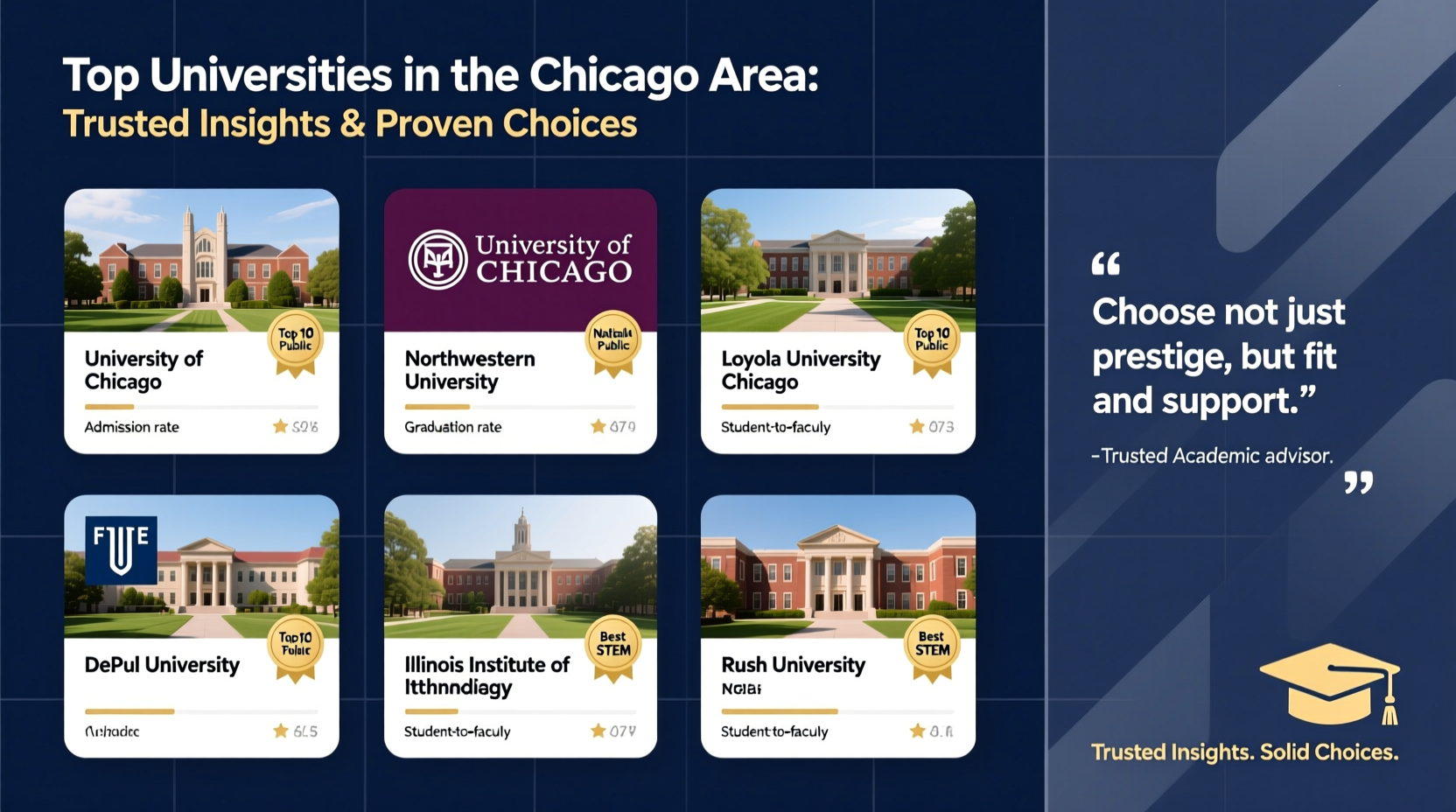
No discussion about higher education in Chicago begins without mentioning the University of Chicago. Consistently ranked among the top 10 national universities in the U.S., UChicago is renowned for its rigorous liberal arts curriculum, pioneering research, and influential faculty. The school’s core curriculum emphasizes critical thinking across disciplines, making it ideal for students who thrive in intellectually demanding environments.
Northwestern University, located just north of the city in Evanston, rounds out the elite tier. A member of the Big Ten Academic Alliance, Northwestern excels in journalism, engineering, business, and performing arts. Its proximity to Chicago allows students access to urban internships while enjoying a traditional collegiate campus experience.
“Northwestern bridges the gap between academic excellence and real-world application. Our students routinely land competitive roles in media, tech, and healthcare because they’re trained to think innovatively.” — Dr. Linda Chen, Associate Dean of Undergraduate Studies, Northwestern University
Both institutions are highly selective, with acceptance rates below 9%, underscoring their status as academic powerhouses. However, their offerings extend beyond prestige—they provide robust financial aid, global study opportunities, and strong alumni networks that open doors long after graduation.
Public and Regional Powerhouses: Value and Accessibility
For students seeking affordability without sacrificing quality, Illinois Institute of Technology (IIT) and the University of Illinois Chicago (UIC) stand out as strong public and semi-public options. IIT, located in Bronzeville, is known for its engineering, computer science, and architecture programs. It consistently ranks among the top engineering schools in the Midwest and maintains strong industry partnerships with firms like Motorola and Exelon.
UIC, as the largest university in the Chicago State System, serves over 30,000 students and offers more than 80 bachelor’s degrees. As a designated Hispanic-Serving Institution and a top producer of medical school applicants among public universities, UIC prides itself on diversity, accessibility, and community impact. Its health sciences programs—particularly nursing, pharmacy, and medicine—are nationally recognized.
Comparing Key Metrics: A Data-Driven Overview
To help clarify how these institutions stack up, here's a comparative table highlighting key factors such as selectivity, tuition, and program strengths:
| University | Acceptance Rate | Undergrad Tuition (approx.) | Notable Programs | Student Population |
|---|---|---|---|---|
| University of Chicago | 5% | $65,000 | Economics, Political Science, Physics | 7,000 |
| Northwestern University | 7% | $63,000 | Journalism, Engineering, Music | 22,000 |
| Illinois Institute of Technology | 60% | $50,000 | Computer Science, Architecture, Engineering | 5,500 |
| University of Illinois Chicago (UIC) | 70% | $17,000 (in-state) | Nursing, Pharmacy, Public Health | 30,000 |
| DePaul University | 68% | $38,000 | Business, Computer Science, Education | 21,000 |
This comparison reveals a clear spectrum—from highly selective, high-cost institutions to accessible, value-driven alternatives. Prospective students should weigh not only rankings but also fit, financial feasibility, and career outcomes.
Real Student Experience: A Case Study
Consider the story of Maria Tran, a first-generation college student from Pilsen. After researching local universities, she applied to UIC, DePaul, and IIT. While she was accepted to all three, her decision came down to affordability, mentorship opportunities, and program alignment.
UIC offered her a full-tuition scholarship through the Chancellor’s Urban Scholars Program and connected her with a faculty advisor in public health during her first semester. By sophomore year, she was conducting research on urban asthma disparities—a project funded by the university’s Office of Undergraduate Research.
“I didn’t think I’d go to college, let alone do research,” Maria said. “But UIC made it possible. The professors care, the resources are there—you just have to reach out.”
Maria’s experience reflects a broader truth: excellence isn’t limited to the most selective schools. Supportive advising, inclusive culture, and hands-on learning often matter more than brand name alone.
How to Choose the Right Fit: A Step-by-Step Guide
Selecting a university should be strategic, not emotional. Follow this timeline to make a confident, informed decision:
- September–October (Junior/Senior Year): Identify your academic interests and career goals. Research departments and faculty at different schools.
- November–December: Visit campuses—either in person or virtually. Attend department open houses or student-led tours.
- January–February: Compare financial aid packages early. Use net price calculators on each school’s website.
- March–April: Talk to current students or alumni via LinkedIn or campus events. Ask about workload, professor accessibility, and internship placement.
- May: Make your final decision based on fit, not fear of missing out. Remember: no single school defines your future.
Common Questions Students Ask
Are private universities always better than public ones in Chicago?
Not necessarily. While private institutions like UChicago and Northwestern have global reputations, public and urban-serving schools like UIC and IIT offer exceptional value, particularly in STEM and health fields. Graduates from these schools are highly competitive in the job market and graduate admissions.
Can I get into a top school with average grades?
Admission to elite schools is highly competitive, but not impossible with lower stats if you demonstrate strength elsewhere—such as compelling essays, leadership, or unique life experiences. For schools like DePaul, IIT, and UIC, GPA and test scores are considered holistically, and many students are admitted with mid-range credentials.
Is living in Chicago an advantage for students?
Absolutely. Chicago offers unparalleled access to internships at Fortune 500 companies, cultural institutions like the Art Institute and Symphony Orchestra, and nonprofit organizations. Many universities have formal partnerships with city employers, giving students a leg up in networking and career development.
Final Checklist Before Applying
- ✅ Confirm that your intended major is offered and well-ranked
- ✅ Review average financial aid package for students with similar background
- ✅ Check graduation and job placement rates for your field
- ✅ Reach out to a professor or admissions counselor with specific questions
- ✅ Attend a virtual class or information session to gauge campus culture
Conclusion: Make Your Choice with Confidence
The best university for you isn’t the one with the highest ranking—it’s the one where you’ll grow, engage, and succeed. The Chicago area offers a rare concentration of academic excellence, from world-renowned research universities to mission-driven urban institutions. Each has its own rhythm, strengths, and student profile.
Take the time to look beyond brochures and rankings. Dig into outcomes, talk to real students, and imagine yourself thriving in each environment. Whether you choose the intellectual intensity of Hyde Park, the creative energy of Evanston, or the dynamic urban classroom of the Loop, Chicago’s universities can launch meaningful careers and lifelong learning.




 浙公网安备
33010002000092号
浙公网安备
33010002000092号 浙B2-20120091-4
Comments
No comments yet. Why don't you start the discussion?