
Maintaining mature trees in residential or commercial landscapes often requires reaching high branches without compromising safety or effectiveness. Standard hand pruners fall short when limbs are out of reach, making extendable tree pruners an essential tool for responsible arboriculture. These tools combine reach, cutting power, and ergonomic design to help users perform precise pruning from the ground. With a wide range of models—manual, pole saws, powered, and ratcheting—the right choice depends on tree size, frequency of use, and user capability.
Selecting the ideal extendable tree pruner isn’t just about convenience; it’s about preserving tree health, preventing disease spread, and minimizing risk. Overgrown or damaged branches can become hazards during storms, while improper cuts invite pests and decay. A quality pruner allows clean, accurate cuts at optimal angles, promoting faster healing and better growth patterns. This guide explores top options, key features, and practical strategies for safe and effective tree maintenance.
Types of Extendable Tree Pruners
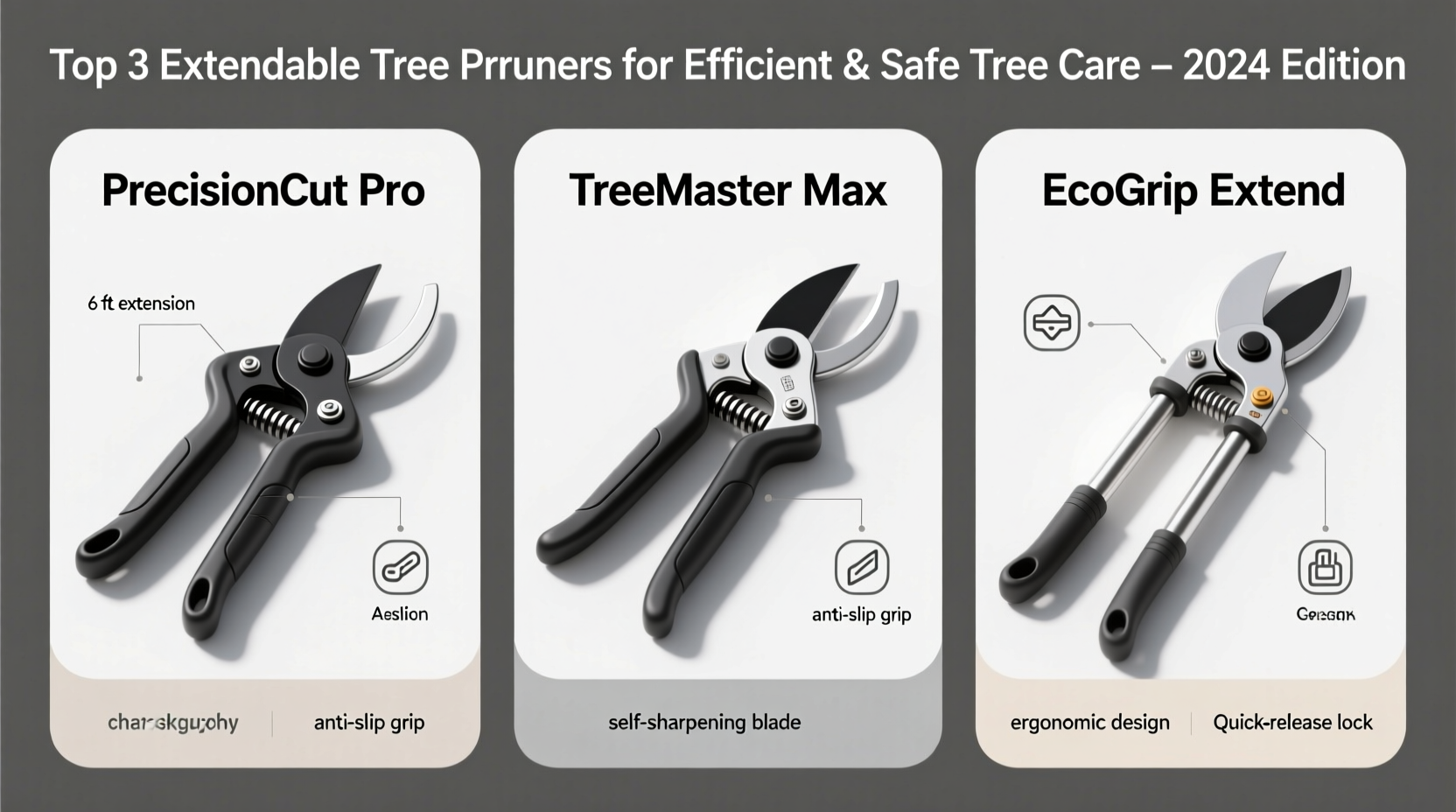
Extendable tree pruners come in several configurations, each suited to different scenarios based on branch thickness, height, and user strength. Understanding these types helps match the tool to your specific needs.
- Manual Bypass Pruners: Operated by pulling a rope or cable, these rely on user strength but offer excellent control and precision. Ideal for small to medium branches up to ¾ inch thick.
- Pole Saws: Feature a saw blade at the end of an adjustable pole, suitable for thicker limbs (up to 2 inches). Some are manual, while others integrate gas or electric power.
- Powered Pruners (Battery/Electric): Use motorized blades for effortless cutting through dense wood. Battery models offer portability; corded versions provide continuous power.
- Ratchet Mechanisms: Incorporate a mechanical advantage that multiplies force with each pull, allowing weaker users to cut through tougher branches safely.
- Combination Tools: Include interchangeable heads—pruner, saw, and sometimes even hedge trimmer attachments—for maximum versatility.
Key Features to Evaluate
Not all extendable pruners deliver equal performance. Prioritize models with thoughtful engineering and durable materials. The following criteria should guide your selection:
| Feature | Why It Matters | Recommended Spec |
|---|---|---|
| Reach Range | Determines maximum working height without a ladder | 6–12 feet (adjustable) |
| Weight | Affects fatigue during extended use | Under 5 lbs for frequent use |
| Blade Material | Influences sharpness retention and corrosion resistance | Hardened steel with non-stick coating |
| Cutting Capacity | Limits branch diameter you can safely cut | Up to 1.5 inches for most homeowners |
| Ergonomic Handle | Reduces hand strain and improves grip | Non-slip rubber with wrist strap |
| Rotating Head | Allows angled cuts without repositioning pole | 360° rotation preferred |
“An extendable pruner that combines lightweight construction with a rotating head gives users both reach and precision—critical for proper pruning technique.” — Dr. Alan Reyes, Urban Forestry Specialist, University of Vermont Extension
Step-by-Step Guide to Safe Pruning with Extendable Tools
Using an extendable pruner effectively requires more than just owning one. Follow this sequence to ensure safety, accuracy, and tree health.
- Assess the Branch: Identify dead, diseased, or crossing limbs. Avoid removing more than 25% of a tree’s canopy in a single season.
- Check Surroundings: Ensure no people, pets, or obstacles are beneath the drop zone. Wear eye protection and gloves.
- Adjust Pole Length: Set the pruner to the shortest effective length for better control. Fully extend only when necessary.
- Position the Blade: Place the bypass blade on the lower side of the branch, just outside the branch collar (the swollen base).
- Make the Cut: Apply steady pressure using the rope or trigger. Let the blade do the work—don’t force it.
- Inspect the Cut: A clean, smooth cut indicates proper blade sharpness and alignment. Ragged edges may invite infection.
- Clean and Store: Wipe the blade with a disinfectant (e.g., isopropyl alcohol) and store in a dry place.
Top Recommended Models and Real-World Performance
Based on durability, user feedback, and professional testing, the following extendable pruners stand out in 2024:
- Fiskars 32-Inch PowerGear2 Extendable Pruner: Uses a geared mechanism to double cutting force. Cuts branches up to 1.5 inches. Lightweight composite shaft.
- Gardena Tree & Shrub Pruner Set: Telescoping aluminum pole (up to 9 ft) with interchangeable saw and pruner heads. Rotates 360° for optimal angles.
- Black+Decker LPP120B 20V Max Pole Pruner: Cordless model with 7.5-inch bar. Ideal for thicker limbs. Includes automatic oiler for chain lubrication.
- Corona RS 7400D T-handle Ratcheting Pruner: Manual ratchet system reduces effort by 70%. Excellent for seniors or those with limited hand strength.
- Sun Joe SPX3000 4-Amp Electric Pole Saw: Budget-friendly corded option with 8-inch bar. Best for light-duty pruning near outlets.
Mini Case Study: Suburban Landscape Maintenance
Janet M., a homeowner in Portland, Oregon, manages a yard with multiple mature maple and cherry trees. She previously relied on ladders and hand pruners, which led to inconsistent cuts and minor injuries. After switching to the Fiskars PowerGear2, she reported a 60% reduction in pruning time and improved branch health. “I can now reach second-story limbs safely,” she said. “The ratcheting feature lets me cut thicker branches without straining my shoulders.” Her trees showed fewer signs of dieback the following spring, and her arborist noted cleaner wound healing during inspection.
Pruning Do’s and Don’ts
| Do’s | Don’ts |
|---|---|
| Prune during dormancy (late winter/early spring) | Top trees or make flush cuts |
| Disinfect blades between trees | Over-prune or remove too much live wood |
| Use three-point cutting method for large limbs | Stand directly under falling debris |
| Wear safety glasses and sturdy shoes | Use dull or damaged tools |
FAQ
Can I use an extendable pruner on wet branches?
Yes, but avoid excessively wet conditions. Moisture increases weight and slip risk. Wet wood also tends to tear rather than cut cleanly, increasing stress on both the tool and tree.
How long do battery-powered pruners last per charge?
Most lithium-ion models last 30–60 minutes of active use. High-capacity batteries (4.0Ah+) can handle larger jobs. Always keep a spare charged if maintaining extensive landscapes.
Are extendable pruners suitable for fruit trees?
Especially so. Fruit trees benefit from annual thinning to improve air circulation and sunlight penetration. An extendable pruner allows access to upper canopy branches without disturbing blossoms or young fruit.
Conclusion
Efficient and safe tree care doesn’t require climbing ladders or hiring professionals for routine maintenance. With the right extendable tree pruner, homeowners and landscapers alike can uphold tree health, enhance aesthetics, and reduce hazards—all from ground level. Whether you choose a manual ratchet model for precision or a powered pole saw for heavy-duty tasks, investing in quality ensures lasting performance and safer outcomes.




 浙公网安备
33010002000092号
浙公网安备
33010002000092号 浙B2-20120091-4
Comments
No comments yet. Why don't you start the discussion?