
Every holiday season, thousands of homes experience flickering lights, tripped breakers—or worse: smoldering cords, melted insulation, and electrical fires. These incidents rarely stem from faulty lights alone. More often, they result from a quiet, overlooked mistake: overloading extension cords with too many light strings. Unlike household appliances with built-in thermal protection, most decorative lighting operates at the edge of safe current capacity—especially when connected in series across low-grade cords, power strips, or outdated outlets. This isn’t theoretical risk. It’s documented hazard: the U.S. Consumer Product Safety Commission (CPSC) reports an average of 700 residential fires annually linked directly to holiday lighting, with extension cord misuse cited in over 42% of those cases.
Yet most homeowners rely on intuition—not amperage ratings—when plugging in lights. “It fits in the outlet” becomes the de facto safety standard. This article cuts through that assumption. Drawing on National Electrical Code (NEC) guidelines, UL certification standards, and real-world incident data, we detail exactly how overload happens, how to quantify it, and—most importantly—how to avoid it without sacrificing festive brightness.
Why Extension Cords Overheat: The Physics Behind the Risk
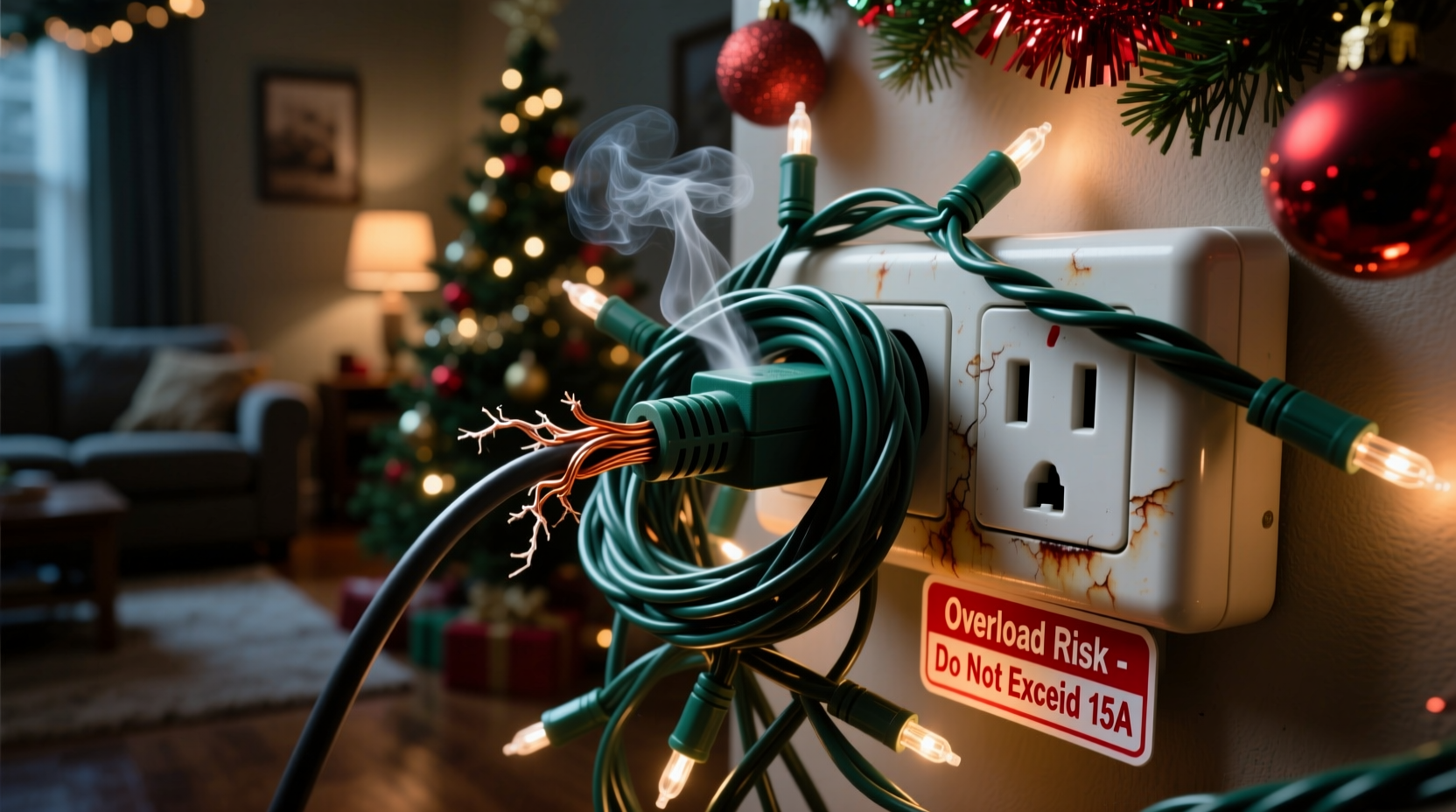
Overload occurs when the total current drawn by connected devices exceeds what the cord’s conductors can safely carry. Heat builds not because of voltage, but due to resistance in the wire. As current increases, heat generation rises exponentially—governed by Joule’s Law: P = I² × R. A cord rated for 13 amps carrying 15 amps doesn’t just run warmer—it generates 33% more resistive heat than designed for. That excess heat degrades insulation, loosens connections, and invites arcing—especially at plug points where corrosion or poor contact multiplies resistance.
Crucially, cord rating depends on three interdependent factors: gauge (wire thickness), length, and ambient temperature. A 16-gauge cord may safely handle 13 amps at 25 feet indoors—but only 10 amps at 50 feet, and just 7 amps outdoors in freezing conditions where copper becomes less conductive and insulation stiffens. Most pre-packaged “indoor/outdoor” extension cords sold near seasonal displays are 16- or 18-gauge—designed for temporary, low-draw use—not sustained loads from 10+ light strings.
How to Calculate Total Load: From Watts to Amps
Manufacturers list light string power consumption in watts—not amps. To assess cord compatibility, convert watts to amps using the formula: Amps = Watts ÷ Volts. In North America, standard circuits operate at 120 volts.
Consider a typical setup: • 5 strings of 100-bulb incandescent mini-lights (each drawing ~40 watts) • 2 strings of 150-bulb LED icicle lights (each drawing ~6 watts) • 1 string of 300-bulb LED net lights (drawing ~12 watts)
Total wattage = (5 × 40) + (2 × 6) + 12 = 200 + 12 + 12 = 224 watts
Total amps = 224 ÷ 120 = 1.87 amps
This seems trivial—until you realize most people don’t stop at one outlet. They chain three or four cords, each feeding five or six strings, often through a single 15-amp circuit. That same 15-amp breaker powers your refrigerator, microwave, and living room lamps. NEC recommends never loading a circuit beyond 80% of its capacity for continuous loads (defined as operating >3 hours). For a 15-amp circuit, that’s just 12 amps—or 1,440 watts.
| Light Type | Typical Wattage per 100 Bulbs | Amps per 100 Bulbs (120V) | Max Safe Strings per 12-Amp Circuit* |
|---|---|---|---|
| Incandescent Mini-Lights | 40–45 W | 0.33–0.38 A | 31–36 |
| Incandescent C7/C9 Bulbs | 120–180 W | 1.0–1.5 A | 8–12 |
| LED Mini-Lights | 2–5 W | 0.02–0.04 A | 300–600 |
| LED Rope Lights (per ft) | 0.5–1.2 W/ft | 0.004–0.01 A/ft | N/A (length-dependent) |
| *Assumes no other loads on the circuit |
Note: These numbers assume new, undamaged cords and factory-fresh bulbs. Age, voltage drop, and manufacturing variances can increase actual draw by 10–15%. Always derate by 10% for safety.
The Daisy-Chaining Trap: Why “One More String” Is Never Safe
Daisy-chaining—plugging one extension cord into another—is the single most common cause of holiday cord failure. Each connection introduces resistance. A loose or corroded plug adds up to 0.5 ohms of resistance. At 10 amps, that creates 5 volts of drop and 50 watts of wasted heat—just at the plug. Chain three cords, and voltage at the final string may fall below 105V, causing LEDs to flicker and incandescents to draw even more current to compensate (due to reduced filament resistance when cooler), creating a dangerous feedback loop.
UL 817 standards explicitly prohibit daisy-chaining extension cords unless specifically labeled “Suitable for Connecting Multiple Cords.” Few consumer-grade cords meet this requirement. Even those that do limit the total length to 100 feet—and require all cords in the chain to be identical in gauge and rating.
“The idea that ‘if it plugs in, it’s fine’ is dangerously outdated. Modern LED strings may draw little power individually, but their internal switching power supplies create harmonic distortion that stresses older wiring and undersized cords in ways incandescents never did.” — Dr. Lena Torres, Electrical Safety Engineer, Underwriters Laboratories (UL)
A Real-World Incident: How One House Avoided Disaster
In December 2022, a homeowner in Portland, Oregon, installed 24 strings of vintage-style incandescent lights along gutters, railings, and trees. He used three 50-foot, 16-gauge “outdoor-rated” cords purchased from a big-box store, daisy-chained end-to-end and fed from a single garage outlet. By dusk, the middle cord’s plug felt warm to the touch. By 9 p.m., the outer sheath near the second connection had visibly softened and warped. He unplugged the system—and discovered the insulation on the inner conductor was partially melted, exposing bare copper.
An electrician later measured the circuit load at 14.2 amps—well above the 12-amp continuous limit. Voltage at the farthest string was 102V. The 16-gauge cords were rated for just 10 amps at 50 feet in outdoor conditions (per NEC Table 400.5(A)(3)). The homeowner hadn’t exceeded outlet count; he’d exceeded physics. His quick action prevented ignition—but the near-miss underscores how silently overload progresses. No breaker tripped because the load remained below the 15-amp instantaneous trip threshold. Thermal damage occurred long before magnetic protection engaged.
Step-by-Step: Building a Safe, Scalable Light Circuit
- Evaluate your circuit capacity: Locate your home’s breaker panel. Identify the circuit powering your outdoor outlets (often labeled “Garage,” “Patio,” or “Exterior”). Note its amperage (usually 15A or 20A). Multiply by 0.8 to get your safe continuous load (e.g., 15A × 0.8 = 12A).
- Inventory all connected loads: Add up wattage of everything on that circuit—garage door opener, freezer, sump pump, landscape lighting timers—even if “off.” Many devices draw standby power.
- Calculate remaining capacity: Subtract existing loads from your safe continuous load. If you have 3A already allocated, only 9A remains for lights.
- Select cords by gauge and length: Use 14-gauge for runs up to 50 feet (15A max), 12-gauge for 50–100 feet (20A max). Never use 16- or 18-gauge for permanent outdoor setups or more than two light strings.
- Use outlet multipliers—not daisy chains: Plug cords into separate, dedicated GFCI-protected outlets. If only one outlet is available, use a UL-listed, heavy-duty power strip rated for outdoor use (look for “WTW” or “E483803” file number) with individual circuit breakers—not a $10 plastic strip from the holiday aisle.
- Test and monitor: After setup, feel plugs and cords after 15 minutes. If any are warm (>104°F / 40°C), unplug immediately. Use a plug-in energy monitor (e.g., Kill A Watt) to verify real-time draw.
Critical Do’s and Don’ts
- Do replace cords showing cracked, brittle, or discolored insulation—even if they still “work.”
- Do unplug lights before adjusting or repairing strings. Wet hands + frayed cord = electrocution risk.
- Do inspect bulbs for broken filaments or darkened glass—these increase resistance and localized heating.
- Don’t run cords under rugs, through doors, or beneath furniture where heat can’t dissipate.
- Don’t use indoor-rated cords outdoors—even “temporary” use. Moisture ingress accelerates corrosion and short circuits.
- Don’t exceed the manufacturer’s stated maximum number of strings per run (e.g., “Connect up to 3 sets end-to-end”). This limit exists for thermal safety—not marketing.
FAQ
Can I use a 20-amp extension cord on a 15-amp circuit?
Yes—but only if the cord is properly rated for the load and length. A 20-amp cord (typically 12-gauge) provides headroom and lower resistance, reducing heat buildup. However, the circuit breaker still limits total current to 15 amps. The cord itself won’t “pull more power”; it simply handles the same load more safely. Never pair a 20-amp cord with a 15-amp outlet adapter unless the adapter is rated for continuous 20-amp service.
Why do LED lights sometimes trip breakers when incandescents didn’t?
LED strings contain electronic drivers that generate high-frequency harmonics and momentary inrush currents (up to 5× steady-state draw for milliseconds at startup). Older breakers and shared neutrals in multi-wire branch circuits can misinterpret this as a fault. Additionally, cheap LED strings often lack proper EMI filtering, causing interference that stresses aging wiring. Using a dedicated circuit and high-quality, UL-listed LED strings mitigates this.
Is it safer to plug lights into a power strip or daisy-chain cords?
Neither is inherently safer—but a UL-listed, outdoor-rated power strip with built-in surge protection and individual outlet breakers is preferable to daisy-chaining. Power strips distribute load across parallel paths; daisy-chaining forces all current through a single, increasingly resistive path. However, avoid “cube taps” or non-grounded strips—they lack overcurrent protection and violate NEC 210.21(B)(1).
Conclusion
Holiday lighting should inspire warmth—not worry. Understanding extension cord overload isn’t about limiting joy; it’s about engineering reliability into celebration. Every time you check a cord’s gauge, verify a circuit’s capacity, or choose a 12-gauge cord over a flimsy 16-gauge one, you’re applying practical electrical literacy that protects your home, your family, and your peace of mind. These aren’t “extra steps”—they’re the foundation of responsible seasonal decorating. Start tonight: unplug your display, read the labels on every cord, sketch a simple circuit map, and recalculate your loads. Then enjoy the lights—fully aware that their brilliance rests on sound, measurable, and deeply human judgment.




 浙公网安备
33010002000092号
浙公网安备
33010002000092号 浙B2-20120091-4
Comments
No comments yet. Why don't you start the discussion?