
In the era of remote work, virtual meetings, and digital content creation, the background you present on camera matters more than ever. It’s not just about professionalism—it’s about presence. A well-curated backdrop subtly communicates attention to detail, creativity, and care. Among the most popular aesthetic enhancements are illuminated backdrops: specifically, fairy light curtains and sheer fabric draped behind string lights. Both promise ambiance, but only one consistently delivers a truly luxe appearance on screen.
While they may appear similar at first glance—soft glows, diffused lighting, dreamy textures—their real-world performance in video calls varies significantly. The difference lies not just in materials, but in how light interacts with them, how they photograph under varied lighting conditions, and how they contribute to visual depth and polish. This article breaks down the nuances between these two options to help you choose the backdrop that elevates your on-camera presence with sophistication.
The Visual Language of Video Call Backgrounds
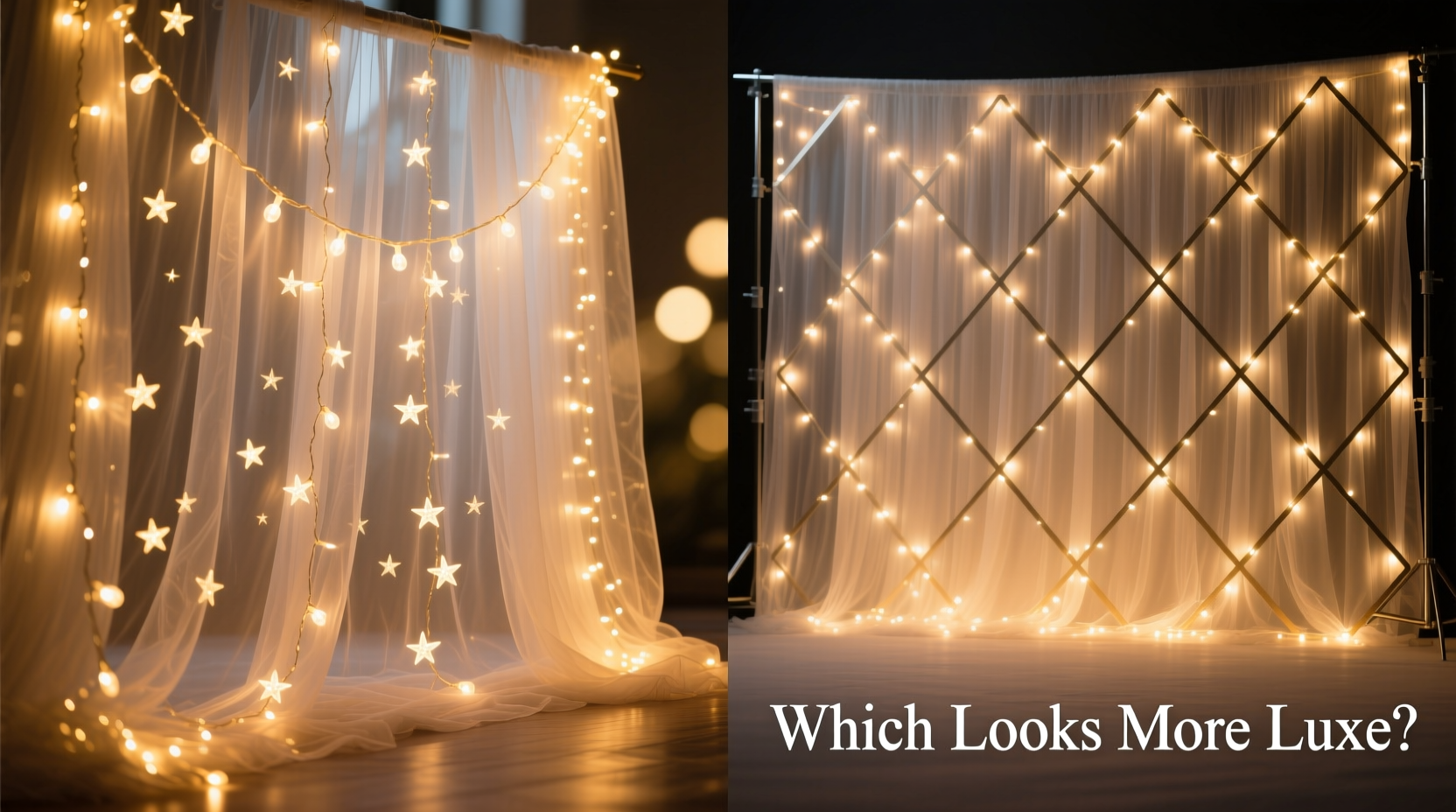
Your video call background functions like a stage set. Even when blurred or partially visible, it affects tone, warmth, and perceived quality. Harsh shadows, clutter, or overly bright elements distract. Conversely, soft gradients, layered lighting, and intentional design draw subtle admiration without pulling focus.
Luxury in this context isn’t about extravagance—it’s about refinement. Think hotel lobbies with ambient glow, high-end studios with carefully layered lighting, or boutique interiors where every element feels deliberate. Achieving this digitally means mastering diffusion, contrast, and dimensionality.
Fairy light curtains and sheer fabric backdrops both aim to create this effect, but their execution diverges sharply. One offers convenience; the other, craftsmanship. Understanding that distinction starts with how each handles light.
How Light Behaves: Fairy Light Curtain vs Sheer Fabric Backdrop
A fairy light curtain is typically a pre-assembled grid of LED string lights mounted on a mesh or wire frame. Each bulb is evenly spaced, often non-dimmable, and emits direct point-source light. When viewed straight-on, especially in low ambient light, it can appear festive—like holiday décor. But on camera, particularly in Zoom, Teams, or Google Meet, its limitations become apparent.
- Bulbs appear as distinct, bright dots that can flare or bloom under autofocus.
- Minimal depth—since the lights are flat against the plane, there’s little sense of layering.
- Harsh contrast between lit and unlit areas, creating a “screen door” effect when slightly out of focus.
In contrast, a sheer fabric backdrop with string lights layered behind it transforms the quality of illumination. The fabric acts as a diffuser, softening individual points into a continuous, ethereal glow. When installed correctly—with lights positioned several inches behind the fabric—the result is dimensional, almost cinematic.
“The key to luxury lighting is diffusion. Hard sources feel cheap; soft, enveloping light feels intentional.” — Lena Tran, Lighting Designer & Virtual Studio Consultant
This principle is why professional photo studios use scrims, silks, and bounce cards. The fabric doesn’t hide the lights—it interprets them, turning stark LEDs into ambient radiance.
Comparative Analysis: Key Factors That Define \"Luxe\"
To determine which setup appears more luxurious, we evaluate across five critical dimensions: depth, texture, adaptability, realism, and long-term impression.
| Factor | Fairy Light Curtain | Sheer Fabric + String Lights |
|---|---|---|
| Depth | Flat, two-dimensional. Lights sit flush, offering no layering. | High. Distance between fabric and lights creates parallax and soft shadow play. |
| Texture | Plastic mesh visible up close; bulbs dominate the visual field. | Soft, flowing drape. Fabric adds organic movement and elegance. |
| Adaptability | Fixed pattern. Cannot be reconfigured without replacing the unit. | Customizable. Adjust fabric type, light density, color temperature, and placement. |
| Realism | Artificial, decorative—resembles seasonal décor rather than interior design. | Natural, studio-quality. Mimics high-end hospitality or boutique aesthetics. |
| Long-Term Impression | Novelty wears off quickly. Can look dated or overused. | Sophisticated and timeless. Feels curated, not purchased off-the-shelf. |
The data shows a clear winner: the sheer fabric backdrop with rear-placed string lights offers superior visual richness. It’s not merely about brightness—it’s about how light is shaped and experienced through materiality.
Real-World Example: Two Professionals, Two Backdrops
Consider Sarah and James, both freelance consultants who upgraded their home office setups for client-facing calls.
Sarah chose a plug-and-play fairy light curtain. It arrived in a box, clipped easily to her wall, and lit up with a satisfying sparkle. Her first few clients complimented the “cute” setup. But over time, she noticed feedback shifting: “It’s a bit distracting,” one said. Another remarked, “Looks like a TikTok filter.” On camera, the individual bulbs pulsed slightly under auto-exposure, and when she moved, the flat plane created an unnatural halo effect.
James, meanwhile, installed a floor-to-ceiling sheer linen curtain with a custom string of dimmable LEDs mounted on a thin wooden frame six inches behind it. He spent an afternoon adjusting tension and testing angles. The result was subtle: a warm, even wash of light that framed him without dominating. Clients described his space as “calm,” “professional,” and “thoughtfully designed.” No one mentioned the lights—because they weren’t seen as separate elements, but as part of the environment.
After three months, Sarah replaced her curtain with James’s approach. “I realized I wanted elegance, not decoration,” she said.
Step-by-Step: Creating a Luxe Sheer Fabric Backdrop
Building a high-end backdrop doesn’t require professional tools—just intention and a few key steps.
- Choose the right fabric: Opt for lightweight, semi-transparent materials like chiffon, voile, or organza. Ivory, taupe, or soft gray tones diffuse light best and avoid looking theatrical.
- Select warm, dimmable string lights: Use LED fairy lights with a color temperature of 2700K–3000K. Avoid cool white or multicolor unless strictly controlled.
- Mount lights behind the fabric: Attach the string lights to a secondary frame, wall hooks, or adhesive clips placed 4–8 inches behind the fabric plane. This gap is crucial for diffusion.
- Ensure even spacing: Distribute bulbs uniformly—typically 6–8 inches apart—to prevent hotspots. Test by viewing from your camera position.
- Control ambient light: Use blackout curtains or blinds to manage daylight. Combine with a front-facing desk lamp (diffused) to balance exposure and eliminate under-lighting.
- Adjust and refine: Record a short test video. Look for harsh glints, uneven patches, or fabric wrinkles. Smooth folds gently and reposition lights as needed.
This method transforms a simple setup into a studio-grade background. Unlike mass-produced alternatives, it feels personal and polished—exactly what luxury conveys.
Why Perception Matters in Professional Presence
On video calls, viewers subconsciously assess credibility within seconds. A cluttered background suggests disorganization. A blank wall may signal minimal effort. An overly flashy one implies distraction. The sweet spot lies in understated elegance—a space that feels lived-in yet refined.
A sheer fabric backdrop with integrated lighting achieves this by mimicking environments associated with quality: boutique hotels, art galleries, editorial photo shoots. These spaces don’t scream luxury—they whisper it through texture, tone, and tranquility.
Fairy light curtains, while accessible and easy to install, often fall into the “DIY project” category. They’re effective for casual streams or creative branding, but rarely convey executive-level polish. In high-stakes meetings—investor pitches, board calls, media appearances—the subtleties matter. You’re not just selling an idea; you’re projecting an image of competence and taste.
Checklist: Building a Luxe Video Backdrop
- ☐ Choose warm-white (2700K–3000K), dimmable string lights
- ☐ Select sheer fabric in neutral tones (ivory, taupe, soft gray)
- ☐ Install fabric tautly to minimize wrinkles
- ☐ Position lights 4–8 inches behind fabric
- ☐ Space bulbs evenly (6–8 inches apart)
- ☐ Eliminate competing light sources (windows, overheads)
- ☐ Test with actual video call software (Zoom, Teams, etc.)
- ☐ Adjust brightness to avoid overexposure on camera
Frequently Asked Questions
Can I use a fairy light curtain and still look professional?
Yes, in certain contexts. For creative industries, social media, or informal meetings, a fairy light curtain can enhance personality. However, for formal business, legal, or financial discussions, it risks appearing unserious. If used, pair it with a solid-colored backdrop behind you to reduce visual noise.
What’s the best fabric for diffusing string lights?
Voile and sheer cotton are ideal—they’re breathable, wrinkle-resistant, and offer balanced translucency. Avoid polyester-heavy blends, which can reflect light too sharply. Natural fibers diffuse more softly and feel more premium on camera.
Do I need expensive equipment to achieve this look?
No. A $15 string of warm-white LEDs and $20 of fabric from a craft store can produce excellent results. The investment is in time and attention to detail, not cost. Focus on proper installation and lighting distance for maximum impact.
Final Verdict: Elegance Over Convenience
The fairy light curtain wins on speed and simplicity. It’s the fast fashion of video backgrounds—immediately available, instantly gratifying, but ultimately disposable in terms of lasting impression.
The sheer fabric backdrop with rear string lighting, by contrast, is slow design. It requires planning, adjustment, and a willingness to experiment. But the payoff is undeniable: a background that doesn’t just look good—it looks intentional. It communicates that you value atmosphere, understand visual storytelling, and care about the experience you provide others.
Luxury isn’t defined by price tags. It’s defined by perception. And in the world of video communication, perception is shaped by light, texture, and subtlety. If your goal is to appear polished, credible, and quietly sophisticated, the sheer fabric backdrop is the definitive choice.




 浙公网安备
33010002000092号
浙公网安备
33010002000092号 浙B2-20120091-4
Comments
No comments yet. Why don't you start the discussion?