
When decorating a Christmas tree, lighting is more than just an accent—it’s the foundation of the entire display. The right set of lights can transform a modest evergreen into a glowing centerpiece that radiates warmth and holiday cheer. But with so many options available, one question consistently arises: fairy lights or net lights—which spreads better coverage on a Christmas tree?
The answer isn’t as simple as choosing one over the other. Each type has distinct advantages depending on tree size, shape, decoration style, and personal preference. Understanding how each light type behaves—how evenly they distribute illumination, how easy they are to install, and how natural they look—is essential to making an informed decision.
Understanding Fairy Lights and Net Lights
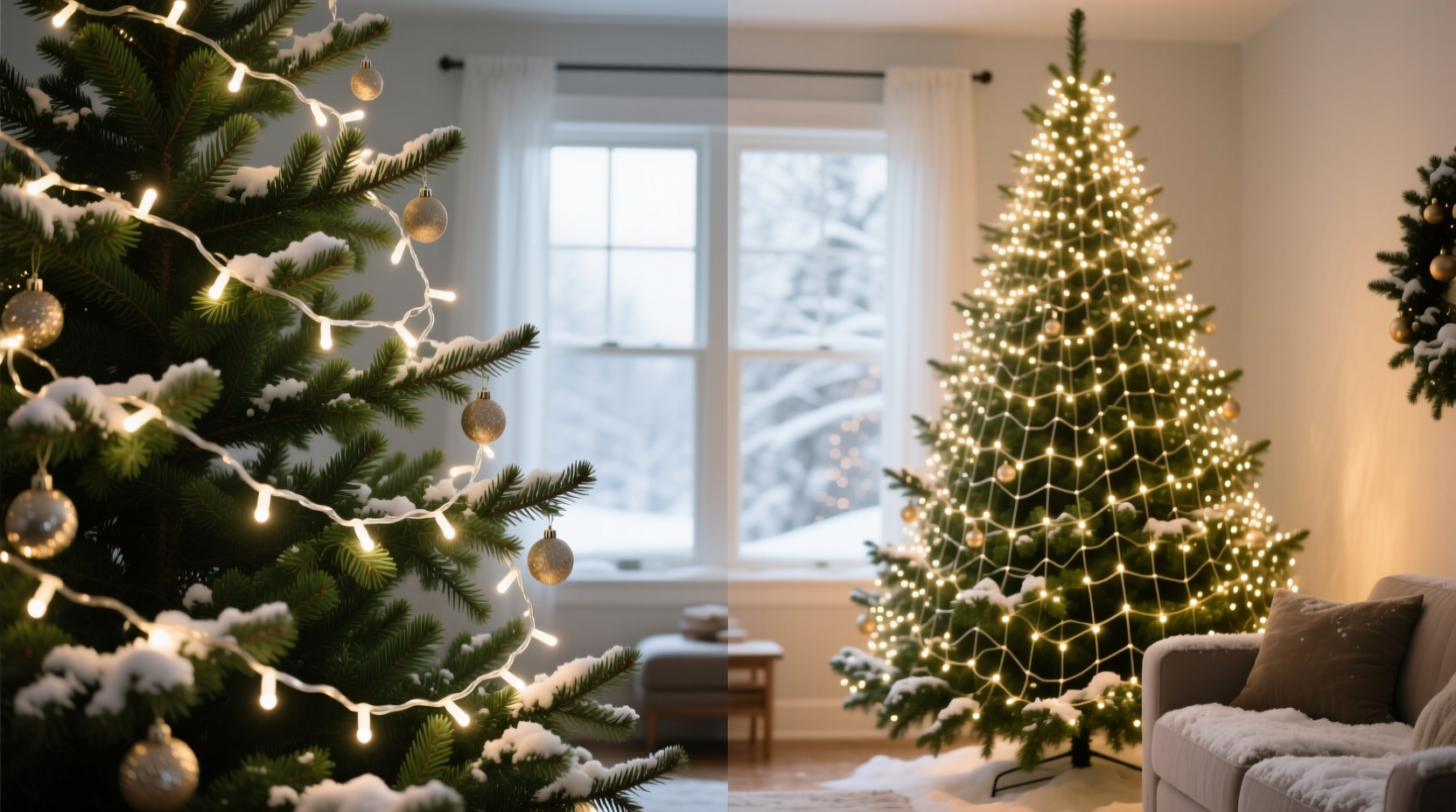
Fairy lights, often called string lights or twinkle lights, are the classic choice for Christmas trees. They consist of individual bulbs spaced along a single wire, typically 6 to 10 inches apart. Available in warm white, cool white, multicolor, and even programmable LED versions, fairy lights offer flexibility in placement and design.
Net lights, on the other hand, are pre-wired in a grid pattern—like a fishing net—where wires run both horizontally and vertically with bulbs at each intersection. These are most commonly used for shrubs, bushes, or flat surfaces but have gained popularity for full-bodied trees when wrapped around the outer layer.
The structural difference between the two leads to fundamentally different lighting behaviors. Fairy lights allow for targeted illumination, enabling decorators to weave them deep into branches for interior glow. Net lights, by contrast, create a dense, uniform curtain of light across the surface, offering instant coverage with minimal effort.
“Net lights excel in speed and surface brilliance, but fairy lights give you control over depth and dimension.” — Clara Mendez, Holiday Lighting Designer
Coverage Comparison: Distribution, Density, and Depth
When evaluating which light type provides better coverage, it's important to define what “coverage” means. Is it about how much of the tree is lit? How evenly the light is distributed? Or how deeply the illumination penetrates through the branches?
Distribution: Net lights provide immediate, even distribution across the area they cover. Because the bulbs are fixed in a grid, there are no gaps if the net fits properly. This makes them ideal for achieving a consistent sparkle on the outer shell of a tree.
Fairy lights, while potentially uneven if poorly installed, allow for strategic placement. When properly layered—starting from the trunk outward and spiraling up—the result is multidimensional lighting that mimics candlelight from within.
Density: A standard net light panel might contain 50 to 100 bulbs per square foot, depending on spacing. This high density creates a shimmering effect that works well for modern, minimalist, or commercial displays where brightness is prioritized.
Fairy lights usually have lower bulb density unless multiple strands are used. However, this can be an advantage—too many lights can overpower ornaments and make the tree look cluttered. With fairy lights, decorators can balance luminosity with elegance.
Depth: This is where fairy lights clearly outperform net lights. Because net lights sit primarily on the surface, they illuminate only the outer foliage. Interior branches remain dark, which can create a hollow appearance from certain angles.
Fairy lights can be threaded through the tree, wrapping around limbs and pointing inward toward the trunk. This technique, known as “layering,” produces a radiant core that glows from within, giving the tree volume and realism—especially effective with opaque or densely foliaged artificial trees.
Installation: Time, Effort, and Precision
One of the biggest practical differences between these two types lies in installation.
Net lights are designed for speed. Simply drape the net over the tree section and tuck the edges into the branches. A medium-sized tree (6–7 feet) can be covered in under 10 minutes with a properly sized net. This makes them a favorite for rental properties, pop-up displays, and households short on time.
However, fitting a net light to a conical tree presents challenges. Most nets are rectangular or square, meaning excess material must be folded or bunched at the top and bottom. This can lead to uneven spacing, clumping, or visible seams. Trees with irregular shapes or sparse lower sections may not conceal the net structure effectively.
Fairy lights take longer to install—typically 20 to 40 minutes for a full tree—but offer superior adaptability. The installer can adjust spacing, avoid bare spots, and route wires behind ornaments. Spiral techniques, where lights follow the natural taper of the tree from bottom to top, ensure balanced coverage.
While more labor-intensive, the process allows for customization. You can emphasize certain areas—like the front-facing side near a window—or dim less-visible zones to save energy and reduce glare.
| Feature | Fairy Lights | Net Lights |
|---|---|---|
| Installation Time | 20–40 minutes | 5–10 minutes |
| Bulb Spacing Control | Full control | Fixed grid |
| Suitable for Irregular Shapes | Yes | Limited |
| Interior Illumination | Excellent | Poor |
| Surface Uniformity | Depends on skill | Consistently high |
| Reusability & Storage | High (if coiled properly) | Moderate (prone to tangling at corners) |
Real-World Example: A Family’s Dual Approach
The Thompson family decorates a 7-foot pre-lit artificial tree every December. For years, they struggled with flat-looking lighting—either too dim or too harsh. In 2022, they experimented with combining both fairy lights and net lights.
They began by installing 3 strands of warm-white fairy lights (300 bulbs total), weaving them from the trunk outward and focusing on the front half of the tree. Then, they draped a green-stringed net light (50 bulbs) over the outermost layer, aligning it with the tree’s silhouette.
The result was transformative. The fairy lights provided a soft inner glow that eliminated shadows, while the net lights added a crisp, sparkling finish. Their tree appeared fuller and more professionally decorated, drawing compliments at their annual open house.
“We used to think it was one or the other,” said Laura Thompson. “But using both gave us the depth we wanted without sacrificing that magical surface twinkle.”
Which Offers Better Coverage? A Balanced Verdict
If “better coverage” means even, fast, surface-level illumination with minimal effort, then **net lights win**. They are unmatched in delivering a uniform blanket of light across large areas quickly. For outdoor trees, hedges, or flat walls, they’re ideal.
But if “better coverage” includes depth, dimension, and balanced illumination throughout the tree—including the interior—then **fairy lights are superior**. They allow for three-dimensional lighting that brings a tree to life from within, avoiding the “glowing shell” effect common with net lights.
Ultimately, the best approach depends on your priorities:
- Choose net lights if you value speed, simplicity, and maximum sparkle on the exterior.
- Choose fairy lights if you want professional-quality depth, control over placement, and a natural, candlelit ambiance.
- Or, consider a hybrid method: use fairy lights for internal coverage and net lights as a top layer for enhanced surface brilliance.
“The most stunning trees I’ve seen don’t rely on one type of light—they use layers. Depth comes from within; sparkle comes from the surface.” — Marcus Reed, Professional Holiday Stylist
Step-by-Step Guide: Achieving Maximum Coverage on Your Tree
Whether you choose fairy lights, net lights, or both, follow this sequence for optimal results:
- Assess your tree. Determine its height, shape, and foliage density. Note any thin spots or awkward angles.
- Start with fairy lights (if using). Plug in one strand and begin at the base. Weave the cord through inner branches, directing bulbs toward the center. Work in a spiral motion upward, overlapping slightly every 6–8 inches.
- Layer additional fairy strands as needed, focusing on the front third of the tree where visibility is highest. Avoid over-lighting the back unless the tree is in a central location.
- Add net lights (optional). Drape the net over the outer layer, starting from the top. Tuck edges into branches to secure. Trim excess netting only if necessary and safe (avoid cutting live wires).
- Step back and evaluate. View the tree from multiple angles and in low ambient light. Fill dark spots with small supplemental fairy light strands.
- Test and finalize. Ensure all connections are secure, timers work, and cords are safely routed away from foot traffic.
Checklist: Choosing the Right Lights for Your Tree
- ☐ Measure your tree’s height and width before buying lights
- ☐ Decide whether depth or speed is more important to you
- ☐ For fairy lights: plan ~100 bulbs per foot of tree height (e.g., 700 for a 7-footer)
- ☐ For net lights: ensure the net dimensions match your tree’s profile
- ☐ Choose green or brown wire to blend with branches
- ☐ Check if lights are UL-listed and suitable for indoor/outdoor use
- ☐ Consider LED over incandescent for safety, energy savings, and longevity
- ☐ Store lights properly after use—use reels for fairy lights, fold nets carefully
Frequently Asked Questions
Can I use net lights on a tall, narrow Christmas tree?
It’s challenging. Most net lights are designed for wide, flat surfaces. On a tall, narrow tree, the net will either bunch at the top and bottom or leave gaps on the sides. If you must use one, choose a vertical-oriented net or cut and reconfigure a larger net (only if it’s safe and doesn’t expose wiring).
Do fairy lights tangle easily?
Yes, especially if stored loosely. To prevent tangling, wrap fairy lights around a cardboard reel or use a plastic spool. Never throw them into a box uncoiled. LED strands with sturdier wires tend to resist kinking better than older, thinner models.
Which uses more electricity—fairy lights or net lights?
It depends on bulb count and type. A dense net light with 100 incandescent bulbs will consume more power than a 200-bulb LED fairy light strand. Modern LED versions of both types are highly efficient—most use under 10 watts per 100 bulbs. Always check the packaging for wattage details.
Final Thoughts: Let Coverage Serve the Design
The debate between fairy lights and net lights isn’t about declaring a universal winner—it’s about matching the tool to the task. A Christmas tree is a canvas, and lighting is your brushstroke. Net lights offer efficiency and brilliance; fairy lights offer artistry and depth.
For most home decorators, fairy lights provide better overall coverage due to their ability to illuminate from within. But dismissing net lights entirely would overlook their value in saving time and enhancing surface appeal.
The smartest approach blends practicality with vision. Start with fairy lights to build a luminous foundation. Then, if desired, add net lights selectively—on the outer front layer, or on specific tiers—to amplify sparkle without sacrificing soul.




 浙公网安备
33010002000092号
浙公网安备
33010002000092号 浙B2-20120091-4
Comments
No comments yet. Why don't you start the discussion?