
Walk into any home goods store during the holiday season—or scroll through lighting listings on major e-commerce platforms—and you’ll see “fairy lights” and “string lights” used interchangeably in product titles, filters, and marketing copy. That ambiguity isn’t accidental. It’s a symptom of decades of evolving terminology, shifting consumer expectations, and manufacturers prioritizing searchability over precision. But for designers, event planners, homeowners, and even renters seeking the right lighting solution, conflating the two can lead to mismatched aesthetics, inadequate illumination, unexpected energy loads, or premature burnout. The truth is neither binary nor trivial: fairy lights and string lights share ancestry but have diverged meaningfully—not just linguistically, but technically, functionally, and experientially.
Origins and Etymology: How Language Shaped Perception
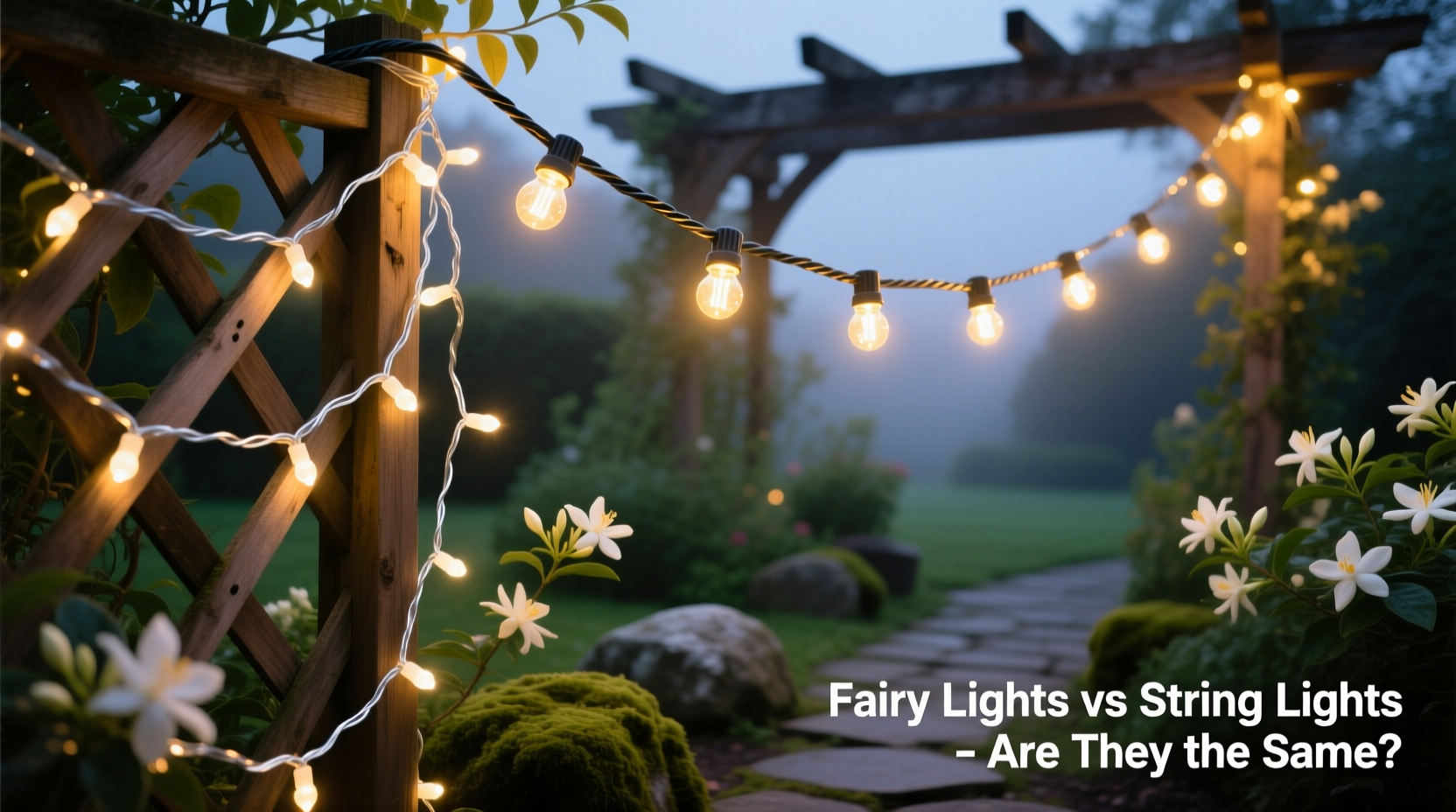
The term “string lights” is literal and functional: a string of electrically connected bulbs, typically spaced evenly along insulated wire. Its roots trace back to early 20th-century Christmas light sets—first introduced commercially by General Electric in 1903—designed as safe, mass-producible alternatives to candle-lit trees. These were unambiguously “strings”: copper-wire circuits with screw-base incandescent bulbs, rated for outdoor or indoor seasonal use.
“Fairy lights,” by contrast, emerged from British theatrical and horticultural tradition. In the late 1800s, gas-powered miniature lamps—often hand-blown glass with delicate filaments—were installed in Victorian conservatories and garden grottos to evoke enchanted, otherworldly glimmers. Their purpose wasn’t illumination but suggestion: soft, diffused points of light that mimicked fireflies or starlight. The name “fairy” wasn’t whimsy—it was descriptive of scale, delicacy, and atmospheric intent. When low-voltage incandescent bulbs became viable in the 1950s, UK manufacturers adopted “fairy lights” to distinguish ultra-fine, low-wattage, often battery-operated sets from standard household string lights.
That semantic split held—until global e-commerce flattened regional nuance. Amazon’s US marketplace began indexing “fairy lights” as a top-level category in 2012, driving sellers to adopt the term for any decorative mini-bulb set—even those with 120V AC wiring and 5W per bulb. Today, a $12 LED “fairy light” string on a major platform may draw more power than a vintage 1970s incandescent string light. Language hasn’t just blurred; it’s inverted.
Core Technical Differences: Beyond the Bulb
While both categories feature multiple light sources on a shared conductor, their engineering priorities differ fundamentally. String lights prioritize durability, consistent output, and standardized voltage compatibility. Fairy lights prioritize subtlety, flexibility, and minimal visual intrusion. This manifests in measurable ways:
| Feature | Fairy Lights | String Lights |
|---|---|---|
| Voltage & Power | Typically low-voltage (12–24V DC), often battery-, USB-, or solar-powered. Total wattage rarely exceeds 5W for 100 bulbs. | Usually line-voltage (120V AC or 230V AC). Even LED versions commonly draw 15–40W for 100 bulbs. |
| Bulb Size & Style | Bulbs ≤ 5mm diameter. Common types: micro LED “rice” bulbs, etched glass “dewdrop” bulbs, filament-style mini-globe bulbs with visible tungsten coils. Emphasis on diffusion and soft edges. | Bulbs ≥ 8mm diameter. Standard shapes: C3, C5, C7, C9, G12, G25. Often designed for directional output or higher lumen output. |
| Wire Gauge & Flexibility | Ultra-thin, often 28–32 AWG copper wire. Highly pliable—can be wrapped around thin branches, curtain rods, or picture frames without kinking. | Thicker insulation and conductor (typically 20–22 AWG). Stiffer, designed for hanging across patios, railings, or eaves with tension support. |
| IP Rating & Weather Resistance | Rarely rated above IP44. Most are indoor-only unless explicitly labeled for outdoor use. Moisture ingress risk is high due to micro-seals and thin casings. | Commonly IP65 or IP67 rated for permanent outdoor installation. Sealed connectors, UV-stabilized PVC jackets, and corrosion-resistant sockets. |
| Control & Dimming | Frequently include built-in timers (6/12-hour cycles), remote controls, or app-based dimming. Many offer color-changing RGB modes—even in warm-white-only variants, subtle fade patterns are standard. | Basic on/off switches dominate. Dimmable versions require compatible wall dimmers or external controllers. Dynamic effects (chasing, fading) are uncommon outside premium commercial lines. |
This isn’t semantics—it’s physics meeting intention. A fairy light’s 3mm bulb emits ~0.5 lumens; a standard C5 string light bulb emits 15–25 lumens. One is meant to be felt, not measured. The other is engineered for visibility at distance.
Real-World Application: When Confusion Leads to Costly Mistakes
Consider Maya, an interior designer based in Portland, Oregon, who sourced 200 feet of “warm white fairy lights” for a client’s wedding canopy. She selected a popular Amazon Best Seller—marketed with “fairy lights” in the title, 1000 bulbs, and “indoor/outdoor” in the description. On-site, she discovered the set required a 120V plug-in transformer, had stiff 22 AWG wiring, and emitted a harsh, pinpoint glare inconsistent with the ethereal mood board she’d presented. Worse, the “waterproof” rating proved unreliable after a light rain shower—the first 30 feet shorted out, leaving half the canopy dark mid-ceremony.
What went wrong? The product was technically a string light—just rebranded for algorithmic advantage. Maya hadn’t misread the specs; she’d been misled by terminology that obscured critical performance attributes. Had she searched using technical filters—“12V DC,” “28 AWG wire,” “IP44 max”—she’d have found true fairy lights. Instead, she optimized for emotional keywords (“dreamy,” “romantic,” “twinkling”) that vendors weaponize to drive clicks.
Choosing the Right Light: A Practical Decision Framework
Selecting between fairy lights and string lights shouldn’t hinge on nostalgia or trendiness. It should follow a deliberate sequence of environmental and functional checks. Here’s how professionals evaluate options before purchase:
- Define the primary purpose: Is this for ambient mood (e.g., bedroom headboard, shelf edging, table centerpieces) or task-oriented illumination (e.g., illuminating a deck, outlining a pergola, lighting a pathway)? Fairy lights excel at the former; string lights at the latter.
- Assess the installation environment: Will lights be exposed to rain, wind, dust, or direct sun? If yes, verify IP65+ rating and UV-resistant materials—regardless of whether the listing says “fairy” or “string.”
- Map the power infrastructure: Do you have accessible outlets within 25 feet? Or will you need battery operation, USB ports, or solar charging? True fairy lights offer greater placement freedom here.
- Evaluate visual weight: Hold a sample wire against your intended surface. Does the wire thickness visually compete with the architecture? A 32 AWG fairy light wire disappears against white paint; a 20 AWG string light wire reads as a thick cord.
- Calculate total load: Multiply bulb wattage × quantity. A 100-bulb fairy light set at 0.05W/bulb = 5W. A 100-bulb string light at 0.5W/bulb = 50W. That difference impacts transformer sizing, circuit capacity, and long-term heat buildup.
This framework prevents aesthetic compromises born of technical oversight. It also explains why high-end hospitality venues use fairy lights *behind* sheer fabric panels (for diffusion) while relying on commercial-grade string lights *above* pool decks (for safety-rated brightness).
Expert Insight: What Lighting Engineers Prioritize
“The biggest misconception is that ‘fairy’ implies inferior technology,” says Dr. Lena Cho, Principal Lighting Engineer at Lumina Labs and co-author of Architectural Light Layering. “In fact, true fairy lights demand more precise thermal management and tighter optical tolerances. You’re packing hundreds of micro-LEDs into millimeters of space—each requiring individual current regulation to prevent cascading failure. A string light’s larger bulb spacing allows passive cooling. But when designers skip the datasheet and chase the word ‘fairy,’ they get cheap, non-regulated circuits that flicker, shift color temperature, or die in six months. The label doesn’t guarantee quality—it signals an intent. Verify the intent matches your application.”
“The most elegant lighting solutions don’t shout. They whisper—and only work because every component, from driver to diode, was chosen for its role in that whisper.” — Dr. Lena Cho, Principal Lighting Engineer, Lumina Labs
FAQ: Clarifying Common Confusions
Can I use fairy lights outdoors?
Only if explicitly rated for outdoor use (IP65 or higher) and powered via a weatherproof transformer or battery pack. Most fairy lights sold as “indoor-only” will fail within days when exposed to humidity—even under covered patios. Never assume “battery-powered” equals “weatherproof.”
Why do some string lights say “fairy” in the name but cost 3x more?
Premium pricing usually reflects genuine engineering upgrades: copper-clad aluminum wire instead of pure aluminum (reducing voltage drop), silicone-jacketed conductors (for cold-weather flexibility), or integrated constant-current drivers (preventing brightness decay over long runs). These are string lights—just built to professional standards. Don’t pay extra for the fairy-light label; pay for verifiable specs.
Are LED fairy lights safer than incandescent string lights?
Yes—but conditionally. LED fairy lights run cooler and draw less power, reducing fire risk. However, many budget LED fairy lights use non-isolated drivers that can leak voltage into the casing. Always use UL/ETL-certified products and avoid daisy-chaining more than three sets unless the manufacturer explicitly permits it. Incandescent string lights pose higher thermal risk but often have robust, isolated transformers.
Conclusion: Precision Over Poetry
Calling all lights “fairy” may make them easier to find in a search bar—but it makes them harder to trust in practice. The distinction between fairy lights and string lights isn’t about magic versus machinery. It’s about intention versus accident. It’s about knowing whether you need a whisper or a voice, a brushstroke or a broad stroke, a detail that recedes or a feature that commands attention. When you understand the voltage behind the sparkle, the wire gauge beneath the twinkle, and the IP rating behind the promise, you stop shopping by mood and start specifying by requirement. That shift—from emotional guesswork to technical clarity—is what transforms temporary decoration into enduring design.
Next time you’re selecting lights, resist the allure of the poetic label. Open the spec sheet. Measure the wire. Test the dimmer. Ask whether the light serves the space—or merely fills it. Your ceilings, your gardens, your celebrations, and your electricity bill will thank you.




 浙公网安备
33010002000092号
浙公网安备
33010002000092号 浙B2-20120091-4
Comments
No comments yet. Why don't you start the discussion?