
Texture is the quiet authority of holiday design. It’s what transforms a well-lit tree from “nice” to “unforgettable”—not through glitter or volume, but through dimension, contrast, and tactility. Yet texture carries risk: too rustic, and it reads as craft-fair circa 2007; too plush, and it veers into mid-century lounge territory. Faux fur tree wrap and burlap ribbon sit at opposite ends of the natural-artificial spectrum—but both promise rich, dimensional appeal. The real question isn’t which is trendier this season. It’s which delivers layered, intentional texture while holding up across years—not just Decembers.
Why Texture Matters More Than Ever (and Why “Dated” Is a Design Failure)
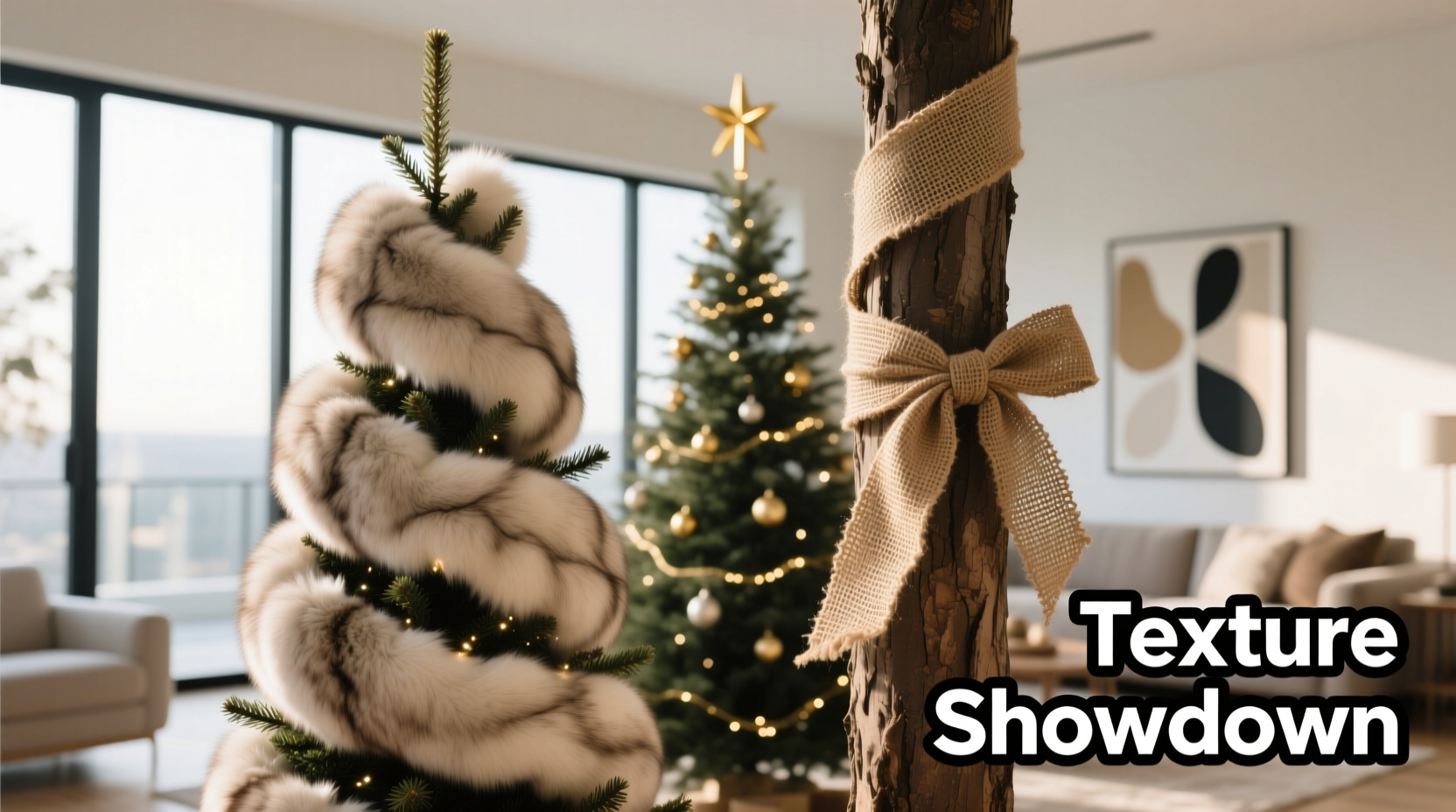
Modern holiday styling has moved decisively away from uniformity. Think monochrome palettes with intentional disruptions: matte black ornaments beside raw wood slices, glass baubles next to hand-thrown ceramic stars. In this context, texture isn’t decorative—it’s structural. It creates visual rhythm, invites touch, and signals intentionality. A tree wrapped in one continuous material becomes an architectural statement—not a backdrop, but a protagonist.
“Dated” doesn’t mean old. It means visually unmoored—lacking clear design logic or contemporary proportion. Burlap became dated not because it’s inherently outdated, but because it was overused in stiff, wide, beige rolls paired with plastic pinecones and red velvet bows in the early 2010s. Faux fur risks dating when applied haphazardly—think oversaturated pastel wraps on slender firs, or excessive fluffing that obscures branch structure. Texture gains longevity when it serves scale, supports palette, and respects material honesty.
Faux Fur Tree Wrap: The Case for Controlled Opulence
Faux fur brings immediate, luxurious weight. Its pile catches light differently at every angle, softening harsh lines and adding depth where branches thin out. But its success hinges on three non-negotiables: color discipline, pile density, and application precision.
High-end faux fur wraps today use tightly spun, low-luster fibers—often in charcoal, oatmeal, deep moss, or slate blue—not candy pink or neon white. These shades recede gracefully, letting ornaments and lights advance. The pile should be dense enough to obscure the trunk beneath but short enough (under 1.5 inches) to avoid a “stuffed animal” effect. And crucially: it must be wrapped *with tension*, overlapping by no more than 1 inch per pass, never spiraling loosely or bunching at the base.
When done right, faux fur adds texture that feels intentional, grounded, and quietly lavish—like a cashmere throw draped over a minimalist sofa. It doesn’t shout “holiday.” It whispers “considered.”
Burlap Ribbon: The Art of Refined Rusticity
Burlap is often mischaracterized as “country” or “farmhouse”—a reductive label that ignores its textile sophistication. Authentic burlap is woven from jute, a bast fiber with natural tensile strength, subtle variegation, and inherent breathability. Its texture comes from irregular slubs, loose weft floats, and gentle fraying—not from stiffness or dullness.
The key to avoiding datedness lies in refinement: choose burlap ribbons with a tighter, cleaner weave (minimum 8–10 threads per inch), finished edges (either serged or lightly fused), and muted, mineral-based dyes—think iron oxide rust, weathered clay, or graphite grey—not flat, bleached beige. Width matters: 2.5 to 4 inches offers presence without overwhelming; anything wider flattens dimension and reads as craft supply.
Application elevates it further. Instead of wrapping trunk-to-tip, use burlap ribbon to define zones: spiral only the lower third, then switch to velvet ribbon or dried eucalyptus for contrast. Or fold it into wide, flat bows pinned at key branch junctions—letting the raw edge fray *just slightly* where light hits it. This isn’t “rustic.” It’s textural editing.
“Burlap isn’t nostalgic—it’s architectural. Its value lies in contrast: how its grit plays against smooth glass, its matte surface against metallic shine, its organic irregularity against precise geometry.” — Lena Torres, Textile Designer & Holiday Stylist for Architectural Digest
Head-to-Head Texture Comparison: What Each Delivers (and Where It Falls Short)
| Texture Attribute | Faux Fur Wrap | Burlap Ribbon |
|---|---|---|
| Tactile Depth | High pile creates three-dimensional relief; responds dynamically to light and movement. Feels substantial, enveloping. | Low relief but high grain variation; texture lives in fiber irregularity and subtle fraying. Feels grounded, honest. |
| Visual Warmth | Warmth depends entirely on dye—cool-toned furs (slate, charcoal) read as modern; warm tones (camel, taupe) risk vintage associations if not balanced with cool metals or matte blacks. | Inherently warm due to jute’s natural golden undertones—but refined dyes (iron oxide, graphite) neutralize this, allowing warmth without sweetness. |
| Longevity of Style | Strong if restrained: monochrome, medium-pile, precise application. Weakens rapidly with bright colors, excessive fluff, or poor proportion. | Exceptional when edited: tight weave, narrow width, strategic placement. Loses relevance when used generically (e.g., full-trunk wrap in raw beige). |
| Ornament Compatibility | Best with sculptural, matte, or metallic ornaments (ceramic spheres, brushed brass, smoked glass). Clashes with delicate glass or glitter-heavy pieces. | Extremely versatile—complements wood, linen-wrapped ornaments, hammered copper, and even minimalist acrylic. Its neutrality is its power. |
| Storage & Reusability | Requires rolling (not folding) to prevent creasing; store flat or hung. Pile can mat if compressed long-term. Needs occasional gentle brushing. | Rolls compactly; no special care. Natural fibers breathe—less prone to odor or compression damage. Fraying stabilizes after first use. |
Real-World Application: A Brooklyn Apartment Tree Transformation
Maya, a graphic designer in Brooklyn, faced a common dilemma: her 7-foot Nordmann fir stood in a sun-drenched corner beside floor-to-ceiling windows. She’d used burlap ribbon for five years—first in wide, raw-beige loops, then in increasingly desperate attempts to “update” it with gold-dipped tips and oversized bows. By year four, friends were whispering “vintage Christmas shop.”
She switched to a charcoal-grey, medium-pile faux fur wrap—but not as a full coverage. Instead, she wrapped only the lower 36 inches of the trunk, starting precisely at the soil line and ending just above the first major branch junction. She left the upper two-thirds bare, allowing the tree’s natural taper and needle density to shine. Then she added minimalist, matte-black ceramic ornaments and clusters of preserved olive branches.
The result? A tree that felt anchored, intentional, and quietly luxe—without a single traditional ornament or ribbon loop. Visitors didn’t ask, “Where did you get the fur?” They said, “This feels like *you*—clean, calm, and deeply considered.” That shift—from accessory-driven to texture-integrated—was the turning point.
Step-by-Step: How to Choose & Apply Based on Your Tree & Space
- Assess your tree’s architecture: Is it full and dense (Nordmann, Fraser)? Or slender and open (Blue Spruce, some fakes)? Dense trees handle faux fur better; slender ones benefit from burlap’s linear emphasis.
- Evaluate your lighting: Direct sunlight + faux fur = potential glare and overheating of fibers. North-facing or shaded rooms favor faux fur. Bright, airy spaces lean toward burlap’s matte diffusion.
- Map your palette: If your decor relies on cool tones (blues, greys, whites, brushed nickel), opt for charcoal or slate faux fur—or graphite-dyed burlap. Warm palettes (terracotta, ochre, blackened steel) pair beautifully with iron-oxide burlap or camel-toned fur.
- Test scale: Hold a 12-inch swatch of each material against your tree’s trunk. Does the faux fur visually thicken the trunk too much? Does the burlap disappear or dominate? Trust what reads clearly at 6 feet—not what looks “cozy” up close.
- Commit to one texture as anchor: Never layer faux fur *and* burlap. Choose one as your primary textural statement. Use the other—if at all—as a tiny accent (e.g., a single burlap bow on a faux-fur-wrapped base).
FAQ
Can I use faux fur wrap on an artificial tree?
Yes—but only if the artificial tree has realistic, dense branch tips and a visible, textured trunk. Avoid faux fur on ultra-sleek, PVC-based fakes with smooth, painted trunks; the contrast reads as costumed, not curated. Opt for burlap instead—it bridges the gap between synthetic and organic effortlessly.
Is burlap eco-friendly, and does that affect its style longevity?
Authentic jute burlap is biodegradable, low-water, and pesticide-free—making it one of the most sustainable holiday materials available. That integrity reinforces its timelessness. Eco-conscious choices aren’t trends; they’re values. When your burlap ribbon decomposes quietly in compost after ten seasons, it doesn’t feel dated—it feels responsible. That resonance extends its stylistic shelf life significantly.
How do I prevent faux fur from shedding or matting over time?
Shedding indicates low-grade fiber or poor construction. Invest in wraps labeled “low-shed” or “high-density polyacrylic blend.” To prevent matting: unroll fully after storage, brush gently *with* the pile using a soft-bristle clothes brush, and never fold or compress tightly. Store rolled around a cardboard tube, upright, in a breathable cotton bag—not plastic.
The Verdict: Texture as Intention, Not Trend
Faux fur tree wrap delivers unmatched tactile opulence—but only when deployed with restraint, tonal discipline, and respect for proportion. It’s the choice for those who want their tree to feel like a sculptural centerpiece, where texture is the dominant language and everything else serves it. Burlap ribbon, in its refined form, offers something rarer: textural authenticity that evolves with age. Its slight fraying, its subtle color shifts under changing light, its quiet strength—these aren’t flaws. They’re evidence of thoughtful use.
So which adds more texture without looking dated? Neither wins by default. The winner is the material you apply with clarity of purpose: faux fur when you seek enveloping, dimensional luxury; burlap when you value grounded, evolving, quietly intelligent texture. Both succeed only when they’re not accessories—but anchors.




 浙公网安备
33010002000092号
浙公网安备
33010002000092号 浙B2-20120091-4
Comments
No comments yet. Why don't you start the discussion?