
In a world buzzing with notifications, social updates, and endless opportunities, the pressure to stay connected and involved has never been greater. The fear of missing out, or FOMO, has become a cultural default—a quiet hum of anxiety that whispers we’re falling behind if we’re not constantly engaged. But there’s a growing counter-movement rooted in presence, intentionality, and calm: the joy of missing out, or JOMO. This isn’t about disengagement—it’s about choosing where you place your attention. Learning to transition from FOMO to JOMO isn’t just beneficial; it’s essential for mental clarity, emotional balance, and long-term fulfillment.
The Hidden Cost of FOMO
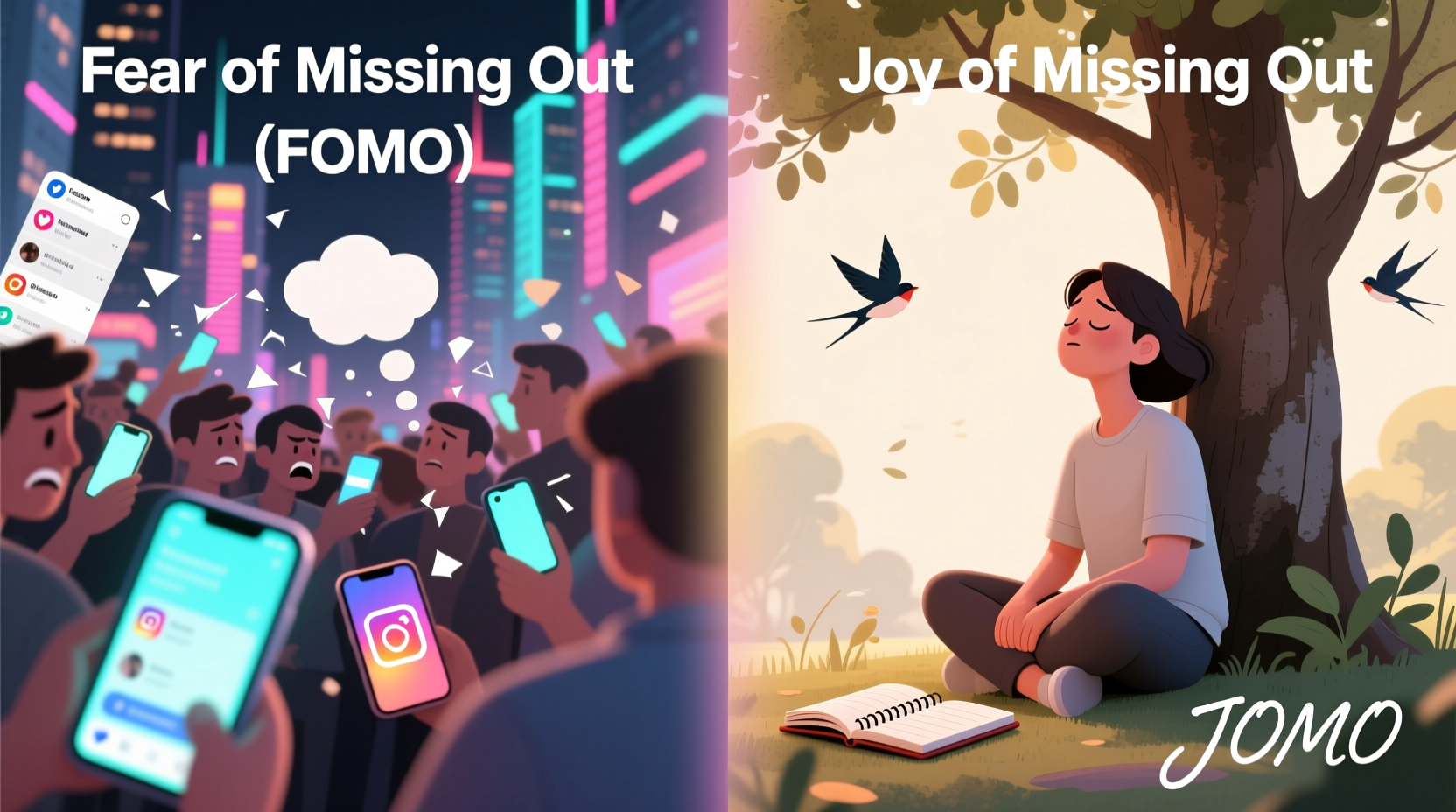
FOMO manifests in subtle yet pervasive ways. It’s the compulsion to check your phone during dinner because someone might have posted something “important.” It’s signing up for events you don’t enjoy just to say you were there. It’s the low-grade anxiety that surfaces when you see photos of friends at a party you weren’t invited to—or worse, one you skipped to rest.
Psychologically, FOMO stems from our evolutionary need for social belonging. In pre-digital times, being excluded from a group could mean real danger. Today, that same wiring misfires in response to curated highlight reels on Instagram or LinkedIn. The result? A distorted sense of reality where everyone else appears more successful, connected, and fulfilled.
Chronic FOMO leads to decision fatigue, overcommitment, and emotional burnout. It fragments attention, reduces productivity, and erodes self-worth. When every choice feels like a potential loss, decision-making becomes paralyzing rather than empowering.
“We compare our behind-the-scenes to everyone else’s highlight reel—and wonder why we feel inadequate.” — Dr. Sarah Lin, Cognitive Behavioral Psychologist
What Is JOMO—and Why It Matters
JOMO—Joy of Missing Out—is the deliberate embrace of absence. It’s the satisfaction found in saying no, disconnecting, and focusing on what truly matters. Where FOMO is reactive and fear-based, JOMO is proactive and values-driven.
JOMO doesn’t reject connection; it redefines it. It’s choosing a quiet evening with a book over scrolling through event invites. It’s turning off notifications during deep work hours without guilt. It’s attending fewer meetings but contributing more meaningfully. JOMO is not withdrawal—it’s refinement.
People who practice JOMO report higher levels of presence, improved sleep, stronger relationships, and increased creativity. By reducing cognitive clutter, they create space for insight, reflection, and authentic engagement.
FOMO vs JOMO: A Practical Comparison
| Aspect | Fear of Missing Out (FOMO) | Joy of Missing Out (JOMO) |
|---|---|---|
| Motivation | Fear, insecurity, comparison | Clarity, values, intention |
| Decision-Making | Reactive, scattered | Deliberate, focused |
| Energy Level | Depleted, anxious | Renewed, centered |
| Social Engagement | Broad, surface-level | Narrow, meaningful |
| Digital Habits | Constant checking, multitasking | Boundaried, mindful use |
| Emotional Outcome | Guilt, envy, exhaustion | Peace, gratitude, fulfillment |
This contrast isn’t moral judgment—it’s a map. Recognizing where you fall helps identify patterns and opens the door to change.
How to Cultivate JOMO: A Step-by-Step Shift
Switching from FOMO to JOMO isn’t an overnight transformation. It’s a gradual recalibration of priorities, habits, and self-perception. Here’s how to begin:
- Identify Your Triggers
Track moments when FOMO arises. Is it after seeing a post? Receiving an invitation? Feeling idle? Journal these instances to uncover patterns. - Define Your Values
Ask: What truly matters to me? Is it family, creativity, growth, health? Write down your top three values. Use them as filters for decisions. - Create Digital Boundaries
Turn off non-essential notifications. Schedule two 15-minute blocks daily to check messages and social media—no more. - Practice Selective Absence
Intentionally skip one optional event or meeting per week. Replace it with a nourishing activity. Reflect on how you feel afterward. - Reframe “Missing Out” as “Choosing In”
Every “no” is a “yes” to something else. Instead of thinking, “I’m missing the conference,” say, “I’m choosing deep work this week.” - Celebrate Quiet Wins
Acknowledge moments of presence: finishing a book, having a distraction-free conversation, sleeping well. These are victories.
The goal isn’t isolation—it’s alignment. JOMO thrives when your actions reflect your inner compass, not external noise.
Mini Case Study: From Burnout to Balance
Lena, a 34-year-old marketing strategist, used to attend nearly every industry webinar, networking event, and team happy hour. She prided herself on being “always on.” But within two years, she was exhausted, irritable, and creatively stagnant. Her doctor flagged early signs of adrenal fatigue.
After reading about JOMO, Lena began experimenting. She declined three out of five event invitations each month. She turned off Slack after 7 PM. On weekends, she left her phone in another room for half the day.
At first, she felt uneasy—like she was falling behind. But within six weeks, her sleep improved. She started painting again, a hobby she’d abandoned for years. Her team noticed she was more focused and insightful in meetings—even though she attended fewer of them.
“I realized I wasn’t missing out,” she said. “I was finally showing up—for myself.”
Essential JOMO Practices: A Checklist
- ☐ Audit your weekly commitments—cancel or delegate one low-value activity
- ☐ Define your top 3 personal values and post them somewhere visible
- ☐ Set app limits on social media (e.g., 30 minutes/day total)
- ☐ Designate one screen-free day per week (or start with a half-day)
- ☐ Practice “single-tasking” for at least one hour daily
- ☐ Replace one digital habit with an analog alternative (e.g., reading a physical book instead of scrolling)
- ☐ End each day with a 5-minute reflection: What did I choose today? Did it align with my values?
Expert Insight: The Psychology of Presence
“JOMO is not passive disengagement—it’s active prioritization. The brain rewards focus with dopamine just as much as novelty, but only if we give it the chance to settle. Slowing down isn’t laziness; it’s neurological hygiene.” — Dr. Rajiv Mehta, Neuroscientist and Author of *The Focused Mind*
Dr. Mehta’s research shows that constant switching between tasks—driven by FOMO—reduces cognitive performance by up to 40%. In contrast, sustained attention strengthens neural pathways associated with memory, creativity, and emotional regulation. JOMO isn’t just a lifestyle trend; it’s brain science.
Common Roadblocks and How to Overcome Them
Transitioning to JOMO isn’t always smooth. Social pressure, workplace culture, and internalized beliefs can make it feel risky. Here’s how to navigate common challenges:
- “I’ll fall behind professionally.”
Focus on quality over quantity. One strategic conversation often yields more value than ten superficial ones. Share insights from your focused work—you’ll stand out more by contributing deeply than by merely attending. - “People will think I’m uninterested.”
Communicate your boundaries kindly but clearly. “I care about this project, so I’m protecting my focus time to contribute my best work.” Most people respect intentionality. - “I feel guilty saying no.”
Remember: guilt often masks misplaced responsibility. You’re not responsible for others’ expectations—only for honoring your energy and purpose. - “I get bored when I’m not busy.”
Boredom is often a signal of under-stimulation, not under-engagement. Try replacing digital distractions with creative outlets: sketching, writing, cooking, or learning an instrument.
FAQ: Understanding JOMO
Is JOMO just another form of social avoidance?
No. JOMO is not about withdrawing from life—it’s about engaging more meaningfully. Avoidance is fear-based; JOMO is choice-based. People practicing JOMO often report deeper connections because they show up with full attention.
Can I experience both FOMO and JOMO?
Absolutely. They’re not mutually exclusive states but ends of a spectrum. Everyone experiences FOMO occasionally. The key is recognizing it and consciously choosing whether to act on it. JOMO grows stronger with practice.
Does JOMO work in high-pressure careers?
Especially then. High performers who master JOMO often outperform their peers because they conserve mental energy for critical tasks. Think of elite athletes: they don’t train every hour—they recover strategically to perform at their peak.
Conclusion: Reclaim Your Attention, Reclaim Your Life
The shift from fear of missing out to joy of missing out is more than a mindset change—it’s a reclamation of agency. In a culture that equates busyness with worth, choosing stillness is revolutionary. Choosing presence over performance. Depth over distraction. Being over doing.
You don’t have to see every post, attend every event, or respond to every message. Your value isn’t measured by your availability. True connection, creativity, and contribution flourish in the space you protect.
Start today. Say no to one thing that doesn’t serve you. Say yes to silence, to focus, to yourself. That’s not missing out—that’s coming home.




 浙公网安备
33010002000092号
浙公网安备
33010002000092号 浙B2-20120091-4
Comments
No comments yet. Why don't you start the discussion?