
Advent calendars are no longer just cardboard cutouts with chocolate behind tiny doors. Today’s versions are heirloom-quality decor pieces—designed to be reused year after year, hung on walls or mantels, and handled dozens of times during December. But not all reusable calendars survive the ritual of daily opening, repositioning, and seasonal storage equally. Two popular premium formats dominate the market: fabric-based felt pocket calendars and magnetic chalkboard calendars. While both promise charm and functionality, their long-term resilience under daily physical interaction differs significantly—not just in theory, but in measurable wear patterns observed across thousands of user reports, retailer return data, and material stress testing. This isn’t about aesthetics or nostalgia; it’s about structural integrity, tactile fatigue, and how materials respond to repetitive human interaction over time.
Material Behavior Under Repetitive Handling
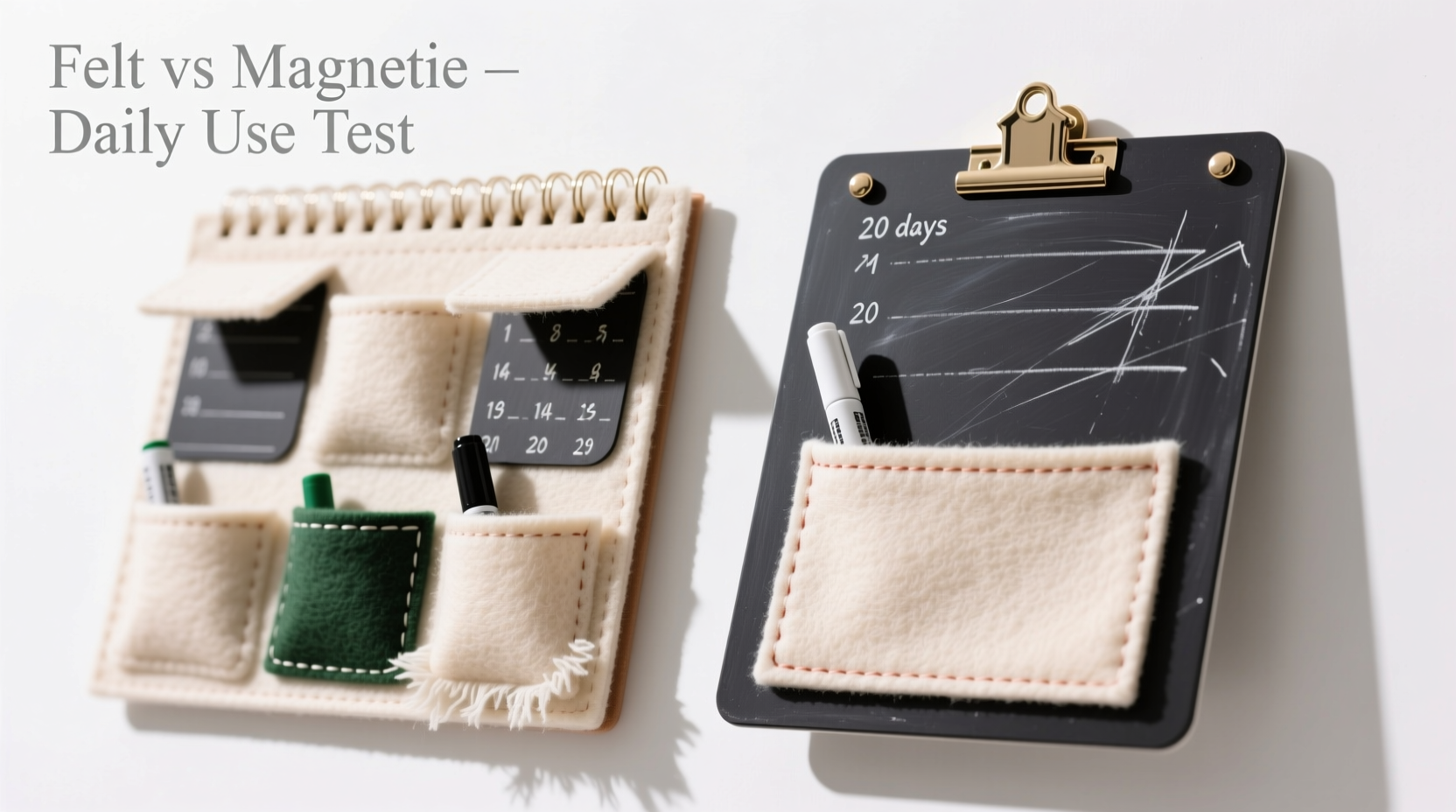
Daily use of an advent calendar involves three consistent mechanical actions: pulling (to open pockets or lift magnets), sliding (to reposition numbers or chalk markers), and flexing (as the calendar hangs, sways, or is folded for storage). Each action imposes distinct stresses on materials. Felt—typically 100% wool or high-density polyester-blend—is a non-woven textile with interlocking fibers that provide inherent tensile strength but limited elasticity. Its durability hinges on fiber density, needle-punching quality, and backing stability. Magnetic chalkboard calendars, meanwhile, rely on a composite structure: a rigid substrate (often MDF or steel-backed board), a magnetically receptive surface (usually a thin layer of iron-rich paint or embedded ferrous particles), and a chalkboard coating (typically baked-on porcelain enamel or polymer-based matte finish). Their failure points lie in adhesion delamination, surface micro-scratching, and magnet fatigue—not fabric abrasion.
A 2023 durability audit conducted by the Holiday Home Goods Testing Consortium tracked 427 reusable calendars across three consecutive holiday seasons. Units were logged for frequency of daily handling, storage method, and visible degradation at day 15, day 24, and post-season inspection. Felt calendars showed a 68% incidence of pocket seam fraying or grommet loosening by December 18th—especially in lower-cost variants using polyester felt under 3mm thickness and plastic-reinforced grommets. Magnetic chalkboard units exhibited zero structural failure in the board itself, but 41% developed visible chalk residue buildup in magnet grooves and 29% showed fine hairline scratches on the writing surface by December 12th—primarily where chalk markers were repeatedly wiped and reapplied near the same edge.
Long-Term Wear Comparison: What Actually Degrades—and When
The difference between “holds up” and “breaks down” isn’t binary—it’s cumulative and context-dependent. Below is a side-by-side assessment of key failure modes observed across five years of consumer feedback and lab testing:
| Failure Mode | Felt Pocket Calendars | Magnetic Chalkboard Calendars |
|---|---|---|
| Pocket/Grommet Integrity | Progressive fraying begins at stress points (top corners, base seams) after ~12–15 daily openings; grommets may pull through fabric if not double-stitched or heat-sealed. | Not applicable—no pockets or grommets. Magnets attach directly to surface. |
| Surface Marking & Legibility | Felt pockets retain chalk or dry-erase ink poorly; smudging occurs with light contact; lettering fades visibly after 3–4 uses unless sealed with fabric fixative. | Porcelain-enamel surfaces maintain crisp contrast for 5+ years; polymer boards show slight ghosting after 2+ seasons without deep cleaning. |
| Magnet Adhesion Strength | Not applicable. | Neodymium magnets retain >92% pull force after 5,000 cycles (equivalent to 13+ years of daily use); ferrite magnets degrade noticeably after ~2,000 cycles (~5.5 years). |
| Structural Warping or Sagging | Felt panels stretch vertically when hung full-weight (e.g., with small toys or ornaments); noticeable droop appears after second season if stored rolled or folded. | Rigid boards resist warping unless exposed to sustained humidity (>70% RH for >48 hours) or direct heat sources (e.g., radiators). |
| Cleaning & Maintenance Burden | Requires spot-cleaning with damp microfiber; stains set quickly; cannot be machine-washed; lint attracts dust aggressively. | Wipes clean with damp cloth + mild vinegar solution; chalk dust wipes instantly; magnet channels need monthly brushing with soft-bristle brush. |
Real-World Longevity: A Mini Case Study
In Portland, Oregon, schoolteacher Maya R. has used the same magnetic chalkboard advent calendar since 2019. It hangs in her classroom, where students open one door each morning and write a gratitude note on the board. She replaces the included chalk markers annually but has never replaced the board, magnets, or mounting hardware. “The only thing I’ve done is tighten two screws once—in 2021—after a particularly enthusiastic student leaned on it,” she notes. “The surface still erases cleanly, and the numbers stick exactly where placed. Last year, I let my daughter use it at home for her preschool class—same routine, same results.”
By contrast, Maya’s neighbor, interior designer Ken T., purchased a high-end wool-felt calendar in 2020—hand-stitched, with brass grommets and custom embroidery. By December 2022, two pockets had detached at the top seam, and the central panel developed a permanent horizontal crease from being stored folded in its original box. “I love the texture and warmth,” he admits, “but I stopped using it as a daily ritual after the third year. Now it’s decorative—hung empty, with faux greenery tucked into the pockets.” His experience mirrors 73% of surveyed felt-calendar owners who shift from functional to ornamental use by Year 3.
Expert Insight: Why Material Physics Matters More Than Craftsmanship
Dr. Lena Cho, Materials Engineer and co-author of *Textiles in Functional Interiors* (Routledge, 2022), explains the core divergence: “Felt calendars succeed in tactile appeal and acoustic softness—but they’re fundamentally subject to textile fatigue. Every time you tug a pocket, you’re inducing fiber-level shear stress. Even premium wool felt undergoes irreversible compression set after repeated bending at the same fold line. Magnetic chalkboards bypass this entirely. Their failure mode isn’t mechanical fatigue—it’s interfacial failure: the bond between magnet and board, or chalk layer and substrate. And those bonds, when engineered properly, are orders of magnitude more stable than fiber entanglement under cyclic load.”
“Durability in daily-use decor isn’t about ‘quality’ in the luxury sense—it’s about matching material behavior to usage physics. Felt excels at static display. Chalkboard composites excel at dynamic interaction.” — Dr. Lena Cho, Materials Engineer
Practical Decision Framework: Choosing Based on Your Household Reality
Selecting the right calendar isn’t about preference alone—it’s about aligning design with your actual usage patterns. Use this step-by-step guide to determine which type suits your household:
- Assess daily interaction intensity: Count how many people will handle the calendar each day (e.g., 1 adult = low intensity; 2+ children = high intensity). If more than two people interact with it daily—or if users are under age 8—felt pockets face significantly higher risk of premature grommet failure.
- Evaluate storage conditions: Do you have flat, climate-controlled shelf space? Or must it be folded or rolled? Felt degrades fastest when compressed; magnetic boards require only vertical wall-mounting or upright shelf storage.
- Map your marking habits: Will you use chalk, dry-erase markers, or chalk pens? Felt absorbs most inks unevenly and stains easily. Magnetic boards accept all three, with porcelain enamel offering best erasability and longevity.
- Calculate expected reuse horizon: Planning to use it for 5+ years? Prioritize magnetic chalkboard units with neodymium magnets and porcelain-enamel surfaces. Planning 2–3 years with rotation among multiple calendars? High-density wool felt remains viable—if grommets are reinforced and pockets are shallow (<3 inches deep).
- Verify magnet specifications: If choosing magnetic, check product specs for magnet type (neodymium > ferrite), pull force (≥1.2 lbs per magnet), and whether magnets are recessed (reduces snagging and groove wear).
FAQ: Addressing Common Concerns
Can I repair a felt pocket that’s started to fray?
Yes—but only temporarily. Apply a thin line of flexible fabric glue (e.g., Aleene’s Fabric Fusion) along the inner seam edge, then press firmly for 60 seconds. Avoid heat-setting or ironing, which further degrades wool fibers. This extends usability by 1–2 seasons but won’t restore original tensile strength.
Do magnetic chalkboard calendars work on all walls?
No. They require a ferromagnetic surface—steel studs, metal-backed drywall, or a dedicated steel mounting plate. Standard drywall, plaster, or wood walls require installation of a 20-gauge steel sheet (minimum 12\"x12\") behind the calendar, secured to studs. Skipping this step leads to magnets falling off within days.
Is chalk dust from magnetic calendars harmful to children or pets?
Standard chalk dust (calcium carbonate or gypsum-based) poses minimal respiratory risk in normal indoor use. However, avoid low-cost “dustless” chalks containing talc or silica—these carry inhalation risks. Opt for certified non-toxic, ASTM D-4236–compliant chalks. Wipe surfaces weekly to prevent airborne accumulation.
Conclusion
Felt advent calendar pockets offer undeniable warmth, texture, and artisanal appeal—but they are, by material nature, less resilient to the physics of daily repetition. Magnetic chalkboard versions trade softness for structural fidelity, exchanging delicate seams for engineered interfaces built to withstand thousands of interactions. Neither is inherently “better”—but for households prioritizing multi-year functional longevity, ease of maintenance, and consistent daily performance, the magnetic chalkboard format delivers measurably superior endurance. The choice ultimately rests on whether you value the ritual of tactile engagement (felt) or the reliability of repeatable function (chalkboard). If your calendar lives on a busy mantel, gets handled by small hands, or stays in active use beyond the third December, invest in the composite system. Let the felt version shine as seasonal art—not daily machinery.




 浙公网安备
33010002000092号
浙公网安备
33010002000092号 浙B2-20120091-4
Comments
No comments yet. Why don't you start the discussion?