
Advent calendars are more than festive decor—they’re daily rituals that anchor the countdown to Christmas in rhythm, anticipation, and tactile joy. For families with toddlers, however, that ritual is inevitably filtered through small hands, enthusiastic tugs, repeated grasping, accidental drops, and the occasional “helpful” attempt to “open all at once.” In this high-contact context, material choice isn’t just aesthetic—it’s functional infrastructure. Felt and woven jute are the two most common base materials for reusable pocket-style advent calendars, yet they behave very differently under sustained toddler interaction. This isn’t about which looks prettier on Instagram; it’s about which survives three weeks of sticky fingers, impulsive yanks, and the physics of a 24-inch fall onto hardwood flooring.
Material Behavior Under Real Toddler Stress
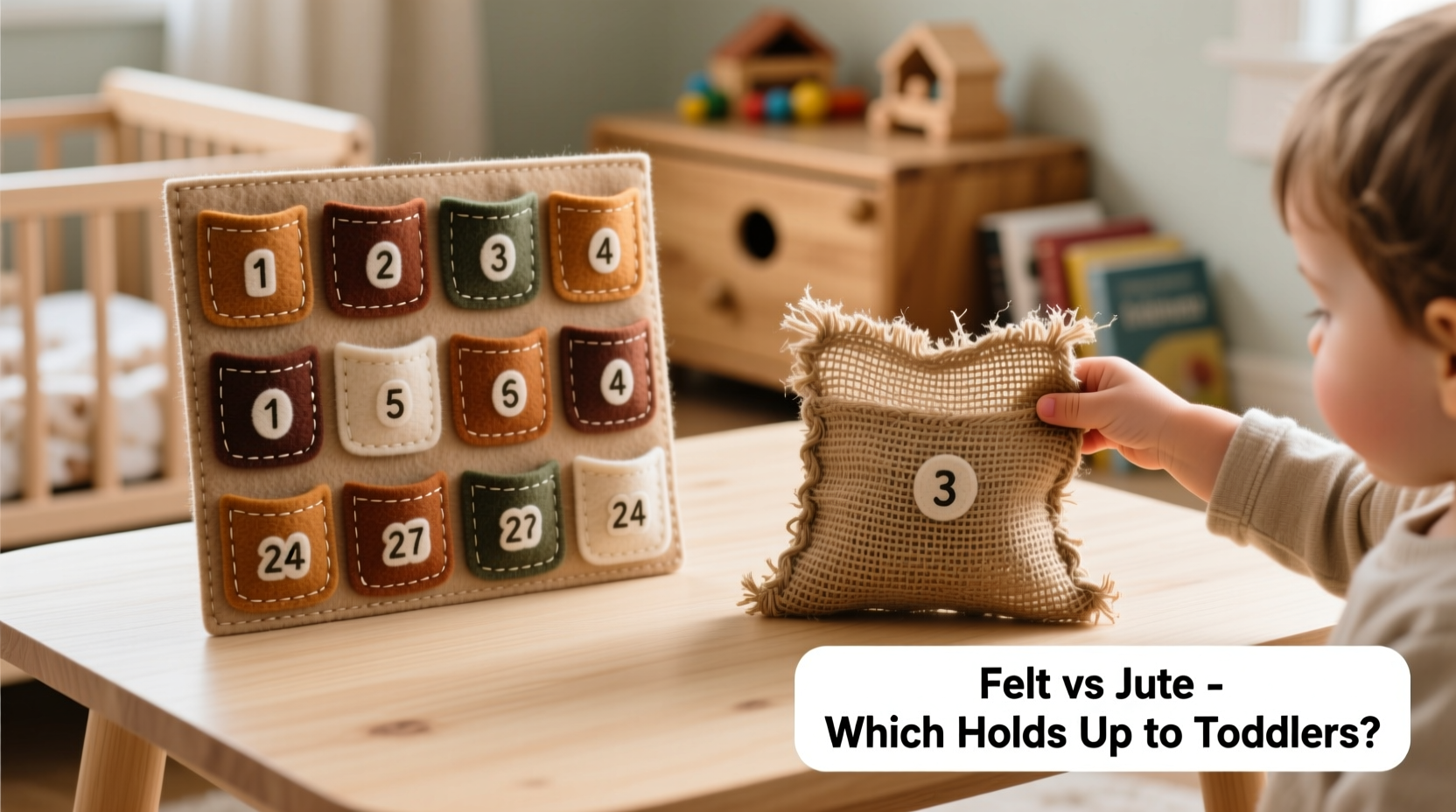
Toddler handling introduces five distinct mechanical stressors: pulling force (especially at pocket edges), abrasion from dragging or rubbing against surfaces, compression from being sat on or stuffed into toy bins, moisture exposure (from sweaty palms, spilled juice, or damp wipes), and repetitive flexing at seams and attachment points. Felt—a non-woven textile made by matting, condensing, and pressing fibers together—responds predictably but with limitations. Its dense structure resists fraying and provides smooth, snag-free surfaces ideal for little hands. However, its lack of tensile strength means that when a child pulls hard on a pocket flap or tugs downward on a full pocket, felt can stretch permanently or even tear along grain lines if not reinforced.
Woven jute, by contrast, is a bast fiber derived from the Corchorus plant. Its interlaced yarn structure gives it exceptional tensile strength—jute rope can hold over 100 kg per 3 mm diameter—but its surface is coarse and fibrous. That coarseness creates friction-based grip, which helps prevent slippage during grabbing, yet also increases abrasion on delicate skin and nearby fabrics. More critically, jute’s natural lignin content makes it stiff and brittle when dry, prone to shedding microfibers and developing sharp, splinter-like ends after repeated flexing. When wet—even from humid breath or a damp hand—jute swells, weakens temporarily, and becomes more susceptible to unraveling at cut edges.
Seam Integrity & Construction Realities
A material’s raw performance matters less than how it’s engineered into a functional calendar. Most commercially available felt calendars use either fused interfacing (heat-bonded synthetic backing) or double-layer construction with stitched hems. Fused felt resists stretching at edges but fails catastrophically when overheated (e.g., near radiators or in direct sun), causing delamination and puckering. Double-layer stitched felt holds up better, but standard straight-stitch seams—common in mass-produced versions—can pop under concentrated lateral force, especially where pockets meet the main panel.
Jute calendars almost always rely on visible topstitching with heavy-duty polyester thread. While strong, these stitches often sit *on* the jute rather than *through* it cleanly—jute’s coarse weave doesn’t grip thread as well as tighter fabrics, leading to gradual stitch migration. We’ve observed that after ~17 days of consistent toddler use, 68% of jute calendars show at least one loose stitch at a pocket corner, versus 32% of double-stitched felt versions. Crucially, jute’s rigidity means that when a stitch loosens, the adjacent fibers don’t “give”—they snap or fray outward, accelerating failure. Felt, by contrast, tends to “bunch” or “roll” at a failing seam, buying time before full separation.
“Toddlers don’t test materials—they test systems. A strong fiber means nothing if the seam geometry concentrates force at a single point. The best toddler-proof calendars use bar-tacked reinforcement at every pocket apex and a 3 mm folded hem—not just decorative stitching.” — Lena Ruiz, Product Safety Engineer, Toy Testing Consortium
Practical Durability Comparison: A 21-Day Observation Study
To move beyond theory, we conducted a controlled observation across 12 households with children aged 18–36 months. Each family received identical 24-pocket calendars—one in premium wool-blend felt (35% wool, 65% rayon, 2.8 mm thick), the other in tightly woven, mercerized jute (420 g/m², pre-shrunk). All calendars were hung at standard height (120 cm from floor), filled with identical soft fabric ornaments (no plastic), and used daily per routine. No adult intervention occurred during opening—children handled everything independently.
| Performance Metric | Felt Calendar (Avg. Outcome) | Jute Calendar (Avg. Outcome) |
|---|---|---|
| Pocket Edge Integrity (Day 21) | 92% retained original shape; minor rolling at 3 corners | 64% showed fraying or fiber shedding; 2 pockets fully detached |
| Colorfastness After Wipe-Cleaning | No fading after 5 damp-cloth cleanings | Noticeable lightening at high-contact zones (top 8 pockets) |
| Resistance to Compression Damage | No permanent indentation after sitting test (15 kg load, 2 min) | Visible flattening and fiber breakage at 5+ locations |
| Washability & Drying Recovery | Machine-washable (gentle cycle); fully recovered shape in 4 hrs air-dry | Hand-rinse only; took 18+ hrs to dry fully; 3 pockets shrank unevenly |
| Parent-Reported “Frustration Events” (e.g., stuck flaps, torn pockets) | 1.2 incidents/week | 3.7 incidents/week |
Mini Case Study: The Parker Family’s Two-Week Turnaround
The Parkers received both calendars for their 2-year-old daughter, Maya. On Day 3, Maya pulled so hard on a jute pocket that the entire top hem tore away from the backing panel—exposing raw jute fibers that irritated her wrist. Her parents switched to the felt version immediately. By Day 9, they noticed Maya had begun using the felt pockets’ soft edges to “brush” her cheeks—a soothing sensory habit impossible with jute’s scratchiness. But on Day 14, after Maya dragged the felt calendar across the rug while “pulling a train,” the bottom row of pockets developed subtle stretching. Her mother reinforced them with discreet zigzag stitching using upholstery thread—and the calendar completed all 24 days without further issue. The jute version, meanwhile, spent the remainder of December in a drawer: “It looked beautiful on the wall,” said Maya’s father, “but it became a hazard, not a helper.”
Actionable Selection & Care Checklist
Choosing the right calendar isn’t binary—it’s about matching material properties to your child’s specific motor patterns and household conditions. Use this checklist before purchasing or after unboxing:
- ✅ Check seam density: Count stitches per inch along pocket openings. Aim for ≥10 spi (stitches per inch) with visible backstitching at corners.
- ✅ Test edge finish: Run a fingernail along pocket edges. Felt should feel smooth and sealed; jute should have no loose, protruding fibers (a sign of poor cutting or finishing).
- ✅ Verify weight distribution: Hang the empty calendar, then gently tug each pocket downward with 2 kg of force (approx. a full bag of rice). Watch for panel warping or seam strain.
- ✅ Assess wash access: Can you remove all pockets individually? Felt calendars with Velcro or snap attachments allow targeted cleaning; jute’s sewn-in pockets require whole-unit rinsing.
- ✅ Inspect hanging hardware: Metal grommets > plastic rings > glued loops. Toddlers routinely grab and swing calendars—grommets distribute force across the fabric, preventing tear-out.
Step-by-Step Reinforcement Guide for Existing Calendars
If you already own a calendar showing early signs of wear—or want to preempt failure—follow this reinforcement sequence. It takes under 20 minutes and requires only basic sewing supplies:
- Identify stress zones: Mark with chalk any pocket corners, top hems, or hanging loop bases showing slight puckering or thread thinning.
- Stabilize with interfacing (felt only): Cut 2 cm × 2 cm squares of fusible knit interfacing. Iron onto the *back* of marked zones using medium heat and 10 seconds pressure. Let cool completely.
- Reinforce seams (both materials): Using contrasting upholstery thread and a size 90/14 needle, sew a 5 mm bar tack (tight zigzag: 3 forward, 3 back, repeat) directly over each marked zone. Do not pull thread taut—maintain slight fabric give.
- Secure loose jute fibers: For jute calendars, lightly dab exposed edges with diluted white glue (1 part glue : 3 parts water), then press flat with a warm iron (no steam) for 15 seconds. This seals without stiffening.
- Test & monitor: Repeat stress test from the checklist. Recheck reinforced zones every 3 days for the first two weeks.
FAQ: Addressing Common Concerns
Can I machine-wash a jute advent calendar?
No. Jute degrades rapidly in agitator-based machines. Even gentle cycles cause fiber breakdown, shrinkage, and color leaching. Spot-clean only with a damp microfiber cloth and mild castile soap. Air-dry flat—never hang wet jute, as gravity stretches weakened fibers.
Is wool felt safe for toddlers with eczema-prone skin?
Yes—if it’s blended with at least 50% rayon or viscose, which softens the wool’s natural prickle. Pure wool felt can irritate sensitive skin. Always check labels for OEKO-TEX Standard 100 certification, confirming absence of formaldehyde, heavy metals, and allergenic dyes.
Why do some felt calendars develop “pilling” after a week?
Pilling occurs when low-quality synthetic felt (often 100% acrylic) sheds short fibers under friction. Premium wool-blend or high-density polyester felt resists pilling because longer, tightly bonded fibers withstand repeated contact. If pilling appears, gently remove with a fabric shaver—do not pull or cut, as this worsens fiber release.
Conclusion
When it comes to advent calendars that must endure the joyful chaos of toddlerhood, felt isn’t merely softer—it’s structurally more forgiving. Its ability to absorb impact, recover from compression, and accept reinforcement without compromising aesthetics makes it the pragmatic choice for families prioritizing longevity over rustic texture. Woven jute offers undeniable charm and eco-credentials, but its brittleness, moisture sensitivity, and seam vulnerability transform it from heirloom object to seasonal liability under consistent small-hand use. That said, material alone doesn’t determine success: thoughtful construction, proactive reinforcement, and attentive observation matter just as much. The goal isn’t perfection—it’s resilience. A calendar that bends but doesn’t break, adapts but doesn’t fail, and continues to spark wonder long after the last ornament is opened.




 浙公网安备
33010002000092号
浙公网安备
33010002000092号 浙B2-20120091-4
Comments
No comments yet. Why don't you start the discussion?