
As the holiday season approaches, educators and parents alike begin searching for engaging, developmentally appropriate tools to help young children count down to Christmas. Among the most popular options are felt advent calendars and magnetic chalkboard versions. Both promise interactive learning and festive fun, but they differ significantly in design, usability, and suitability for different environments—especially when toddlers or classroom settings are involved.
Choosing between a felt advent calendar and a magnetic chalkboard version isn't just about aesthetics. It's about understanding developmental needs, safety considerations, maintenance requirements, and long-term educational value. This comparison dives deep into real-world performance across key categories to help you make an informed decision that supports both learning and enjoyment.
Safety and Accessibility for Toddlers
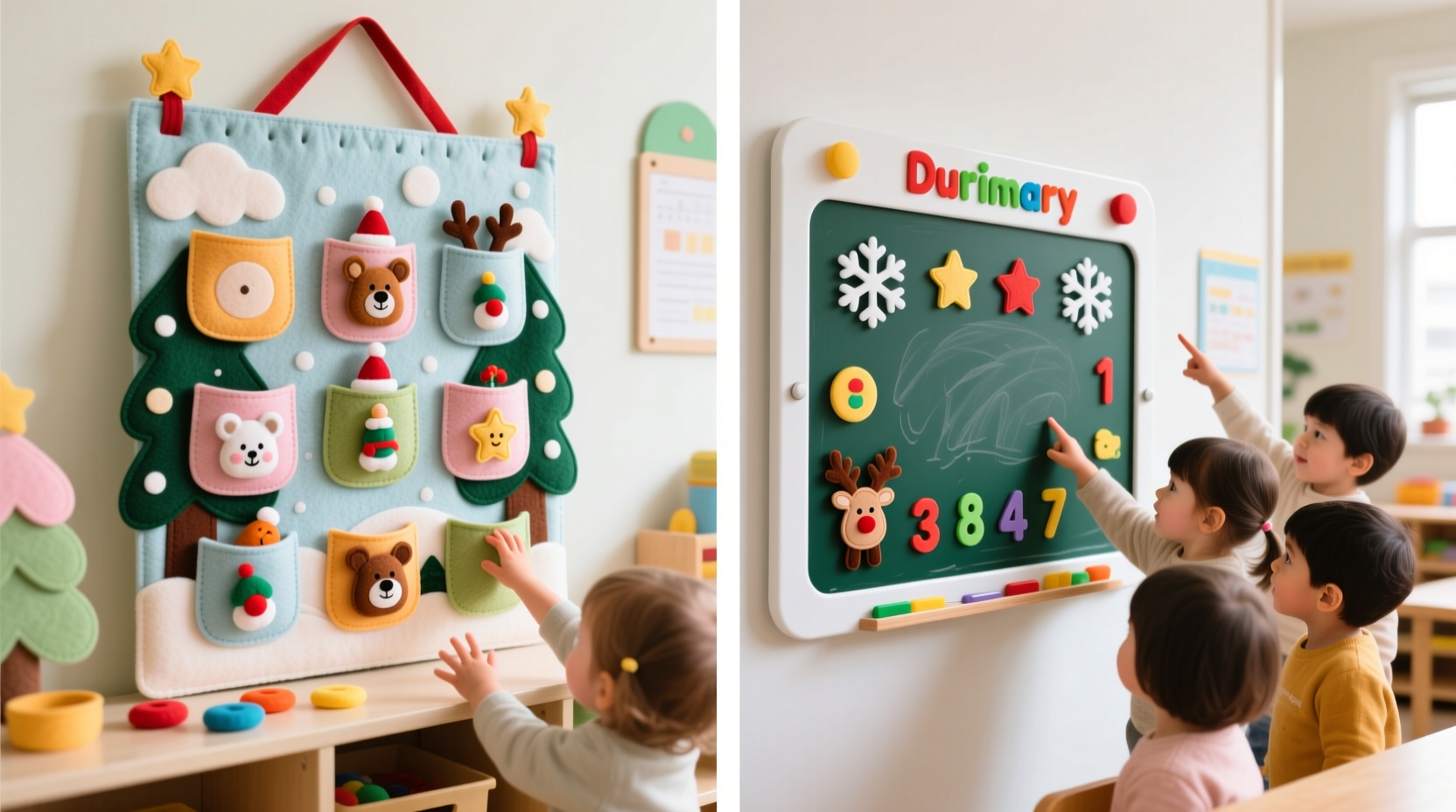
Toddlers thrive on tactile experiences, but their motor skills are still developing. Safety and accessibility are non-negotiable when selecting classroom or home-based tools. Felt advent calendars typically consist of soft fabric pieces that attach via hook-and-loop (Velcro) fasteners to a larger backing panel. These materials are inherently child-safe—soft, lightweight, and free from sharp edges or small detachable magnets.
In contrast, magnetic chalkboard advent calendars rely on small metal-backed pieces that adhere to a magnetic surface. While visually striking and reusable, these magnets pose a choking hazard if detached and swallowed—a legitimate concern for children under three. The U.S. Consumer Product Safety Commission has repeatedly warned against small, loose magnets in toys due to the risk of intestinal damage if ingested.
Felt pieces, by comparison, are easier for little hands to grasp and manipulate. Their larger size and textured surface support pincer grip development and hand-eye coordination without risk. For daycare centers or preschool classrooms with mixed-age groups, felt calendars offer a safer default option.
Durability and Long-Term Use in Classrooms
Classroom tools must withstand repeated handling, frequent setup and storage, and occasional rough treatment. Durability becomes a critical factor when evaluating cost-effectiveness and sustainability.
Felt calendars are generally made from polyester or wool-blend fabrics. While resistant to tearing under normal use, they can pill over time or lose adhesive strength at attachment points after months of daily removal and reattachment. However, many high-quality felt sets come with reinforced stitching and industrial-grade Velcro, extending their lifespan to several holiday seasons.
Magnetic chalkboard calendars often feature a rigid steel board paired with laminated or wooden number tiles. These boards resist warping and hold up well to classroom routines. The magnetic backing on individual elements tends to remain strong for years, assuming the pieces aren’t dropped or bent. However, the main drawback lies in portability—chalkboards are heavier, harder to store, and require wall mounting or a stable easel.
“Early childhood materials should be durable enough to last beyond one season, but safe enough for independent exploration.” — Dr. Lena Torres, Early Childhood Education Specialist
In high-traffic classrooms, magnetic systems may suffer from missing or misplaced pieces. Felt sets, while also prone to loss, are easier to replace individually and often come in customizable kits. For schools prioritizing low-maintenance, reusable resources, magnetic chalkboards win on longevity—but only if properly managed and stored.
Educational Value and Learning Integration
Both types of calendars support core early learning concepts such as sequencing, counting, calendar awareness, and fine motor development. But how they deliver this instruction varies meaningfully.
Felt advent calendars often come pre-designed with holiday themes—snowmen, reindeer, elves—that appeal emotionally to young children. Teachers can use them to reinforce vocabulary (\"What color is Santa’s coat?\"), storytelling (\"What happens on December 24th?\"), and pattern recognition (alternating colors or shapes). Because felt pieces are easy to swap, educators can modify the calendar mid-season to reflect class progress or student interests.
Magnetic chalkboard versions offer greater flexibility in content. Educators can write daily messages, math problems, or questions directly onto the numbers or adjacent space. For example, \"Open today’s door!\" might become \"Solve 2 + 1 to unlock today’s surprise.\" This adaptability makes magnetic calendars particularly effective in kindergarten or pre-K settings where literacy and numeracy goals are more structured.
| Feature | Felt Advent Calendar | Magnetic Chalkboard Calendar |
|---|---|---|
| BEST FOR | Toddlers, sensory learners, emotional engagement | Pre-K to Grade 1, cognitive skill-building |
| LITERACY SUPPORT | Limited to labels and images | Customizable text, phonics prompts, sight words |
| NUMERACY INTEGRATION | Number recognition, sequencing | Addition/subtraction, number writing practice |
| CREATIVE PLAY | High – pieces double as storytelling props | Low – focused on routine and structure |
| TEACHER CUSTOMIZATION | Moderate – limited to rearranging pieces | High – full control over content and layout |
The ability to integrate curriculum-aligned tasks gives magnetic calendars an edge in formal classroom instruction. Yet for younger toddlers still mastering basic routines, the predictability and sensory comfort of felt materials foster confidence and independence.
Setup, Storage, and Maintenance Requirements
Practicality matters—especially for busy teachers managing multiple units or parents juggling seasonal schedules. How quickly can the calendar be set up each morning? How easy is it to store during off-seasons?
Felt calendars typically roll or fold into compact bundles. They require no additional tools and can be hung with tape, pins, or a simple rod. Daily interaction involves removing a single piece and placing it elsewhere (e.g., on a tree or tray), minimizing clutter. Cleaning is straightforward: spot-wipe stains or hand-wash sections if needed.
Magnetic chalkboard calendars usually mount on walls or sit on easels. Setup requires screws, anchors, or strong adhesive strips—time-consuming in temporary classrooms. Daily updates may involve erasing and rewriting messages, increasing prep time. Dust from chalk residue can accumulate on magnets, reducing adhesion over time unless wiped regularly. Additionally, exposed magnetic surfaces attract paperclips, scissors, and other metal objects, creating hazards if not monitored.
Storage poses another challenge. Felt rolls fit neatly into bins or drawers. Magnetic boards, being rigid and bulky, require flat storage to avoid bending—difficult in crowded closets. In mobile classrooms or homes with limited space, felt wins decisively on convenience.
Real-World Application: A Preschool Case Study
At Bright Horizons Pre-K in Portland, Oregon, two parallel classrooms tested both calendar types during the 2023 holiday season. Room A (ages 2–3) used a large forest-themed felt calendar with animal cutouts. Room B (ages 4–5) implemented a magnetic chalkboard calendar with daily math puzzles.
In Room A, teachers observed increased verbal participation during calendar time. Children eagerly identified animals, mimicked sounds (\"The bear growls!\"), and practiced taking turns removing pieces. One toddler with speech delays began using two-word phrases like “red fox” consistently after two weeks of daily interaction. No incidents of lost or damaged parts occurred.
Room B leveraged the magnetic board for targeted learning. Each day, students solved a simple equation (e.g., “Today is 7. What comes before?”) before placing the correct tile. Teachers reported stronger number fluency gains compared to previous years using static paper calendars. However, three magnet pieces went missing within the first month, and one child accidentally erased the entire week’s entries during cleanup.
The school concluded that age-appropriate matching was essential. They now use felt calendars in toddler rooms and reserve magnetic boards for older preschoolers, citing developmental alignment as the deciding factor.
Step-by-Step Guide: Choosing the Right Calendar for Your Setting
Follow this decision-making process to select the best advent calendar for your environment:
- Assess the age group: Under 3? Prioritize felt. Ages 4+? Consider magnetic.
- Evaluate supervision levels: Constant adult presence allows for safer magnetic use; unsupervised areas favor felt.
- Determine educational goals: Focus on play and language? Choose felt. Targeting math or literacy? Magnetic offers more customization.
- Check physical space: Limited wall or floor space? Opt for portable felt. Dedicated learning center? Magnetic can be anchored securely.
- Review budget and replacement costs: Felt replacements are cheaper per piece; losing a few magnets won’t break the bank, but frequent losses add up.
- Test for one week: Pilot both styles if possible. Observe engagement, ease of use, and incident frequency before committing.
FAQ
Can I convert a felt calendar into a learning tool like a magnetic one?
Yes. Attach blank felt squares behind each number and use fabric markers to write daily prompts. You can also glue miniature pockets to hold task cards, enabling literacy or math challenges without sacrificing safety.
Are there hybrid options available?
Some brands now offer dual-function boards—magnetic backing with felt-covered tiles. These combine visual texture with secure attachment, eliminating loose magnets while preserving reusability. Look for products labeled “soft magnetic” or “felt-mag combo.”
How do I clean a magnetic chalkboard surface without damaging it?
Use a microfiber cloth dampened with water or a mild white vinegar solution (1:1 with water). Avoid abrasive cleaners or ammonia-based sprays, which can degrade the finish. Dry immediately to prevent moisture buildup.
Conclusion: Making the Right Choice for Developmental Success
The choice between a felt advent calendar and a magnetic chalkboard version ultimately hinges on context. For toddlers, felt calendars are superior in safety, sensory appeal, and ease of use. Their soft, forgiving nature aligns perfectly with early developmental stages, encouraging exploration without risk.
In classrooms serving older preschoolers, magnetic chalkboard calendars provide unmatched flexibility for integrating academic skills. When managed responsibly—with secure storage and consistent supervision—they become powerful tools for building foundational knowledge.
There is no universal winner. Instead, success lies in matching the tool to the child. By considering age, environment, learning objectives, and practical constraints, educators and caregivers can create meaningful countdown experiences that blend joy with growth.




 浙公网安备
33010002000092号
浙公网安备
33010002000092号 浙B2-20120091-4
Comments
No comments yet. Why don't you start the discussion?